


You Can’t Do Everything
posted 8th January 2026
You Can’t Do Everything: Why High Achievement Can Quietly Undermine Meaning
Many high-achieving individuals reach therapy not because they lack success, but because success has stopped feeling stabilising. Externally, life appears full: career progression, financial security, cultural experiences, self-development, and a life that looks well-constructed. Internally, however, there is often a persistent sense of strain — the feeling that something is always being chased, yet nothing ever quite settles.
This is not a lack of gratitude or ambition. It is the psychological cost of trying to live multiple, incompatible lives at once.
The executive trap: optimisation without arrival
High performers are particularly vulnerable to the belief that life should be optimised across all domains simultaneously. The same skills that drive professional success — planning, comparison, self-monitoring, and goal-orientation — are often applied indiscriminately to personal life. The result is not fulfilment, but constant internal evaluation.
Research on role overload and self-discrepancy consistently shows that wellbeing declines when individuals attempt to meet too many idealised standards at once. When the gap between who we are and who we believe we should be becomes chronic, anxiety and dissatisfaction follow — even in objectively successful lives.
Social comparison in the age of curated excellence
For high-achieving individuals, social media rarely induces envy in a simple sense. Instead, it activates a subtler anxiety: am I maximising my life appropriately? Passive exposure to others’ apparent success — travel, lifestyle, productivity, physical optimisation — creates an unspoken benchmark. Even when we know the images are curated, the nervous system responds as if they are evidence.
Psychological studies show that passive consumption of aspirational content increases dissatisfaction precisely because it bypasses rational scrutiny. The issue is not belief in the fantasy, but the erosion of internal authority over what “enough” looks like.
The fear beneath the striving
At a deeper level, much of this pressure is not about achievement or experience at all. It is about confronting limitation. High achievers often struggle not with failure, but with ordinariness — the realisation that even a well-lived life may not be exceptional, unique, or historically meaningful.
Existential psychology suggests that humans cope with this discomfort by pursuing symbolic forms of immortality: status, legacy, visibility, or distinction. The idea that a particular career, lifestyle, or experience will finally confer meaning is deeply compelling — and endlessly disappointing.
A trip to Thailand does not make a life special. Nor does a promotion, a property, or physical optimisation. These experiences can be enjoyable, but they cannot resolve the deeper fear of being one among many.
Enjoyment versus performance
High-achieving clients often confuse intensity with meaning. Experiences are selected not primarily for enjoyment, but for what they signal — to others and to the self. Over time, life becomes performative rather than lived.
Research on wellbeing repeatedly demonstrates that subjective enjoyment, not external validation, predicts long-term psychological health. People can and do experience contentment in lives that are quiet, constrained, or socially unremarkable — including in modest homes, routine environments, and limited circumstances. What matters is not novelty, but the capacity to inhabit one’s life without contempt.
The necessity of limits
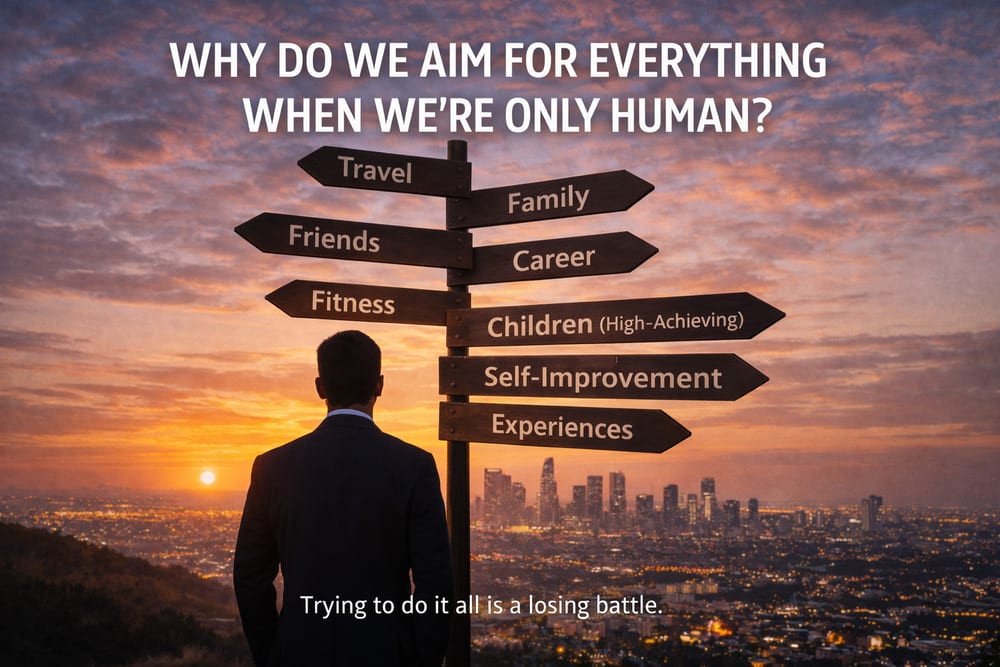
From a clinical perspective, the attempt to do everything is a refusal to accept human limitation. Time, energy, attention, and emotional capacity are finite. Trying to excel simultaneously at career, family, health, self-development, social life, and exploration leads not to balance, but to fragmentation.
Psychological maturity involves recognising that life unfolds in phases. Prioritising one domain necessarily means allowing others to recede. This is not failure; it is reality. Meaning emerges from commitment, not accumulation.
What actually sustains high-achieving individuals
Longitudinal research on adult development consistently shows that wellbeing in later life is predicted far more by relational stability, emotional regulation, and values-based living than by achievement or status. Simple, repeatable practices — regular physical movement, time outdoors, sustained relationships, and periods of mental quiet — exert a powerful protective effect against anxiety and burnout.
A daily walk, undertaken without optimisation or performance, offers measurable psychological benefits comparable to far more elaborate interventions. This is not because it is efficient, but because it restores contact with the present.
So what is the point?
For high-achieving individuals, the point is often not to achieve more, but to stop outsourcing meaning to the future. A life does not need to be special to be worthwhile. It needs to be lived deliberately, within limits, and without the constant pressure to justify its value.
Letting go of the fantasy of “having it all” is not resignation. It is the beginning of a more stable, less anxious relationship with time, self, and mortality.
Psychological wellbeing improves when high-achieving individuals relinquish the need to optimise every aspect of life and instead choose what matters — knowing that something else will be left undone. Meaning is not found in distinction, but in presence. Enjoyment, not performance, is what ultimately sustains us.