


Why We Care So Much What Other People Think?
posted 29th May 2026
Click image to enlarge
Why Do We Care So Much What Other People Think? The Psychology of Social Judgement and Approval
Most people like to believe they are independent thinkers. We tell ourselves that we make decisions based on our own values and priorities, unaffected by the opinions of others. Yet a closer look at human behaviour reveals a very different reality.
People worry about what to wear before social events. They replay conversations in their minds after meetings. They hesitate before posting on social media. They avoid speaking up in groups because they fear appearing foolish. Some spend years pursuing careers, relationships or lifestyles that impress others rather than genuinely fulfilling themselves.
The uncomfortable truth is that most of us care far more about what other people think than we would like to admit.
The question is why.
At first glance, this behaviour appears irrational. Why should the opinions of strangers matter? Why do people become anxious over criticism from individuals they barely know? Why does rejection sometimes feel devastating even when it comes from someone whose opinion should carry little weight?
The answer lies deep within human evolution.
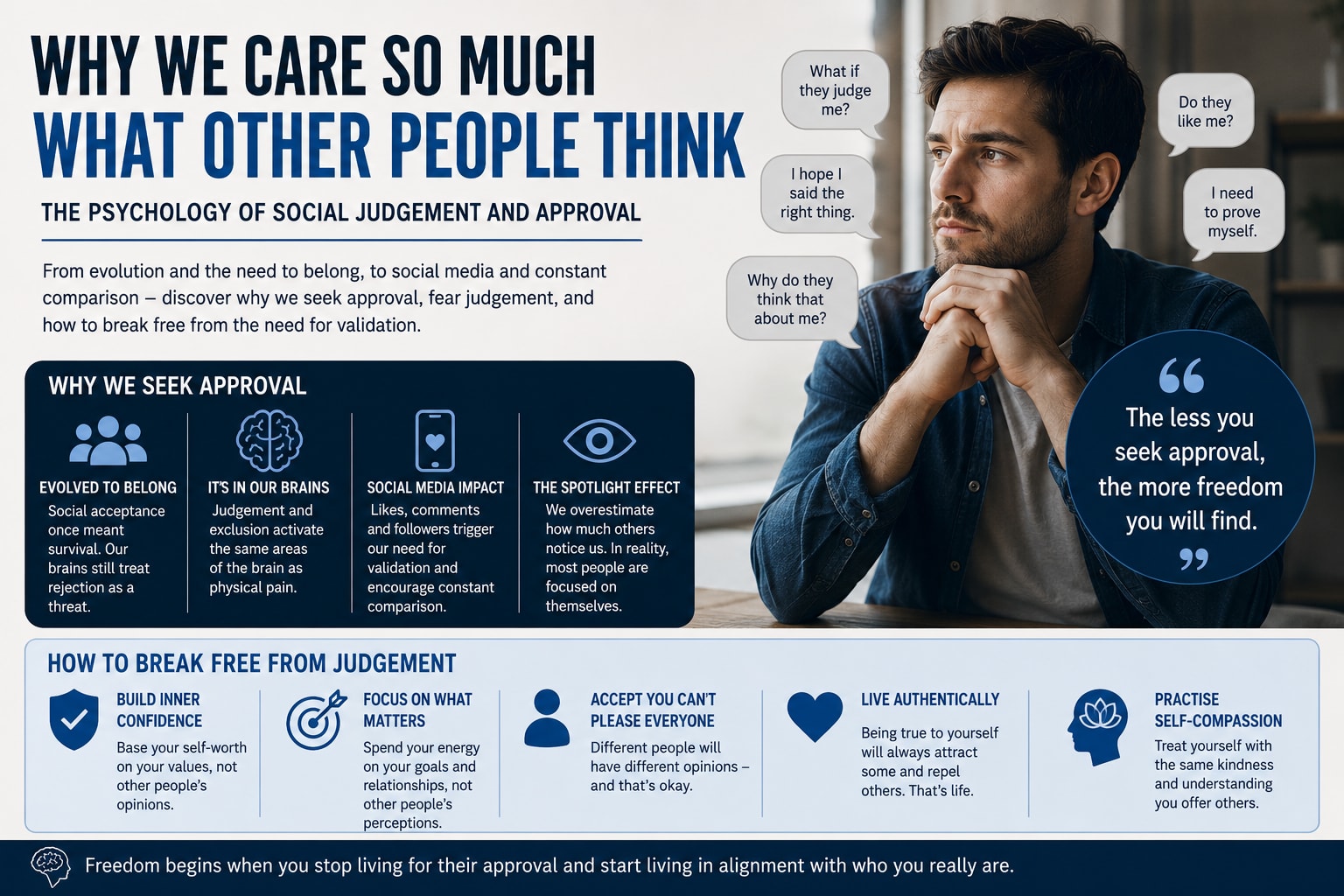
For most of human history, survival depended upon belonging to a group. Thousands of years ago, being rejected by your tribe was not simply embarrassing. It was dangerous. Human beings survived through cooperation, protection and shared resources. Social acceptance increased the chances of survival. Social exclusion reduced them.
As a result, our brains evolved to treat social threats seriously.
Even today, rejection activates many of the same neurological pathways involved in physical pain. The sting of embarrassment, criticism or exclusion is not simply metaphorical. The brain genuinely experiences these events as threats.
This ancient survival mechanism still operates in modern life, despite the fact that being unfollowed on social media or receiving criticism from a colleague no longer threatens our survival.
Unfortunately, the brain has not fully caught up.
One of the most fascinating aspects of human psychology is what researchers call the spotlight effect. People consistently overestimate how much attention others pay to them.
Most individuals assume that everyone notices their mistakes, awkward moments and imperfections. In reality, most people are far too busy worrying about themselves to pay much attention to anyone else.
Think about the last time you noticed a stranger make a minor mistake in public. You probably forgot about it within minutes.
Yet if you made the same mistake yourself, you might remember it for weeks.
This discrepancy exists because we experience our own lives from the centre of our attention. We are constantly aware of our thoughts, emotions and behaviours. Consequently, we assume others are equally focused on us.
They are not.
In many ways, everybody is the main character in their own psychological story.
Social media has dramatically amplified this tendency. For the first time in human history, people can receive immediate feedback from hundreds or even thousands of individuals. Likes, comments, views and followers create measurable indicators of social approval.
The problem is that the brain treats these signals as meaningful social information.
A photograph that receives fewer likes than expected can trigger disappointment.
A critical comment can ruin an entire day.
A lack of response may be interpreted as rejection.
What makes this particularly problematic is that social media encourages constant comparison. People compare their appearance, relationships, careers and lifestyles against carefully curated versions of other people's lives.
The result is often a persistent feeling of inadequacy.
Many clients who seek therapy describe feeling exhausted by the pressure to perform. They feel as though they are constantly being evaluated. They worry about appearing successful, attractive, intelligent or interesting enough.
Yet when we examine these fears more closely, something surprising often emerges.
The imagined audience is largely fictional.
Most people are far less interested in judging us than we believe.
This does not mean social judgement is entirely irrelevant. Human beings are social creatures and feedback serves important functions. It helps us maintain relationships, cooperate effectively and navigate social environments.
Problems arise when external approval becomes the primary source of self-worth.
When this happens, confidence becomes fragile because it depends upon factors outside our control. Praise creates temporary relief. Criticism creates distress. The individual becomes emotionally dependent upon other people's opinions.
This is one reason genuinely confident people often appear so attractive. Their confidence is not built upon constant validation. It comes from an internal sense of worth that remains relatively stable regardless of what others think.
Ironically, many people spend years trying to gain approval from others because they believe it will increase their confidence. In reality, confidence usually develops in the opposite direction.
The less dependent we become on approval, the more confident we feel.
This does not happen overnight. It requires accepting an uncomfortable truth.
Not everybody will like you.
Some people will misunderstand you.
Some will criticise you.
Some will disagree with your choices.
No amount of effort can completely eliminate this reality.
The most psychologically healthy individuals eventually stop trying.
They recognise that approval is pleasant but not essential. They understand that disagreement does not equal failure. They accept that being authentic will inevitably attract both supporters and critics.
Perhaps the greatest freedom in adulthood comes from realising that most people are too busy worrying about what others think of them to spend much time thinking about you.
The judgement we fear is often far smaller than we imagine.
And the life we sacrifice trying to avoid it is often far more valuable than the approval we hope to gain.
Real confidence is not reaching a point where nobody judges you.
It is reaching a point where their judgement no longer determines your worth.