


Why Some People Never Move On From
posted 29th May 2026
Click image to enlarge
Why Some People Never Move On From Their Ex: The Psychology of Letting Go
Most people expect heartbreak to follow a predictable timeline. A relationship ends, there is a period of sadness, and eventually life moves forward. Yet psychologists frequently meet individuals who remain emotionally attached to former partners months or even years after the relationship has ended. Some continue thinking about their ex every day. Others compare every new relationship to the one they lost. A few find themselves trapped in a cycle of nostalgia, regret and longing that feels impossible to escape.
What makes this particularly confusing is that it often has little to do with love.
Many people assume they cannot move on because they are still in love with their former partner. Whilst this is sometimes true, psychology suggests that the situation is often far more complex. In many cases, people are not struggling to let go of the person. They are struggling to let go of what that person represented.
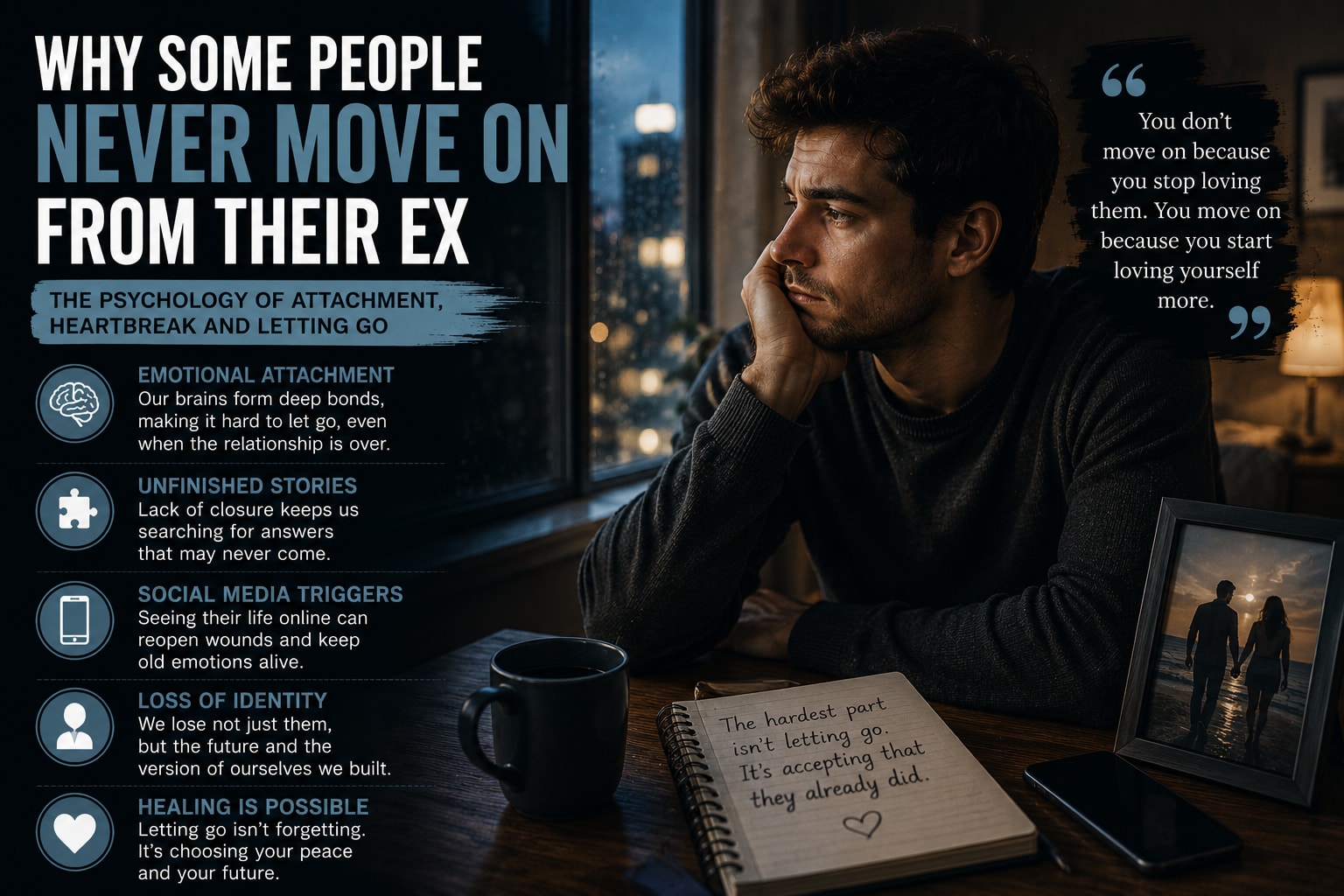
Relationships become woven into our identity. They influence our routines, our future plans and our sense of who we are. When a relationship ends, we do not simply lose another person. We lose a version of ourselves. We lose the future we imagined. We lose the certainty that came from believing we knew where life was heading.
The brain dislikes uncertainty. Human beings are naturally drawn towards closure and explanation. Unfortunately, many relationships end without either. One person leaves unexpectedly. An explanation never arrives. Questions remain unanswered. The mind keeps revisiting the relationship, searching for clarity that may never come.
This is one reason why people often become stuck. They believe they are searching for answers, when in reality they are searching for relief. The brain assumes that if it can only understand what happened, the pain will disappear. As a result, people replay conversations, analyse old messages and revisit memories repeatedly. Instead of helping them move forward, these mental habits keep the relationship psychologically alive.
Interestingly, the relationships that are hardest to forget are not always the happiest ones. Some of the strongest emotional attachments develop in relationships characterised by uncertainty, inconsistency or emotional unavailability. When affection is unpredictable, people often become more invested rather than less. Psychologists refer to this as intermittent reinforcement, a process that creates powerful emotional bonds by making rewards feel scarce and therefore more valuable.
This helps explain why some people struggle to move on from partners who treated them poorly. Friends and family may find it difficult to understand. They focus on the reality of the relationship, while the individual remains attached to the possibility of what it could have become. They continue longing for the future they imagined rather than the reality they experienced.
Social media has made this process considerably more difficult. Previous generations were often forced to lose contact after a breakup. Today, former partners remain permanently accessible. Their photographs appear unexpectedly. Their achievements become visible. New relationships are displayed publicly. Every update has the potential to reopen emotional wounds.
The problem is that social media rarely presents reality. People share their happiest moments and conceal their struggles. An ex-partner who appears to have moved on effortlessly may be experiencing their own pain, uncertainty and regret. Yet the person watching from a distance sees only a carefully curated version of events. They compare their private suffering to somebody else's public highlight reel.
Another reason people struggle to let go is because rejection often activates deeper insecurities. The pain is not always about losing the relationship itself. Sometimes it is about what the loss appears to say about us. People begin questioning their attractiveness, their worth and their ability to be loved. They interpret a breakup as evidence that they were not enough.
This is where heartbreak can become dangerous. The relationship gradually stops being about another person and starts becoming a measure of self-worth. The individual believes that moving on would somehow invalidate the significance of the relationship or diminish what they felt. In reality, letting go does neither. It simply means accepting that something meaningful has ended.
Perhaps the most surprising finding from psychological research is that closure rarely arrives from another person. People often imagine that one final conversation, one explanation or one apology will provide the relief they need. Whilst these things can sometimes help, genuine closure is usually an internal process. It occurs when we stop demanding answers that may never come and begin accepting uncertainty.
The people who recover most successfully from heartbreak are not necessarily those who find the perfect explanation. They are the ones who gradually redirect their attention towards rebuilding their own lives. They create new routines, new goals and new experiences. They stop viewing their future through the lens of a past relationship and begin investing in possibilities that still exist.
This does not mean forgetting. Significant relationships leave lasting impressions. They shape who we become and teach us important lessons about ourselves. Moving on is not about erasing memories. It is about removing the emotional hold those memories have over your present.
If you find yourself unable to stop thinking about a former partner, it may be worth asking a difficult question. Are you missing the person, or are you missing the version of yourself that existed when they were in your life?
For many people, that distinction is the beginning of healing.
The truth is that most individuals who struggle to move on are not broken, weak or destined to remain trapped in the past. They are simply human. They are experiencing the natural consequences of attachment, loss and uncertainty.
The good news is that healing is possible. Not because the past changes, but because you do.
Eventually, the relationship becomes part of your story rather than the centre of it. And when that happens, the future begins to feel possible again.