


Why Overthinking Is Increasing
posted 7th April 2026
Click to enlarge
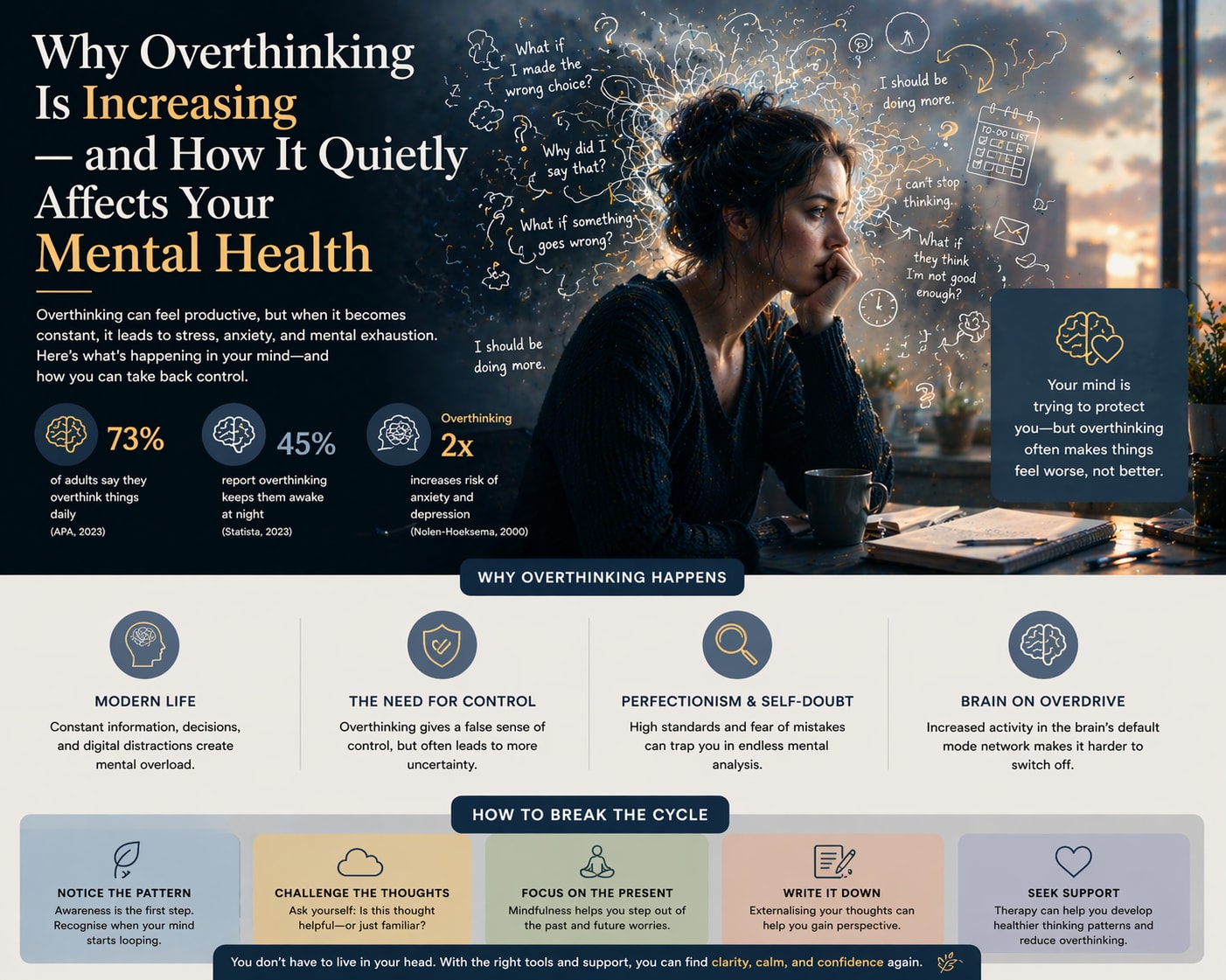
Why Overthinking Is Increasing — and How It Quietly Affects Your Mental Health
Overthinking has become an increasingly common experience in modern life. Many people describe feeling mentally “switched on” at all times—constantly analysing, replaying conversations, anticipating problems, and struggling to switch off. While occasional reflection is a normal and often helpful cognitive process, chronic overthinking can become exhausting, intrusive, and difficult to control.
In psychological terms, overthinking is often linked to rumination and worry. Rumination tends to focus on the past—replaying events, analysing mistakes, and questioning decisions—whereas worry is typically future-focused, involving “what if” scenarios and attempts to predict or prevent negative outcomes. Both processes are strongly associated with anxiety and depression, and research shows they play a key role in maintaining emotional distress.
One reason overthinking is increasing relates to the cognitive demands of modern life. We are exposed to a constant flow of information, decisions, and social comparison, particularly through digital environments. This creates more opportunities for reflection—but also more opportunities for doubt, self-criticism, and mental overload. At the same time, many environments reward careful thinking, planning, and risk anticipation, which can unintentionally reinforce patterns of excessive mental analysis.
From a psychological perspective, overthinking is often driven by underlying beliefs such as “If I think this through enough, I’ll find the right answer” or “Worrying will help me stay in control.” While these beliefs can feel convincing, they tend to backfire. Instead of producing clarity, overthinking often leads to increased uncertainty, indecision, and emotional fatigue. The mind becomes stuck in a loop, searching for certainty that is ultimately unattainable.
Neuroscientific research suggests that overthinking is associated with increased activity in brain networks involved in self-referential processing, particularly the default mode network (DMN). When this network is overactive, individuals may become more internally focused, leading to repetitive thought patterns and reduced ability to disengage from distressing mental content.
Importantly, overthinking does not always appear problematic from the outside. Individuals who overthink are often seen as thoughtful, conscientious, or detail-oriented. However, internally, they may experience heightened anxiety, difficulty making decisions, sleep disruption, and a persistent sense of mental exhaustion. Over time, this can impact both emotional wellbeing and day-to-day functioning.
Despite its prevalence, overthinking is both understandable and treatable. Psychological approaches such as cognitive behavioural therapy (CBT) focus on identifying and challenging unhelpful thinking patterns, while mindfulness-based interventions help individuals develop a different relationship with their thoughts—learning to observe them without becoming entangled.
A key aim of treatment is not to eliminate thinking, but to create flexibility. This involves recognising when thinking is helpful and when it becomes repetitive and unproductive. With the right support, individuals can learn to step out of cycles of rumination and worry, improving both clarity of thought and emotional wellbeing.
Ultimately, overthinking reflects a mind that is trying—often very hard—to solve problems and stay safe. However, when this process becomes excessive, it can have the opposite effect. Developing a more balanced relationship with thinking is not about doing less, but about thinking more effectively—and with greater psychological freedom.