


Why Obsess Over People Who Reject Us?
posted 29th May 2026
Click image to enlarge
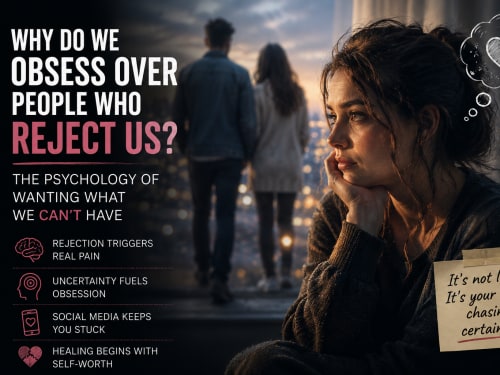
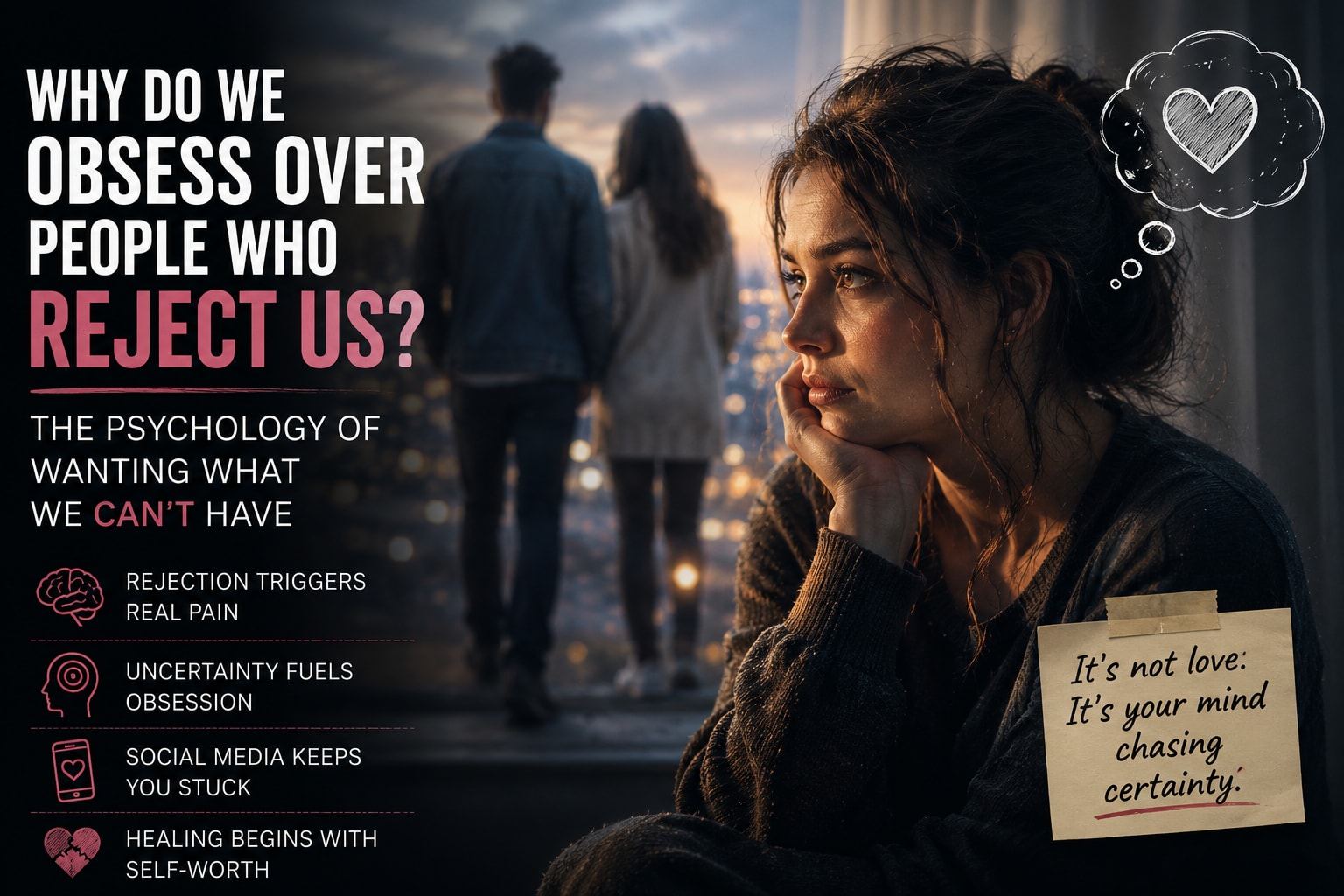
Why Do We Obsess Over People Who Reject Us? The Psychology of Wanting What We Can't Have
There is perhaps no emotional experience more frustrating than wanting someone who does not want us back.
Most people can recall a time when they became preoccupied with someone who showed little interest in them. It might have been an ex-partner who moved on, a potential partner who suddenly lost interest, or someone who remained emotionally unavailable despite all our efforts. What makes these situations particularly painful is that logic rarely seems to help. We know the relationship is unlikely to happen, yet our thoughts keep returning to the person.
Psychologists have long been fascinated by this phenomenon because it appears to contradict common sense. If someone values us, supports us and wants to be with us, surely that should be more attractive than someone who rejects us. Yet human beings are not purely rational creatures. In many cases, rejection can actually increase desire.
Part of the explanation lies deep within our evolutionary history. Human beings evolved in groups where social acceptance was essential for survival. Being excluded from the tribe was not merely unpleasant; it could be life-threatening. As a result, our brains developed highly sensitive systems for detecting rejection and social exclusion.
Modern rejection activates many of the same neural pathways associated with physical pain. In other words, heartbreak genuinely hurts. The brain interprets rejection as a threat and immediately begins searching for ways to resolve it. Unfortunately, this often means becoming increasingly focused on the person who rejected us.
The more uncertain the situation becomes, the stronger this focus can grow. Psychologists refer to this as the power of intermittent reinforcement. When outcomes are unpredictable, people often become more invested rather than less. It is the same psychological principle that keeps people playing slot machines and repeatedly checking social media notifications.
An emotionally unavailable person can unknowingly create exactly this dynamic. Occasional attention, mixed signals and moments of affection become powerful rewards. The rejected individual starts chasing the next positive interaction, believing that if they say the right thing or behave differently, the relationship might finally work.
What many people fail to recognise is that they are no longer pursuing the person. They are pursuing the possibility.
This distinction matters.
Often, the individual becomes attached not to who the other person really is, but to who they imagine them to be. Fantasy fills the gaps left by uncertainty. The less information we have, the easier it becomes to create an idealised version of someone in our minds.
This is one reason why relationships that never fully develop can sometimes be harder to get over than relationships that actually existed. Reality has a way of exposing flaws. Fantasy does not.
Social media has amplified this problem dramatically. Previous generations experienced rejection and eventually lost contact with the person involved. Today, many people continue observing the lives of former partners for months or years. Every photograph, holiday and new relationship becomes another source of emotional fuel.
Unfortunately, social media rarely presents reality. People showcase the best moments of their lives whilst hiding the struggles, insecurities and disappointments that occur behind closed doors. The rejected individual is therefore comparing their emotional pain with someone else's carefully edited highlight reel.
Another reason rejection can become so obsessive is that it often activates deeper psychological wounds. The distress is not always about the current relationship. For some people, rejection triggers old feelings of not being good enough, not being chosen or not being valued. The pain feels disproportionately intense because it is connected to experiences that extend far beyond the present moment.
This helps explain why two people can experience exactly the same rejection and respond in completely different ways. One person feels disappointed and moves on. Another becomes consumed by intrusive thoughts, self-doubt and longing. The difference often lies in what the rejection symbolises rather than the rejection itself.
Ironically, the people we obsess over are often not as extraordinary as we imagine. The emotional intensity comes from what they represent. They become symbols of love, validation, status, acceptance or self-worth. The mind convinces itself that obtaining this person would somehow resolve deeper insecurities.
In reality, no relationship can permanently fix a lack of self-worth.
This is why therapy often focuses not on the rejected person but on the meaning attached to the rejection. When people begin to understand what they were truly seeking, they often discover that their obsession had very little to do with the other individual at all.
The healthiest relationships are usually not those that create the strongest emotional highs. They are the ones that create emotional safety. They involve consistency rather than confusion, security rather than uncertainty and genuine connection rather than pursuit.
If you find yourself unable to stop thinking about someone who rejected you, it may be worth asking a simple question: "Am I missing this person, or am I missing how I hoped they would make me feel?"
For many people, the answer changes everything.
The truth is that rejection does not determine your worth. It simply reflects compatibility, timing, circumstances and personal preferences. Someone else's inability to see your value does not reduce your value.
Real confidence begins when you stop trying to convince someone to choose you and start choosing yourself.