


Why Do Some People Feel Sad All the Time?
posted 18th May 2026
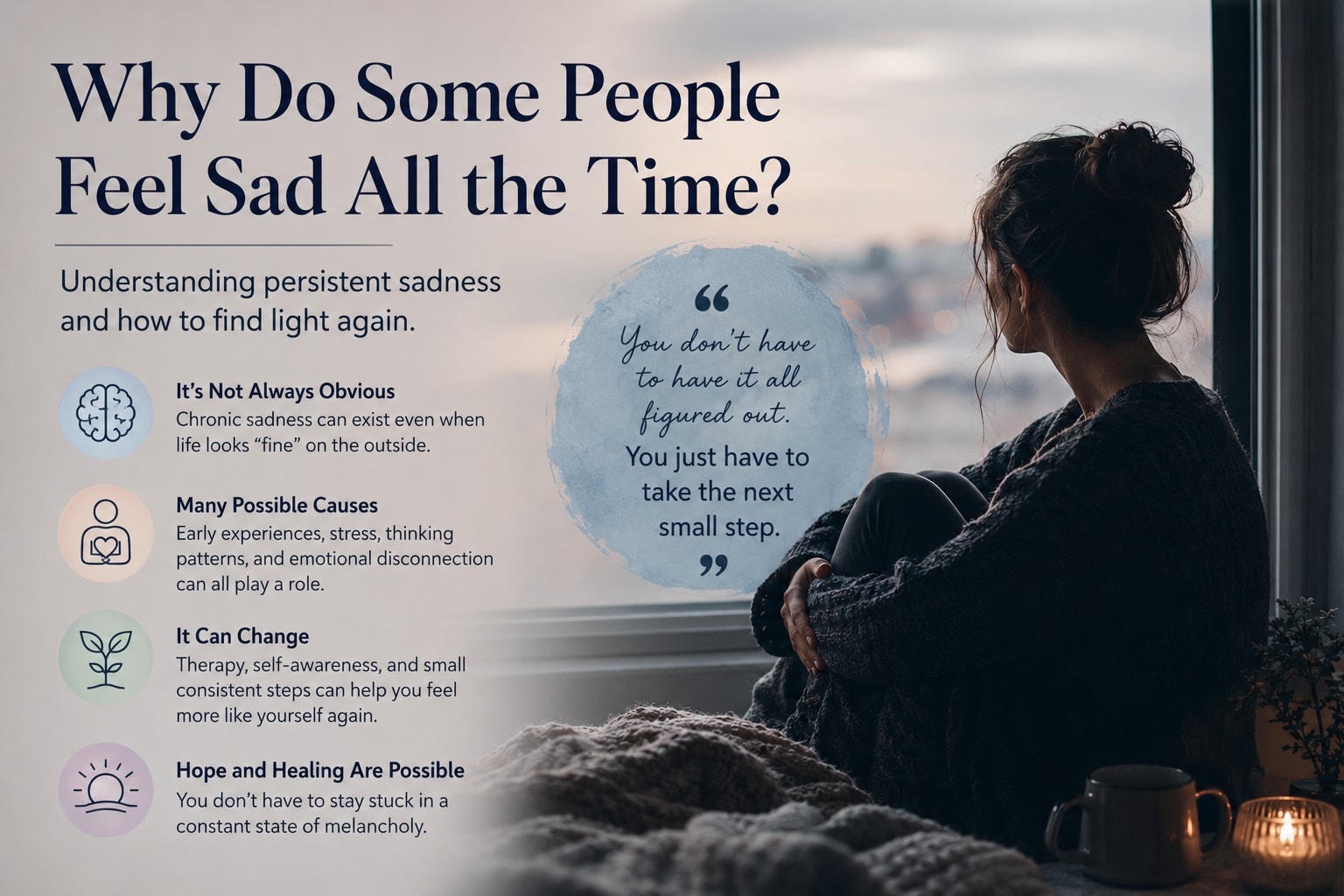
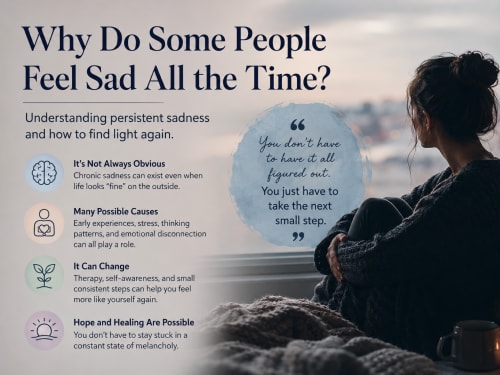
Click image to enlarge
Why Do Some People Feel Sad All the Time?
Some people move through life carrying a quiet, persistent sadness that never fully lifts. It is not always dramatic or overwhelming, and there may be no obvious crisis causing it. They continue going to work, maintaining relationships, and functioning day to day, yet underneath everything sits a constant feeling of melancholy, emotional flatness, or heaviness. Many describe it as feeling emotionally “grey,” where life lacks real excitement, pleasure, or emotional intensity.
“I’m not deeply depressed, I just never really feel happy.”
“Life feels emotionally flat.”
“Nothing is terribly wrong, but nothing feels good either.”
For many people, this experience can be confusing because they often feel guilty for struggling when their life appears outwardly stable. However, psychology increasingly recognises that emotional suffering does not always emerge from major crises. Sometimes it develops slowly over years through emotional patterns, chronic stress, personality factors, or unresolved psychological experiences.
The DSM-5 and Persistent Depressive Disorder
In the DSM-5, the diagnostic manual used by mental health professionals, chronic low mood is classified as Persistent Depressive Disorder (PDD), previously known as dysthymia. Unlike Major Depressive Disorder, which often involves more severe depressive episodes, Persistent Depressive Disorder is characterised by a long-lasting depressed or low mood lasting at least two years in adults.
The symptoms are often milder than major depression, but they are far more chronic and enduring. Many individuals continue functioning outwardly, which means the condition frequently goes unnoticed for years.
Research suggests that people experiencing persistent depressive symptoms often report:
Low self-esteem
Reduced pleasure or enjoyment
Emotional numbness
Fatigue and low motivation
Hopelessness
Chronic self-criticism
Difficulty experiencing joy
Social withdrawal
One of the most significant features of chronic low mood is that people often begin to believe:
“This is just who I am.”
Over time, sadness can start to feel like an identity rather than a treatable psychological state.
Why Does This Happen?
Persistent melancholy rarely has one single cause. In most cases, it develops through a combination of biological, psychological, emotional, and environmental factors.
Early Emotional Experiences
Many people who experience chronic low mood grew up in environments where emotions were ignored, criticised, or unsafe to express. Children who learn that emotional needs will not be met often become adults who disconnect from their emotional world.
A person may not consciously identify their childhood as traumatic, yet still carry deeply ingrained feelings of:
Shame
Inadequacy
Emotional loneliness
Fear of vulnerability
Chronic self-criticism
Over time, emotional suppression can evolve into a constant sense of sadness or emotional numbness.
Chronic Stress and Emotional Exhaustion
Research has shown that prolonged stress changes how the brain and nervous system function. Long-term activation of stress systems can affect:
Sleep regulation
Motivation
Emotional responsiveness
Pleasure and reward processing
Energy levels
Some individuals stop experiencing emotional highs not because they are incapable of happiness, but because the nervous system has adapted to prolonged emotional strain. In many ways, chronic melancholy can reflect emotional exhaustion rather than weakness.
Personality and Thinking Patterns
Certain cognitive styles are strongly associated with persistent depressive states. Individuals who are highly perfectionistic, self-critical, or prone to rumination often unknowingly maintain low mood through habitual patterns of thought.
These patterns may include:
Discounting positive experiences
Assuming negative outcomes
Interpreting neutral situations negatively
Feeling never “good enough”
Believing happiness is temporary or unsafe
Over years, these ways of thinking become automatic and continuously reinforce emotional flatness.
Emotional Disconnection
For some people, the issue is not intense sadness, but emotional disconnection. They no longer feel excitement, spontaneity, meaning, or emotional engagement with life. Activities that once brought pleasure feel emotionally muted.
This emotional blunting can develop after:
Burnout
Unresolved grief
Chronic anxiety
Repeated disappointment
Emotional neglect
Years of suppressing emotions
Sometimes sadness itself is not the core issue. Instead, the person has become disconnected from their own emotional needs and inner world.
A Clinical Example
Consider a common clinical example. A man in his late thirties described himself as “functioning but empty.” He maintained a successful career, exercised regularly, and socialised with friends, yet could not remember the last time he felt genuinely excited or joyful.
During therapy, it became clear that emotional expression had been discouraged throughout childhood and achievement had been valued more than emotional connection. Over time, he had developed a relentless internal critic and learned to suppress vulnerability, emotional needs, and exhaustion.
His sadness was not random. It reflected years of emotional adaptation and self-suppression.
Can This Change Without Medication?
In many cases, yes.
Medication can be extremely helpful for some individuals, particularly when symptoms are severe or biologically driven. However, research also supports several effective non-pharmacological approaches for persistent depressive symptoms.
Psychological Therapy
Therapy is often most effective when it moves beyond simply managing symptoms and begins exploring the underlying emotional patterns maintaining the sadness.
Evidence-based approaches include:
Cognitive Behavioural Therapy (CBT)
Psychodynamic psychotherapy
Compassion-focused therapy
Interpersonal therapy
Schema therapy
Behavioural activation
Therapy can help individuals:
Understand hidden emotional patterns
Reduce chronic self-criticism
Reconnect with emotions
Develop self-awareness
Improve emotional regulation
Rebuild meaning and motivation
Behavioural Activation
One of depression’s most powerful traps is withdrawal. People stop socialising, creating, exploring, resting, or engaging in meaningful experiences. Unfortunately, this withdrawal often deepens emotional flatness.
Behavioural activation works by gradually helping individuals re-engage with activities that create meaning, connection, pleasure, or achievement — even before motivation naturally returns.
Research consistently shows that action often precedes emotional change, rather than the other way around.
Learning to Understand What Sits Beneath the Sadness
Many people with chronic melancholy struggle to identify what they actually feel underneath the persistent low mood. In therapy, individuals often discover underlying:
Grief
Loneliness
Anger
Fear
Exhaustion
Unmet emotional needs
Sometimes sadness becomes a protective emotional “cover state” hiding deeper unresolved emotions.
Lifestyle Factors Matter
Although lifestyle changes alone may not completely resolve chronic depression, they can significantly improve emotional regulation and nervous system functioning.
Research strongly supports:
Regular exercise
Consistent sleep
Exposure to daylight
Reducing alcohol use
Mindfulness and relaxation practices
Meaningful social connection
Structured daily routines
Small but consistent changes can gradually improve emotional resilience over time.
The Most Important Thing to Understand
Persistent melancholy is not simply “being negative,” weak, or flawed. In many cases, it reflects years of emotional adaptation, chronic stress, learned beliefs, nervous system exhaustion, or emotional suppression.
People who have felt this way for years often assume:
“This is just my personality.”
But psychology increasingly recognises that chronic low mood is not always an identity. Often, it is a psychological pattern that can be understood, explored, and gradually changed with the right support, insight, and emotional work.