


Why Do Nice People Fall for Narcissists?
posted 29th May 2026
Click image to enlarge
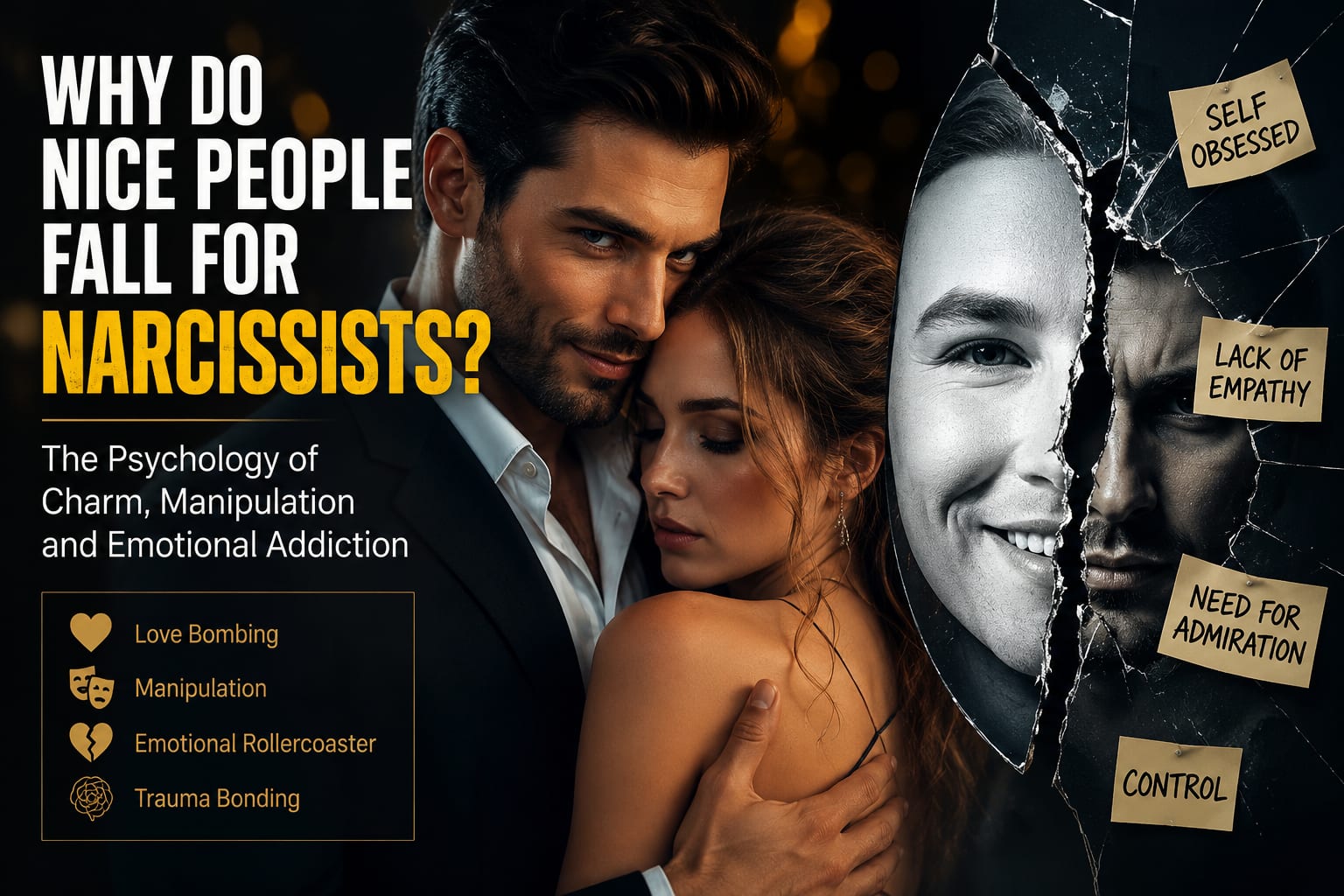
Why Do Nice People Fall for Narcissists? The Psychology of Charm, Manipulation and Emotional Addiction
Few psychological questions generate as much curiosity as this one: why do intelligent, successful and emotionally aware people so often find themselves trapped in relationships with narcissists?
The popular stereotype suggests that only vulnerable or naive individuals become involved with manipulative partners. Yet psychologists frequently work with highly capable professionals, business leaders, doctors, lawyers and emotionally intelligent individuals who have found themselves caught in relationships that slowly became controlling, confusing and psychologically exhausting.
The reality is that narcissists rarely appear narcissistic at the beginning. If they did, very few people would be attracted to them. Instead, they often present themselves as charming, confident, attentive and exciting. They know how to make someone feel seen, valued and special. They create chemistry quickly and establish emotional connections that can feel unusually intense.
This is not accidental.
Many narcissistic individuals possess an intuitive understanding of human psychology. They recognise what people want to hear, what makes them feel important and what creates emotional attachment. During the early stages of a relationship they may appear exceptionally attentive, showering a partner with affection, compliments and attention. Many people describe this period as feeling like a fairy tale. They feel chosen, admired and understood in a way they may never have experienced before.
The problem is that genuine intimacy usually develops gradually. Healthy relationships build trust over time. They allow people to reveal themselves slowly and naturally. Narcissistic relationships often move at a much faster pace because the objective is not necessarily emotional intimacy but emotional attachment. The stronger the attachment becomes, the more difficult it is for the other person to leave when the relationship begins to change.
One of the most fascinating aspects of narcissistic relationships is that the qualities which make someone a good partner often become the very qualities that place them at risk. Kind people tend to see the best in others. Empathetic people are more willing to forgive mistakes. Loyal people are more likely to persevere through difficulties. Unfortunately, narcissistic individuals can exploit these strengths.
When troubling behaviour begins to emerge, many people assume there must be a reasonable explanation. They tell themselves their partner is stressed, struggling emotionally or dealing with unresolved issues from childhood. Rather than recognising a pattern, they focus on isolated incidents. They continue giving the benefit of the doubt long after their instincts have begun warning them that something is wrong.
This gradual process is one reason why so many intelligent people become trapped. The relationship rarely becomes toxic overnight. Instead, the shift is subtle. Affection becomes criticism. Encouragement becomes control. Openness becomes manipulation. What once felt exciting begins to feel emotionally draining.
Many clients describe feeling as though they are constantly walking on eggshells. They become increasingly focused on managing the other person's emotions and avoiding conflict. They start questioning their own perceptions and wondering whether they are being too sensitive, too demanding or simply imagining problems that do not exist.
Over time, the relationship can begin to affect self-esteem. The confidence that existed before the relationship gradually erodes. The person becomes more anxious, more self-critical and increasingly dependent upon the approval of the very individual who is contributing to their distress.
This process is not simply emotional. It also has a neurological component.
Psychologists have long understood that intermittent rewards can create powerful forms of attachment. Slot machines operate using this principle. Social media platforms rely upon it. Toxic relationships often do too.
When affection and validation become unpredictable, people frequently become more invested rather than less. They continue hoping for a return to the person they met at the beginning of the relationship. They remember the early excitement, the affection and the sense of connection. They convince themselves that if they can just say the right thing, behave differently or try harder, everything will return to how it once was.
In many cases, that version of the relationship never truly existed. It was part of the process of securing emotional investment.
This helps explain why so many people remain in relationships they know are unhealthy. From the outside, friends and family may struggle to understand. They wonder why someone does not simply leave. What they often fail to appreciate is the psychological complexity of emotional attachment. Human beings are not purely rational creatures. We are influenced by hope, fear, longing and the desire for connection. These forces can be extraordinarily powerful.
Modern social media has added another layer to this dynamic. Platforms such as Instagram, TikTok and Facebook reward image management, self-promotion and public validation. Whilst most confident people are not narcissists, online environments frequently blur the distinction between healthy self-confidence and narcissistic behaviour.
Many people become attracted to carefully constructed identities rather than authentic personalities. They mistake popularity for character, attention for substance and confidence for emotional maturity. In a culture increasingly obsessed with visibility and status, it can sometimes be difficult to recognise the difference.
Perhaps this explains why conversations about narcissism have become so common. More people are beginning to recognise patterns of manipulation, emotional control and psychological dependency that previously went unnamed. However, there is also a danger in labelling every difficult person a narcissist. True narcissistic traits exist on a spectrum, and not every selfish or insensitive individual meets the criteria for a personality disorder.
The more useful question is not whether someone is technically a narcissist. The more important question is how the relationship makes you feel.
Do you feel emotionally safe?
Do you feel respected?
Do you feel free to express yourself without fear of criticism or punishment?
Do you feel valued for who you are rather than for what you provide?
Healthy relationships do not require constant self-doubt. They do not depend upon manipulation, control or emotional unpredictability. Whilst all relationships involve challenges, they should not leave you feeling chronically anxious, confused or emotionally depleted.
Perhaps the most important lesson is that people do not fall for narcissists because they are weak. They fall for narcissists because they are human. We are all wired to seek love, belonging, admiration and connection. These instincts have helped human beings survive for thousands of years. Under the wrong circumstances, however, those same instincts can leave us vulnerable to individuals who know how to exploit them.
Understanding these psychological mechanisms is not about becoming cynical or mistrustful. It is about developing greater awareness. The more we understand why we are drawn to certain people, the better equipped we become to build healthier relationships in the future.
Real love does not require manipulation. Real confidence does not require domination. Real intimacy does not require control.
The healthiest relationships are often not the most dramatic ones. They are the ones in which both people feel secure enough to be themselves.