


Why Do Kind People Attract Manipulative People?
posted 24th July 2026
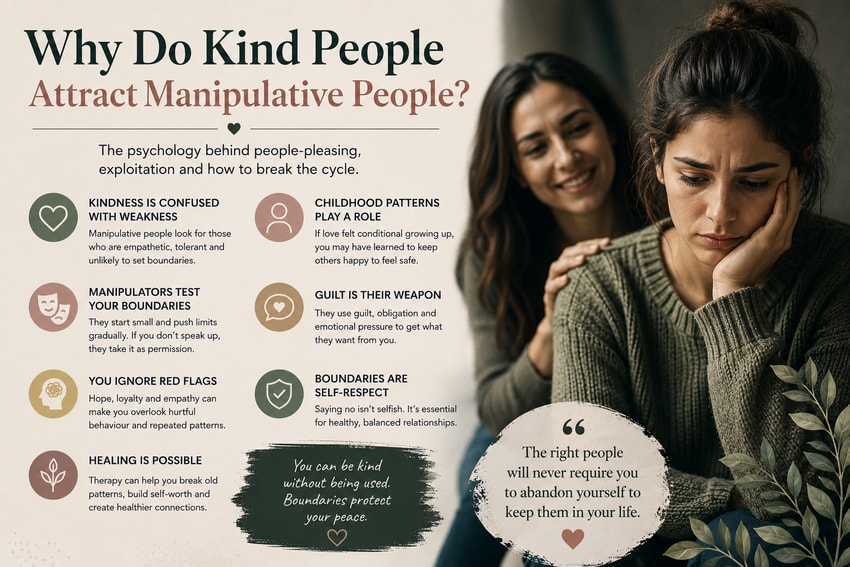
Why Do Kind People Attract Manipulative People? The Psychology Behind People-Pleasing and Exploitation
Kindness is one of the qualities we value most in ourselves and others. Compassion, generosity and empathy help build trusting relationships, strengthen communities and improve psychological wellbeing. Yet many people who are consistently described as "the nicest person you'll ever meet" eventually find themselves asking a painful question:
"Why do I always seem to attract people who take advantage of me?"
Whether it is a demanding friend, a controlling partner, an overbearing family member or a colleague who continually shifts work onto them, some people appear to become magnets for individuals who exploit their goodwill.
The answer is not that kind people are weak. In fact, the opposite is often true. Their greatest strengths—empathy, patience, forgiveness and loyalty—can become vulnerabilities when they are not balanced with healthy boundaries.
Understanding why this happens is the first step towards changing it.
Kindness and People-Pleasing Are Not the Same Thing
One of the biggest misconceptions in psychology is that kindness and people-pleasing are interchangeable.
They are not.
Healthy kindness comes from choice.
People-pleasing often comes from fear.
A genuinely kind person helps others because they want to. A people-pleaser frequently helps because they fear disappointing someone, being rejected or being viewed negatively.
Although the behaviour may look identical on the surface, the underlying psychology is completely different.
Healthy kindness feels satisfying.
People-pleasing often feels exhausting.
Why Manipulative People Recognise Their Targets
Most manipulative individuals are surprisingly skilled at identifying people who are unlikely to challenge them.
This process often happens unconsciously.
They notice who apologises unnecessarily.
Who struggles to say no.
Who avoids conflict.
Who repeatedly gives second chances.
Who worries excessively about upsetting others.
These behaviours communicate one important message:
"My boundaries are flexible."
Manipulative people rarely begin with obvious abuse. Instead, they gradually test how much another person is willing to tolerate.
If small boundary violations go unchallenged, larger ones often follow.
The Childhood Origins of People-Pleasing
For many people, people-pleasing begins long before adulthood.
Children naturally depend upon caregivers for emotional and physical survival. If approval, affection or attention become conditional, children often learn that love must be earned.
Some grow up believing:
- "I need to keep everyone happy."
- "My needs are less important."
- "Conflict means people will leave me."
- "If someone is upset, it must be my responsibility."
These beliefs are rarely conscious.
Instead, they become deeply rooted psychological rules that continue shaping adult relationships decades later.
The Hidden Cost of Being 'Easy Going'
Many people pride themselves on being laid-back.
They avoid arguments.
They compromise.
They rarely complain.
Others often describe them as "so easy to get along with."
While flexibility is a healthy quality, constantly suppressing your own needs comes at a psychological cost.
Every time we ignore our own feelings to avoid disappointing someone else, we send ourselves an unconscious message:
"My needs don't matter as much."
Over months and years, this can gradually erode self-esteem and create resentment.
Ironically, the people we work hardest to keep happy often become the people who appreciate us the least.
Empathy Without Boundaries Becomes Self-Neglect
Empathy is one of humanity's greatest strengths.
It allows us to understand another person's perspective and respond with compassion.
However, empathy without boundaries can become psychologically dangerous.
Highly empathetic people often spend enormous amounts of time explaining other people's behaviour.
- "They're under a lot of stress."
- "They've had a difficult childhood."
- "They don't really mean it."
- "They're struggling themselves."
While these explanations may be true, understanding someone's behaviour is not the same as accepting it.
A person's difficult past may explain their actions.
It does not excuse repeated mistreatment.
The Psychology of Guilt
Manipulative people often rely on guilt because it is one of the most effective ways to override healthy boundaries.
Instead of asking directly, they create emotional pressure.
They may suggest you are selfish.
Question your loyalty.
Remind you of everything they have done for you.
Or imply that saying no makes you a bad person.
People who already struggle with guilt are particularly vulnerable to these tactics.
They confuse feeling guilty with actually doing something wrong.
The two are not the same.
Sometimes guilt is simply the emotional discomfort that comes from finally protecting yourself.
Why We Ignore Red Flags
One of the most fascinating aspects of human psychology is confirmation bias.
Once we decide someone is a good person, we naturally search for information that confirms that belief.
We minimise warning signs.
We dismiss uncomfortable feelings.
We focus on isolated acts of kindness rather than consistent patterns of behaviour.
Eventually, we begin trusting our hope more than our experience.
Psychological change often begins when we stop asking:
"What are they like when they're at their best?"
and instead ask:
"How do they treat me most of the time?"
Learning to Say No
For lifelong people-pleasers, saying no often feels physically uncomfortable.
The heart races.
Anxiety increases.
Thoughts of disappointing others become overwhelming.
Many assume these feelings mean they are doing something wrong.
In reality, they often mean they are doing something new.
Healthy boundaries frequently feel uncomfortable before they begin to feel natural.
Like any new psychological skill, assertiveness improves with practice.
What Healthy Relationships Feel Like
Many people who have spent years in one-sided relationships are surprised by how calm healthy relationships feel.
There is less anxiety.
Less guessing.
Less emotional exhaustion.
Healthy people respect boundaries without punishment.
They accept no without withdrawing affection.
They celebrate your achievements instead of competing with them.
They ask for support rather than demanding it.
Most importantly, they make you feel psychologically safe.
You do not spend your time analysing every conversation or worrying that one mistake will destroy the relationship.
Therapy Can Help Break the Pattern
People often believe they need to become less caring in order to stop being exploited.
The opposite is true.
Therapy does not aim to reduce kindness.
It aims to strengthen self-respect.
By understanding attachment patterns, identifying unhelpful beliefs, improving assertiveness and learning to tolerate the discomfort that sometimes accompanies healthy boundaries, people gradually discover they can remain compassionate without sacrificing themselves.
Kindness becomes a choice rather than an obligation.
Final Thoughts
The healthiest people are rarely those who give everything to everyone.
They are the people who have learned that compassion includes themselves.
Healthy boundaries do not make us selfish.
They make our relationships sustainable.
The goal is not to become harder, colder or less trusting.
It is to become wise enough to recognise the difference between someone who appreciates your kindness and someone who simply expects it.
The right people will never require you to shrink yourself to keep the relationship alive. Instead, they will respect your limits, value your generosity and encourage you to care for yourself with the same compassion you so freely offer to everyone else.