


Why Being Certain Doesn't Mean You're Right
posted 29th June 2026
Click image to enlarge
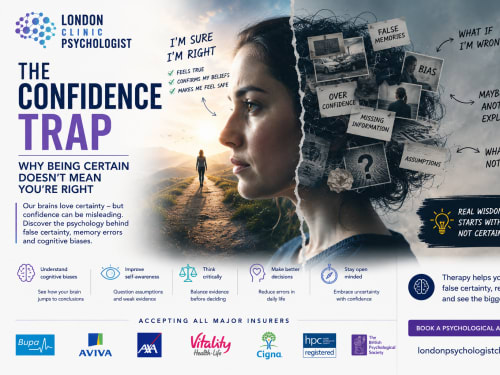
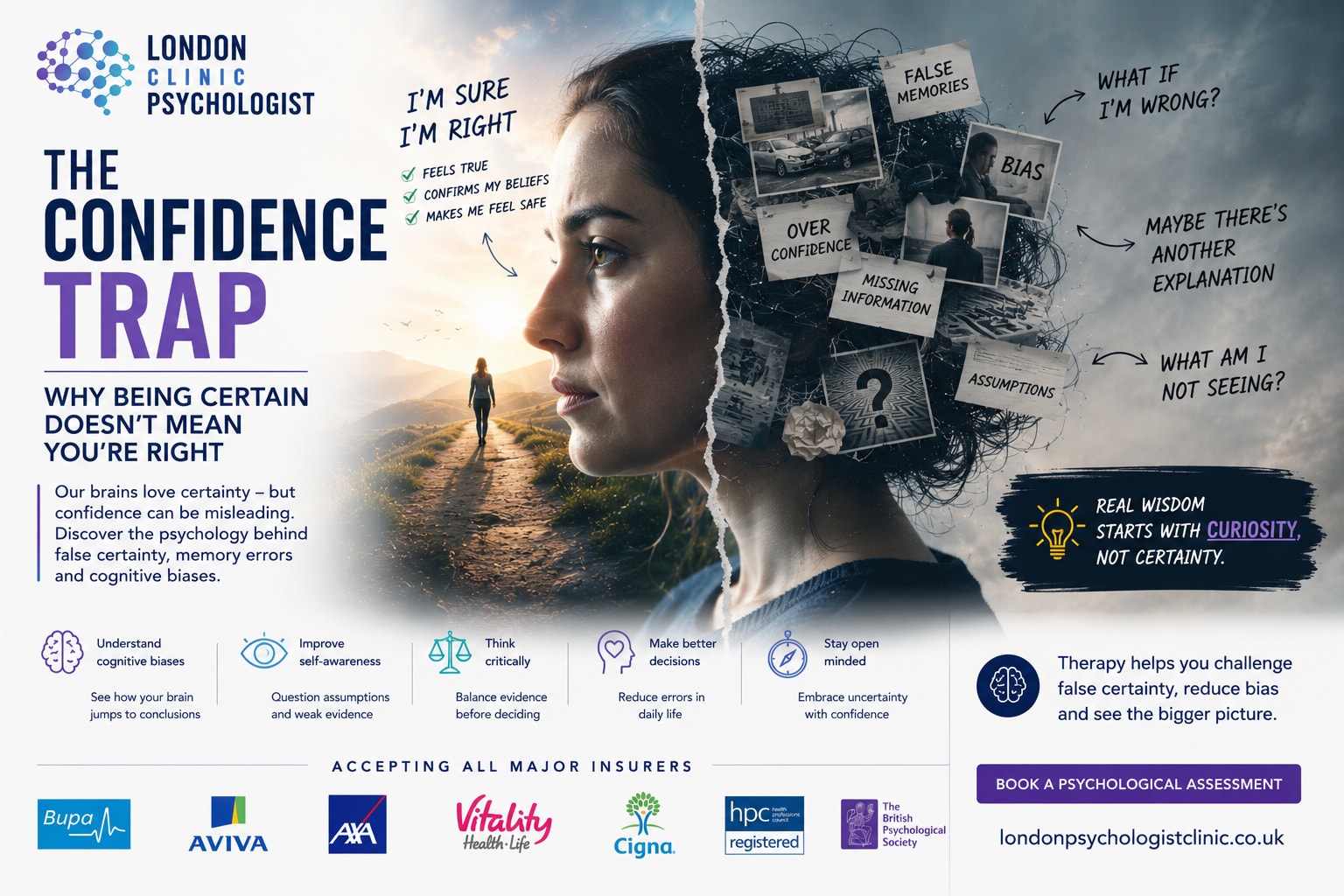
The Confidence Trap: Why Being Certain Doesn't Mean You're Right
We've all met them. The colleague who confidently explains something that later turns out to be completely wrong. The friend who insists they've "done their research" despite relying on social media posts. Or perhaps we've caught ourselves feeling absolutely certain about a memory, only to discover that events happened very differently.
One of psychology's most fascinating discoveries is that confidence and accuracy are surprisingly poor partners. In other words, the more certain we feel about something, the more likely we are to believe we're right—but not necessarily the more likely we actually are to be right.
Psychologists have spent decades studying the relationship between confidence, memory and decision-making. Their findings challenge one of our most deeply held assumptions: that certainty is a reliable indicator of truth.
One of the most influential researchers in this field is cognitive psychologist Professor Elizabeth Loftus. Through decades of research, Loftus demonstrated that human memory is remarkably flexible. In one famous series of experiments, participants viewed videos of car accidents before being asked questions about what they had seen. Simply changing one word dramatically altered their recollections. Participants asked how fast the cars were travelling when they "smashed" into one another estimated significantly higher speeds than those asked when the cars merely "hit" each other. Many even confidently remembered seeing broken glass that had never existed.
The remarkable aspect of these studies was not simply that memories changed. Participants often became more confident in their false memories over time. Their certainty felt entirely genuine, despite the memories themselves being inaccurate.
This phenomenon extends far beyond laboratory experiments. Eyewitness testimony, workplace disagreements, family conflicts and even long-standing personal beliefs are influenced by reconstructive memory. Each time we recall an event, the memory is reconstructed rather than replayed exactly as it occurred. New information, emotions and expectations can subtly reshape what we remember without us realising it.
Psychologists also recognise another powerful cognitive bias known as the Dunning-Kruger Effect. Researchers David Dunning and Justin Kruger found that individuals with lower levels of knowledge in a particular area often overestimate their own competence because they lack the expertise needed to recognise the limits of their understanding. Conversely, highly knowledgeable individuals frequently underestimate their relative expertise because they appreciate the complexity of the subject.
This does not mean that confident people are unintelligent. Nor does it suggest experts lack confidence. Instead, it highlights an important psychological principle: genuine expertise often brings greater awareness of uncertainty.
The modern digital world amplifies these biases. Social media algorithms tend to present information that aligns with our existing beliefs, reinforcing what psychologists call confirmation bias. Once we adopt a particular viewpoint, our brains naturally search for information that supports it while paying less attention to contradictory evidence. Over time, repeated exposure increases confidence even if the underlying information is inaccurate.
The Diagnostic and Statistical Manual of Mental Disorders (DSM-5-TR) does not classify overconfidence or cognitive biases as mental disorders. They are universal features of human thinking. However, these biases may become particularly influential in certain psychological conditions. For example, anxiety disorders often involve excessive certainty about negative outcomes, while depression may produce excessive certainty about one's perceived inadequacies despite evidence to the contrary.
One fascinating example comes from medical decision-making. Research has shown that experienced clinicians who deliberately pause to consider alternative explanations make fewer diagnostic errors than those relying solely on their first intuitive judgement. This demonstrates that confidence alone does not guarantee accuracy—even among experts.
Therapy frequently helps individuals become more psychologically curious rather than more psychologically certain. Cognitive Behavioural Therapy (CBT), for example, encourages people to ask questions such as:
"What evidence supports this thought?"
"What evidence challenges it?"
"Is there another explanation I haven't considered?"
These simple questions introduce flexibility into thinking patterns that have often become rigid over many years.
Interestingly, psychological wellbeing is not about doubting everything. Rather, it involves recognising that our thoughts, memories and interpretations are hypotheses rather than objective facts. This shift allows people to become less reactive, less defensive and more open to new perspectives.
At The London Psychologist Clinic, we often help individuals who feel trapped by assumptions about themselves, their relationships or their future. Therapy is not about replacing one rigid belief with another. It is about developing the confidence to question our own thinking with curiosity rather than fear. Ironically, the strongest minds are often those most comfortable saying, "I might be wrong."
In a world overflowing with certainty, perhaps the greatest psychological strength is the willingness to remain open-minded. Confidence may feel reassuring, but genuine wisdom often begins with curiosity.
References
- American Psychiatric Association (2022). Diagnostic and Statistical Manual of Mental Disorders (5th ed., Text Revision). DSM-5-TR.
- Loftus, E. F., & Palmer, J. C. (1974). Reconstruction of Automobile Destruction: An Example of the Interaction Between Language and Memory.
- Dunning, D., & Kruger, J. (1999). Unskilled and Unaware of It: How Difficulties in Recognising One's Own Incompetence Lead to Inflated Self-Assessments.
- Kahneman, D. (2011). Thinking, Fast and Slow.
- Nickerson, R. S. (1998). Confirmation Bias: A Ubiquitous Phenomenon in Many Guises.