


When Your Daydreaming Has Gone Too Far
posted 10th June 2026
Click image to enlarge
Here's How to Tell When Your Daydreaming Has Gone Too Far
Most of us daydream.
Perhaps you imagine finally telling your boss exactly what you think, winning the lottery, reconnecting with an old partner, or achieving a long-held ambition. Daydreaming is a normal and healthy part of human psychology. In fact, research suggests that our minds wander for almost half of our waking hours.
Daydreaming can boost creativity, help us solve problems, rehearse future situations, and provide a temporary escape from stress. However, there is a point where harmless mental wandering can begin to interfere with daily life. When fantasy starts replacing reality rather than enriching it, it may be a sign that something deeper is happening.
So how can you tell when your daydreaming has gone too far?
When Daydreaming Stops Being Occasional
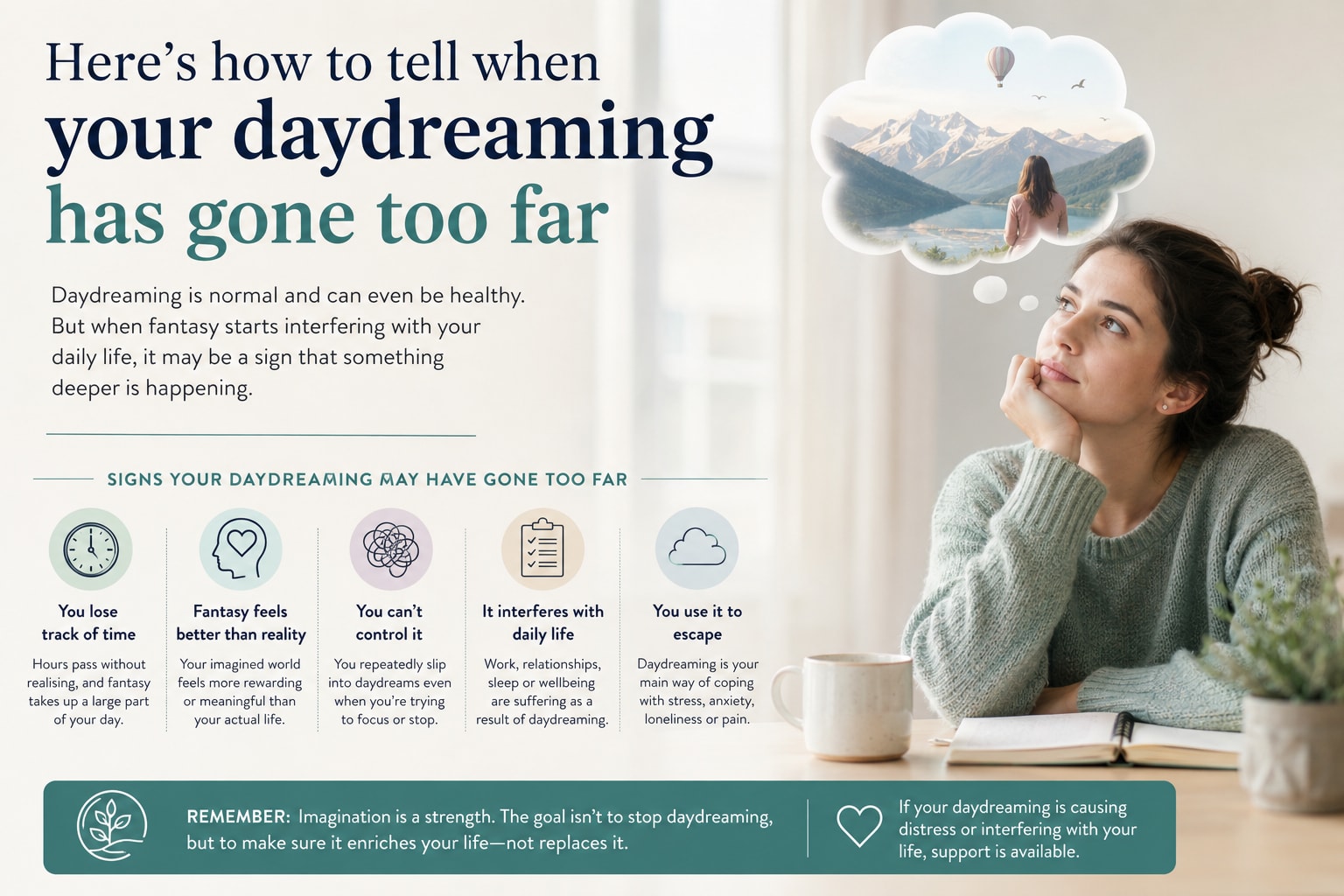
Healthy daydreaming tends to come and go naturally. It might occur while commuting, exercising, or completing repetitive tasks. Once something requires your attention, you can usually return your focus without difficulty.
A potential problem arises when daydreaming becomes your default mental state. You may find yourself spending hours immersed in imagined scenarios, repeatedly returning to the same fantasy worlds or narratives throughout the day.
If you regularly lose significant chunks of time because you are absorbed in fantasy, it may be worth paying attention.
When Fantasy Feels Better Than Reality
Many people use daydreams as a temporary escape from life's pressures. However, if your imagined world consistently feels more rewarding, meaningful, or exciting than your actual life, it can create difficulties.
You might begin to:
Withdraw from relationships
Avoid responsibilities
Neglect hobbies or interests
Delay important decisions
* Feel disappointed when returning to reality
Over time, fantasy can become a substitute for taking action in the real world. The more rewarding the daydream becomes, the harder it may feel to engage with everyday life.
When You Can't Control It
One key difference between healthy daydreaming and problematic daydreaming is control.
Can you choose when to engage in fantasy and when to stop?
Or do you find yourself repeatedly slipping into elaborate daydreams even when you are trying to concentrate?
Some individuals describe feeling almost compelled to continue their imagined scenarios, despite wanting to focus on work, study, or relationships. If your daydreaming feels automatic or difficult to control, it may be more than simple mind-wandering.
When It Interferes With Daily Life
The most important question is not how much you daydream, but whether it causes problems.
Consider whether your daydreaming affects:
Work or Academic Performance
Do you struggle to stay focused during meetings, lectures, or important tasks?
Relationships
Are you emotionally withdrawing from people around you because your fantasy life feels more satisfying?
Sleep
Do you stay awake for hours developing imaginary scenarios?
Emotional Wellbeing
Do you feel distressed, frustrated, or ashamed about the amount of time spent daydreaming?
If the answer to any of these questions is yes, your daydreaming may be having a significant impact on your wellbeing.
The Rise of Maladaptive Daydreaming
In recent years, psychologists have become increasingly interested in a phenomenon known as maladaptive daydreaming.
Although it is not currently recognised as an official psychiatric diagnosis, maladaptive daydreaming refers to excessive, immersive fantasy activity that disrupts everyday functioning.
People experiencing maladaptive daydreaming often report:
Highly detailed and complex fantasy worlds
Strong emotional involvement in imagined stories
Difficulty controlling or stopping daydreams
Spending several hours a day fantasising
* Using fantasy to cope with loneliness, anxiety, trauma, or stress
Many describe it as feeling similar to an addiction, where the urge to return to fantasy becomes difficult to resist.
What Is Your Daydreaming Trying to Tell You?
Rather than viewing excessive daydreaming as the problem itself, it can be helpful to ask what purpose it serves.
Daydreaming often meets important psychological needs.
For example, it may provide:
A sense of achievement when you feel stuck
Emotional connection when you feel lonely
Control when life feels uncertain
Comfort during periods of stress
* Escape from painful emotions
Understanding what your fantasy life provides can offer valuable clues about what may be missing or difficult in your waking life.
When to Seek Support
If your daydreaming is causing distress or interfering with your ability to function, speaking with a psychologist can help.
Therapy is not about eliminating imagination. Imagination is one of humanity's greatest strengths. Instead, therapy can help you understand why you are retreating into fantasy and develop healthier ways of meeting those underlying emotional needs.
The goal is not to stop daydreaming altogether, but to ensure that your imagination enriches your life rather than replacing it.
Daydreaming is a natural part of being human. It allows us to imagine possibilities, rehearse future challenges, and explore parts of ourselves that may not yet exist in reality.
But when fantasy becomes a place you feel compelled to live rather than visit, it may be worth asking why.
The healthiest imagination is not one that pulls us away from life—it is one that helps us engage with it more fully.