


When Your Brain Predicts Disaster
posted 5th June 2026
When Your Brain Predicts Disaster: Understanding Catastrophising
Imagine receiving a short text message from your partner.
"Can we talk later?"
Within seconds, your mind begins racing.
Perhaps they are upset with you. Maybe something terrible has happened. Perhaps your relationship is ending. Before long, you have mentally constructed an entire disaster scenario despite having very little information.
This process is known in psychology as catastrophising.
Catastrophising is one of the most common cognitive distortions identified within Cognitive Behavioural Therapy (CBT). It involves automatically assuming the worst possible outcome, often treating unlikely events as though they are highly probable.
Although everyone catastrophises occasionally, for some individuals it can become a persistent pattern that contributes significantly to anxiety, stress and emotional distress.
At The London Psychologist Clinic, many clients describe feeling trapped in cycles of catastrophic thinking. Understanding why this happens can be the first step towards regaining a greater sense of control.
What Is Catastrophising?
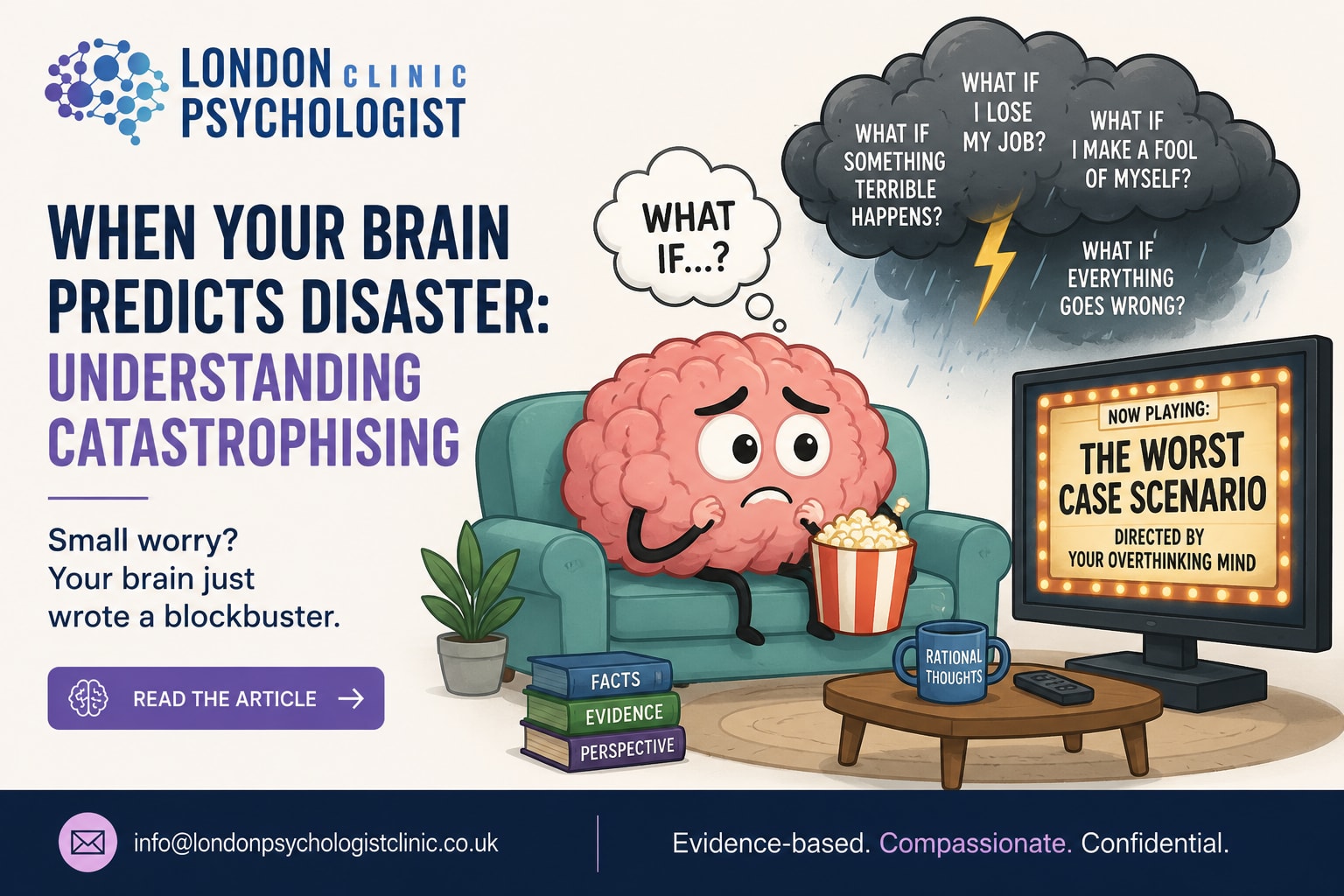
Catastrophising occurs when the mind jumps from uncertainty to disaster.
A minor problem becomes a major crisis.
A small setback becomes evidence of inevitable failure.
A physical symptom becomes a serious illness.
The key feature is not simply worrying about negative outcomes. Rather, it is overestimating both the likelihood and severity of those outcomes.
Examples might include:
- "If I make a mistake during this presentation, everyone will think I'm incompetent."
- "If my child is late home, something terrible must have happened."
- "If I don't get this job, my career is ruined."
- "This headache could be a brain tumour."
These thoughts often feel convincing because they are driven by emotion rather than evidence.
Why Does the Brain Catastrophise?
From an evolutionary perspective, the brain evolved to prioritise survival.
Our ancestors who detected threats quickly were more likely to stay alive.
As a result, the human brain developed what psychologists sometimes call a negativity bias.
Potential dangers often capture attention more easily than potential rewards.
The problem is that the same threat-detection system that once protected us from predators can become activated by modern concerns such as relationships, work, finances and health.
The brain begins treating uncertainty itself as a threat.
When information is incomplete, the mind often fills in the gaps with worst-case scenarios.
Catastrophising and Anxiety Disorders
Catastrophic thinking is strongly associated with anxiety disorders recognised within the DSM-5-TR.
Individuals experiencing Generalized Anxiety Disorder frequently report excessive worry across multiple areas of life, while those with Panic Disorder may catastrophically interpret normal bodily sensations as signs of imminent danger.
For example, a racing heart may be interpreted as a heart attack.
Mild dizziness may be interpreted as evidence of collapse.
The fear generated by these interpretations can intensify physical symptoms, creating a self-perpetuating cycle of anxiety.
The Link Between Catastrophising and Health Anxiety
Catastrophising is particularly common among individuals experiencing health anxiety.
The DSM-5-TR describes Illness Anxiety Disorder as involving excessive concern about having or developing a serious medical condition.
A minor symptom that most people would dismiss may trigger intense worry.
Individuals often find themselves repeatedly checking symptoms, seeking reassurance or searching online for explanations.
Unfortunately, these behaviours often reinforce rather than reduce anxiety.
Why Catastrophising Feels So Real
One of the most challenging aspects of catastrophising is that the brain responds to imagined threats as though they are real.
The body activates the stress response.
Heart rate increases.
Muscles tense.
Attention narrows.
The resulting physical sensations seem to confirm that danger exists.
In reality, the brain is reacting to a prediction rather than a fact.
How Therapy Can Help
Therapy can help individuals recognise and challenge catastrophic thinking patterns.
Cognitive Behavioural Therapy (CBT) is particularly effective because it focuses on identifying cognitive distortions and examining the evidence supporting anxious predictions.
Clients often learn to ask questions such as:
- What evidence supports this thought?
- What evidence contradicts it?
- What is the most realistic outcome?
- If the worst happened, how would I cope?
Over time, these skills help reduce the tendency to automatically assume disaster.
Catastrophising is not a sign of weakness or irrationality.
It reflects the brain's attempt to anticipate and avoid danger.
The difficulty arises when the threat-detection system becomes overly sensitive and begins interpreting uncertainty as catastrophe.
Learning to recognise catastrophic thinking can be remarkably empowering.
When we understand that our thoughts are predictions rather than facts, we gain the ability to respond with greater balance, perspective and emotional resilience.
The future may be uncertain, but uncertainty does not automatically mean disaster.
Click image to enlarge