


When the Fear of Being Sick
posted 25th August 2026
Emetophobia: When the Fear of Being Sick Begins to Control Your Life
Most people dislike being sick. The sensation of nausea is unpleasant, vomiting can be embarrassing, and nobody particularly wants to become ill in a restaurant, on a train or in front of other people.
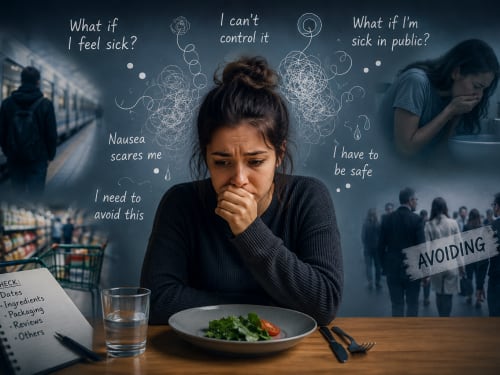
For someone experiencing emetophobia, however, this ordinary dislike can develop into something considerably more powerful. Emetophobia is an intense fear associated with vomiting. The person may fear vomiting themselves, seeing another person vomit, feeling nauseous, encountering somebody who appears unwell or being trapped somewhere from which they believe they could not easily escape if they became sick.
What makes emetophobia psychologically interesting is that the person's life can gradually become organised around preventing an event that may happen extremely rarely.
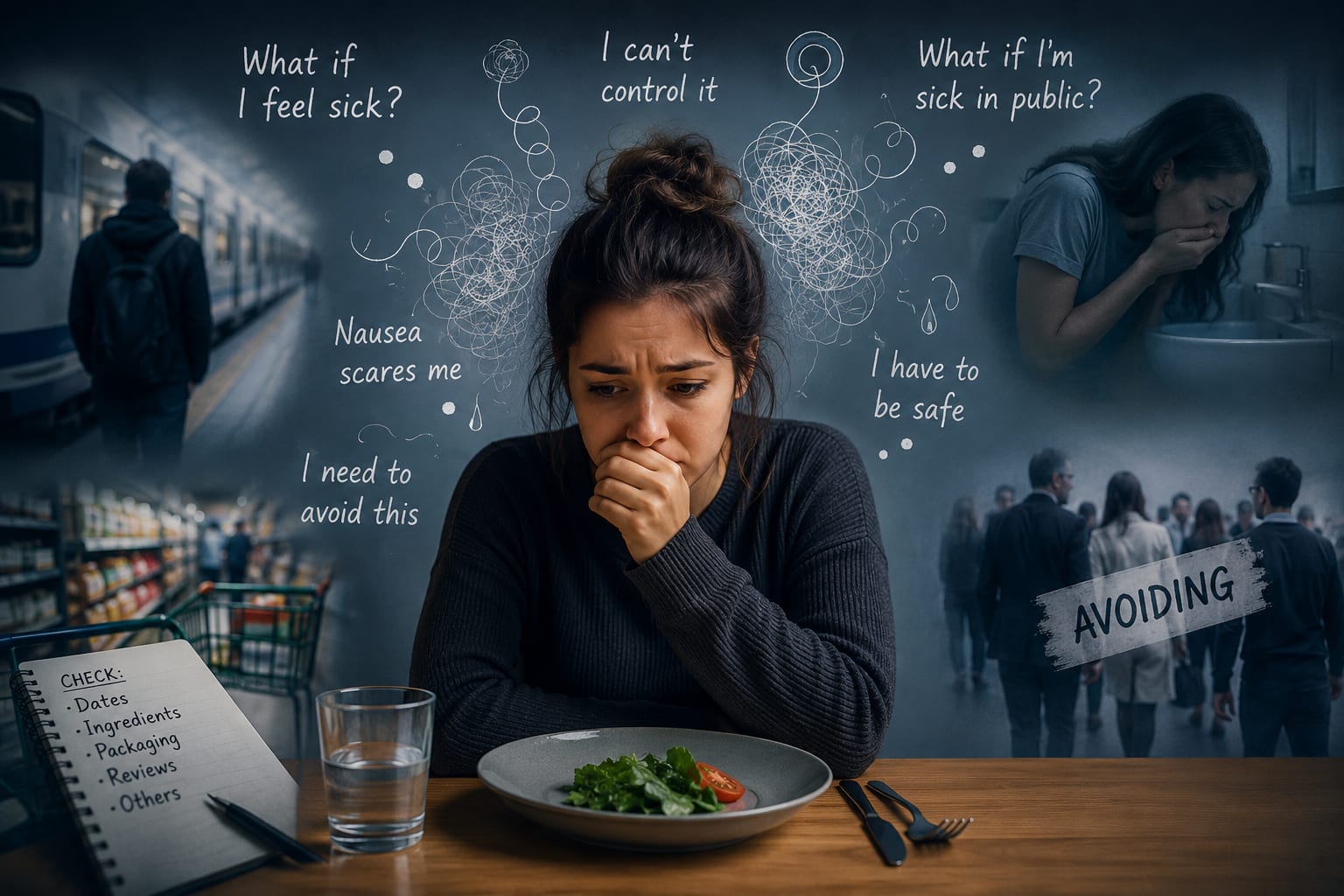
Someone may check food obsessively, avoid restaurants, stop drinking alcohol, avoid travelling, become frightened of hospitals, monitor other people's health or repeatedly analyse sensations in their stomach. Eventually, the fear of vomiting can become considerably more disruptive than vomiting itself.
Is Emetophobia Recognised in the DSM-5-TR?
Unlike cherophobia, emetophobia can fall within a recognised DSM-5-TR diagnostic category. Clinically significant fear of vomiting may be diagnosed under Specific Phobia, Other type, provided the broader diagnostic criteria for specific phobia are met.
These include a marked fear or anxiety concerning a particular object or situation, an immediate anxiety response, avoidance or endurance with significant distress, fear that is disproportionate to the actual danger, persistence typically lasting six months or longer and clinically significant interference with everyday functioning.
Importantly, diagnosis also requires consideration of whether another psychological difficulty provides a better explanation. Emetophobia can sometimes resemble Obsessive Compulsive Disorder (OCD), health anxiety, panic disorder, agoraphobia, social anxiety or an eating disorder.
This is one reason a detailed psychological assessment can be important.
How Does Someone Become Frightened of Vomiting?
There is unlikely to be one explanation that applies to everybody. Some people cannot remember ever not being frightened of vomiting. Others can identify an extraordinarily specific moment when everything changed.
Published clinical cases provide fascinating examples. One case involved an eight-year-old boy whose difficulties developed following a particularly distressing episode of vomiting. He subsequently became convinced that vomiting could be extremely dangerous and began restricting his food intake.
But there was another important element to his experience. The episode had also been embarrassing.
His fear therefore wasn't simply, “What if I vomit?” It also incorporated, “What will other people think if they see me?”
This distinction is psychologically important because what initially appears to be a simple fear of a physical event may actually contain several fears simultaneously — loss of control, humiliation, illness, contamination and even death.
When One Bad Experience Changes the Meaning of Nausea
Phobias can sometimes develop through a process of classical conditioning.
Imagine that somebody becomes violently sick after eating a particular meal. The experience is frightening, painful and unpredictable. Before that event, feeling full may simply have been an ordinary bodily sensation. Afterwards, feeling full can become associated with possible vomiting and therefore danger.
The body hasn't necessarily changed. The meaning attributed to the sensation has.
This was particularly apparent in the published childhood case. Following the vomiting episode, the boy began restricting the amount and types of food he ate. The authors conceptualised his fear as having become associated with eating and sensations of fullness.
Avoiding food then prevented him from discovering something important: eating normally does not inevitably result in vomiting.
The behaviour intended to protect him was inadvertently preventing the fear from being corrected.
The Fear Can Also Be Learned by Watching Someone Else
A person does not necessarily have to experience severe vomiting themselves to develop the fear.
In another published case series, a seven-year-old girl's intense fear reportedly began after her cousin vomited inside the family's vehicle. Afterwards, she became extremely alert to the possibility of other people being sick. At school she monitored whether anybody appeared unwell and could become extremely distressed if she discovered somebody was ill.
This illustrates another route through which phobias can develop: vicarious learning. The brain witnesses something frightening happening to another person and concludes, “I need to make sure that never happens around me.” The original incident may last minutes. The psychological consequences can last years.
Why Emetophobia Can Become So Powerful
One reason emetophobia can become particularly intrusive is that it concerns something that can never be completely controlled. Nobody can guarantee that they will never vomit. For someone who is uncomfortable with uncertainty, this can create an impossible psychological problem. They may therefore attempt to manufacture certainty through behaviour.
They might repeatedly check expiry dates, examine chicken to make absolutely certain it is cooked, avoid buffet food, ask other people whether they feel ill, wash their hands excessively or avoid children because children frequently develop stomach bugs.
Some people avoid drunk people because they might vomit. Others avoid aeroplanes, trains, cinemas or theatres because leaving quickly might be difficult.
Each precaution may appear reasonable when considered individually. Collectively, however, they can create a life increasingly governed by fear.
The Nausea Paradox
There is another particularly difficult component of emetophobia: anxiety itself can produce gastrointestinal sensations. Someone becomes frightened that they might feel sick. They begin monitoring their stomach. Their anxiety increases and the autonomic nervous system responds. Their stomach feels different, they notice the sensation and interpret it as evidence that they really are becoming sick. This can create a cycle of fear of nausea, bodily monitoring, anxiety, nausea sensations, catastrophic interpretation and even greater fear.
The person may conclude, “I knew I was going to be sick.”
Yet some of the sensations they are interpreting as evidence of illness may actually have been intensified by anxiety.
This does not mean the nausea is imaginary. The physical sensation can be entirely genuine. The psychological question concerns what is producing or amplifying it and how the sensation is subsequently interpreted.
When Food Becomes About Safety Rather Than Hunger
Some people with emetophobia begin changing how they eat. They may avoid particular foods they regard as dangerous, eat only at home, repeatedly check preparation dates or restrict how much they consume because feeling full resembles nausea.
Published cases describe young people whose avoidance became sufficiently extensive to cause weight loss, dehydration or substantial dietary restriction. This can create diagnostic confusion because the behaviour may initially resemble an eating disorder. The motivation, however, can be quite different. The person may not be thinking, “I don't want to gain weight.” Instead, they may be thinking, “If I don't eat very much, I won't be sick.”
Understanding the psychological function of the behaviour is therefore essential.
Why Reassurance Doesn't Always Work
Families understandably try to help. They might reassure the person that they are not going to be sick, that food is properly cooked or that nobody else is feeling ill.
The reassurance may immediately reduce anxiety. Unfortunately, repeated reassurance can sometimes become another safety behaviour.
The person begins to believe, “I can cope because somebody has confirmed that I'm safe,” rather than developing the belief, “I can tolerate not knowing with complete certainty whether I'm safe.”
This distinction is subtle but important.
The therapeutic objective is generally not to provide increasingly convincing guarantees that vomiting will never occur. No therapist can truthfully provide that guarantee.
Instead, therapy can help someone discover that uncertainty can be tolerated.
How Avoidance Keeps Emetophobia Alive
Avoidance is one of the most powerful mechanisms maintaining many phobias.
Imagine somebody who fears becoming sick on public transport. They stop taking trains and immediately their anxiety decreases. Their brain can therefore learn that trains represent danger and avoiding trains provides safety.
What they never discover is what would have happened had they taken the train.
Perhaps they would have felt anxious for twenty minutes. Perhaps they would have noticed their stomach. Perhaps the anxiety would then have gradually subsided. Perhaps they wouldn't have vomited at all.
Avoidance removes the opportunity for new learning.
Over time, the list of avoided situations can become longer. Trains become aeroplanes, restaurants, cinemas, parties, unfamiliar foods and eventually anywhere perceived as difficult to escape.
A person's geographical and social world can gradually become smaller without them consciously deciding that this should happen.
A Published Adult Case: When the World Becomes Smaller
One published case described a 46-year-old woman who had experienced a severe fear of vomiting for as long as she could remember.
She avoided seeing other people vomit — including her own children — because she feared that witnessing it would make her vomit too. Her avoidance extended to hospitals and particular television programmes and films.
Over time, her everyday world had become increasingly restricted.
This illustrates what makes severe phobias clinically important. The problem isn't simply how frightened somebody feels when confronted with the feared situation.
It is how much of their life they gradually surrender in order to ensure that confrontation never happens.
How CBT Can Help With Emetophobia
Cognitive Behavioural Therapy (CBT) can help identify the predictions, interpretations, avoidance patterns and safety behaviours maintaining the fear.
Someone might believe, “If I feel nauseous, I will definitely vomit.” Another person may believe, “If I vomit in public, everybody will be disgusted by me.” Someone else might think, “If somebody near me is sick, I will catch whatever they have.”
CBT examines these predictions rather than simply telling the person that they are irrational.
Treatment may also incorporate carefully planned exposure-based work. Exposure does not mean abruptly forcing somebody into their most frightening situation. It is generally approached collaboratively and progressively according to an individual formulation.
A fear hierarchy might begin with relatively manageable triggers and gradually progress towards more difficult situations. The person learns to remain with anxiety without automatically performing the behaviour they normally use to neutralise it.
The objective is not necessarily to think, “I must convince myself that I will never vomit.”
A more useful psychological shift can be: “I don't know whether I will ever vomit again, but I no longer need to organise my life around preventing it.”
What Published Cases Tell Us About Recovery
Clinical case reports provide encouraging examples.
In the case of the eight-year-old boy who had restricted his diet, treatment incorporated cognitive techniques, a fear hierarchy, gradual reintroduction of foods, exposure and parental involvement. His food intake and ability to eat publicly subsequently improved.
Another published case described a young woman initially referred with a suspected eating disorder who was subsequently conceptualised as experiencing emetophobia. Following a course of CBT-based psychotherapy, significant improvement in her core symptoms was reported, although some avoidance remained.
More recent published work has similarly described improvement following structured CBT incorporating cognitive restructuring, exposure, response prevention and work on attention and safety behaviours.
Case studies cannot tell us that every person will respond identically. They do, however, illustrate something clinically important: even longstanding avoidance patterns can change when the mechanisms maintaining them are identified and addressed.
How Talking Therapy May Help Us Understand the Fear
CBT can address the mechanisms maintaining emetophobia in the present, while broader talking therapy may also help some individuals understand the personal meaning attached to the fear.
For one person, vomiting may represent humiliation. For another, it represents contamination. For another, it represents loss of bodily control.
For somebody who grew up with an unpredictable or frighteningly ill parent, sickness might have acquired a much broader emotional meaning involving vulnerability or mortality. Someone who was mocked after being sick at school may primarily fear social humiliation. Another person may have watched a family member become seriously ill and subsequently developed heightened vigilance towards physical symptoms.
This is why two people can apparently have the same phobia while psychologically fearing quite different things. Good therapy therefore asks not only, “What are you frightened of?” but also, “What would it mean to you if the thing you fear actually happened?” The answer to the second question is often considerably more revealing.
When Avoiding Being Sick Means Avoiding Life
Perhaps the most striking aspect of emetophobia is how an understandable human instinct — avoiding something unpleasant — can gradually become an elaborate system of psychological protection.
The individual may believe that their precautions are preventing catastrophe. Yet those same precautions can eventually prevent restaurants, holidays, relationships, travel, spontaneous experiences and ordinary enjoyment. Treatment is therefore not about persuading someone that vomiting is pleasant. It isn't.
The therapeutic task is helping the person recognise that something can be unpleasant without needing to become psychologically intolerable. Recovery does not necessarily mean reaching a point where somebody no longer cares whether they are sick. It can mean reaching the much more realistic position: “I would strongly prefer not to be sick, but I trust myself to cope if it happens.” That apparently small change in psychological position can make an enormous difference to how freely somebody is able to live.
Psychological Therapy at London Psychologist Clinic
Emetophobia can affect eating, travelling, relationships, work, education and social activities, particularly when avoidance and reassurance-seeking begin to dominate everyday decisions.
CBT and talking therapies can help explore the beliefs, previous experiences, bodily sensations and avoidance behaviours associated with the fear. Treatment can be individually formulated, recognising that the apparent fear of vomiting may sometimes conceal deeper fears involving loss of control, embarrassment, contamination, vulnerability or uncertainty.
At London Psychologist Clinic, psychological therapy provides a confidential setting in which these patterns can be explored and gradually changed.
Click image to enlarge