


When Success Masks Struggle

posted 23rd June 2026
Click image to enlarge
High-Functioning Anxiety: The Hidden Cost of Success
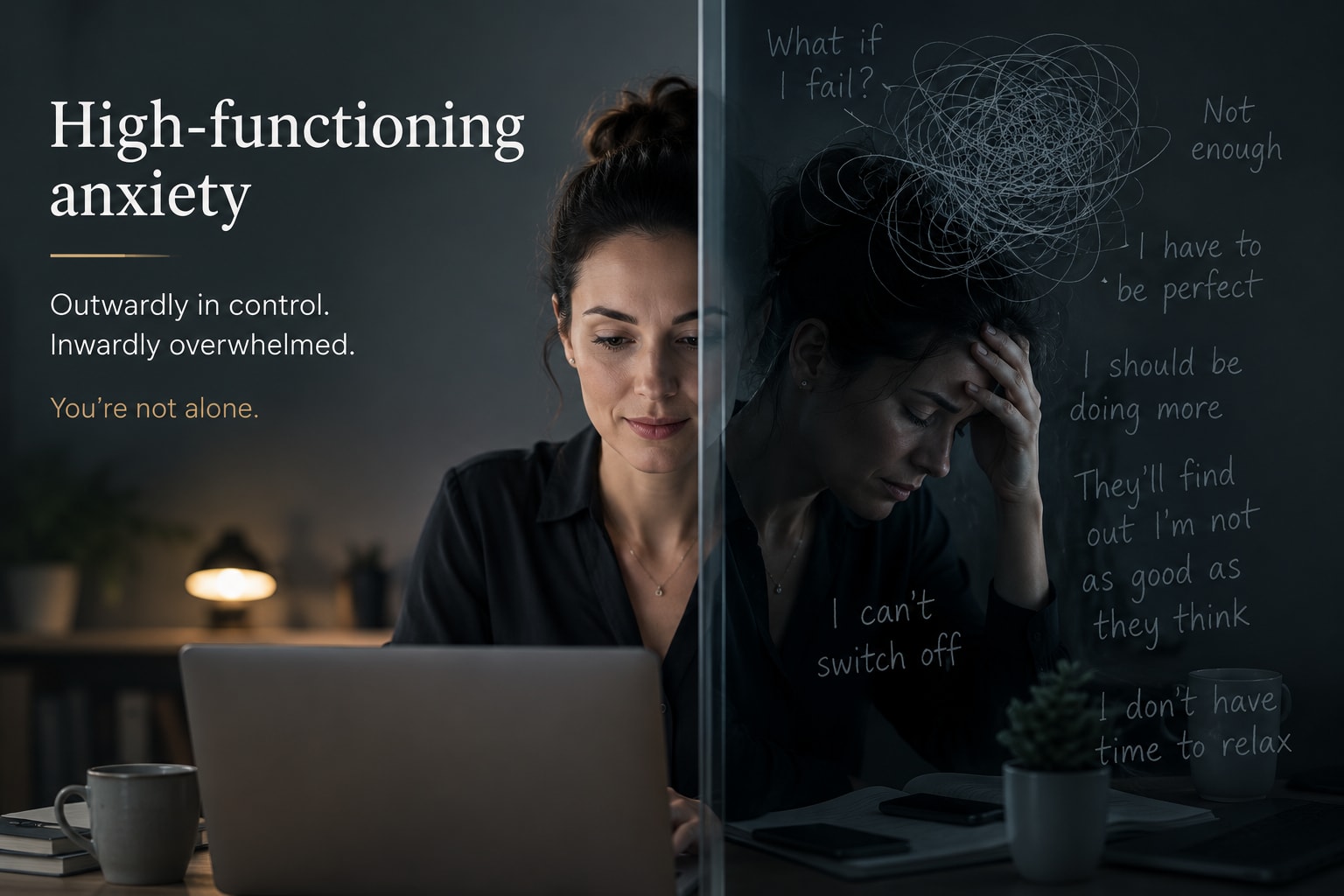
High-functioning anxiety is one of the most misunderstood presentations of psychological distress. Unlike the stereotypical image of anxiety, where an individual appears visibly overwhelmed or unable to cope, people experiencing high-functioning anxiety often appear highly competent, successful and productive. They meet deadlines, perform well professionally, maintain relationships and fulfil responsibilities. To colleagues, friends and family, they often seem resilient, organised and ambitious. Yet beneath this outward competence, many experience chronic worry, persistent self-doubt, emotional exhaustion and a relentless sense of pressure that rarely subsides.
Although high-functioning anxiety is not recognised as a formal diagnosis within the DSM-5-TR, it reflects a pattern of symptoms frequently associated with anxiety disorders, particularly Generalised Anxiety Disorder (GAD). The key difference is that the individual's level of functioning remains relatively intact. Indeed, in many cases anxiety becomes the very mechanism through which performance is maintained. The result is that anxiety is often overlooked because success masks suffering.
When Anxiety Becomes an Adaptive Strategy
From a psychological perspective, anxiety is not inherently problematic. Anxiety evolved as a survival mechanism designed to identify threats and prepare us to respond to potential danger. Activation of the sympathetic nervous system triggers physiological changes including increased heart rate, heightened vigilance and the release of stress hormones such as adrenaline and cortisol. In genuinely threatening situations, this response is adaptive.
The difficulty arises when the threat detection system becomes chronically activated. For individuals with high-functioning anxiety, the brain often interprets everyday situations as carrying significant consequences. A presentation becomes a potential source of humiliation. A minor mistake becomes evidence of incompetence. Delayed responses to emails are interpreted as signs of disapproval. As a result, the individual remains in a near-constant state of anticipatory anxiety.
Interestingly, this anxiety often leads to behaviours that are socially rewarded. Excessive preparation, meticulous attention to detail, perfectionism and overachievement may all contribute to professional success. Consequently, the individual begins to associate anxiety with competence. They may develop the belief that their achievements are only possible because they worry so much.
This creates a powerful psychological trap. While anxiety generates distress, it also appears to produce results. The individual becomes reluctant to let go of the anxiety for fear that performance will deteriorate.
The Role of Perfectionism
Perfectionism is one of the most significant psychological processes underlying high-functioning anxiety. Contemporary cognitive-behavioural models suggest that perfectionistic individuals base their self-worth upon the achievement of unrealistically high standards. Rather than viewing mistakes as a normal aspect of learning and growth, they interpret errors as evidence of personal inadequacy.
Research consistently demonstrates that maladaptive perfectionism is associated with increased levels of anxiety, depression, burnout and psychological distress. Perfectionists engage in what psychologists refer to as conditional self-worth, whereby self-esteem becomes contingent upon achievement and external validation.
As a result, accomplishments rarely produce lasting satisfaction. A successful presentation may generate temporary relief, but attention quickly shifts towards the next challenge. Positive feedback is discounted, while criticism is amplified. This pattern reflects a well-established cognitive bias whereby threatening information receives greater psychological weighting than positive information.
Over time, individuals become trapped in a cycle of striving without ever feeling genuinely successful.
Cognitive Distortions and Chronic Worry
One of the hallmarks of high-functioning anxiety is excessive cognitive activity. Many individuals describe an inability to "switch off" their minds. Even during periods of rest, they continue mentally rehearsing future scenarios, analysing past interactions or anticipating potential problems.
Cognitive Behavioural Therapy (CBT) identifies several cognitive distortions commonly associated with this pattern. Catastrophising involves assuming the worst possible outcome from uncertain situations. Mind reading occurs when individuals presume they know what others think about them, usually assuming negative evaluations. Intolerance of uncertainty, a key factor in Generalised Anxiety Disorder, leads individuals to experience significant discomfort whenever outcomes cannot be predicted or controlled.
These cognitive processes create a state of chronic hypervigilance. The individual remains psychologically prepared for threats that may never materialise. Although worry creates the illusion of control, research suggests that excessive worrying rarely improves problem-solving and often increases emotional distress.
The Neurobiology of High-Functioning Anxiety
Advances in neuroscience have provided valuable insight into the mechanisms underlying chronic anxiety. Neuroimaging studies suggest that anxiety involves increased activation of the amygdala, a brain structure involved in processing threat and emotional salience. Simultaneously, difficulties regulating emotional responses may involve interactions between the amygdala and regions of the prefrontal cortex responsible for executive functioning and emotional regulation.
When anxiety becomes chronic, the body's stress response remains activated for prolonged periods. Elevated cortisol levels have been associated with difficulties concentrating, sleep disturbances, irritability, fatigue and impaired emotional regulation. Over time, chronic stress can contribute to both psychological and physical health difficulties.
This helps explain why many individuals with high-functioning anxiety eventually reach a point of exhaustion. While they may continue functioning outwardly, maintaining that level of performance requires substantial psychological effort.
The Link Between Anxiety and Impostor Syndrome
High-functioning anxiety frequently coexists with Impostor Syndrome. Despite objective evidence of competence, individuals may attribute their achievements to luck, timing or external circumstances rather than ability. They fear being exposed as inadequate and often overcompensate through excessive preparation and overwork.
Psychologically, this reflects a pattern of attributional bias. Successes are attributed externally, while failures are internalised. Consequently, achievements fail to improve self-confidence because they are never accepted as evidence of competence.
This dynamic contributes to a cycle of chronic self-doubt. No matter how successful the individual becomes, anxiety continues to insist that they are not doing enough.
Why Burnout Often Follows
One of the greatest risks associated with high-functioning anxiety is burnout. Burnout is characterised by emotional exhaustion, depersonalisation and reduced feelings of accomplishment. While burnout is often discussed in occupational contexts, it reflects a broader depletion of psychological resources.
Individuals with high-functioning anxiety frequently ignore early warning signs. They continue pushing themselves despite fatigue, dismiss stress as normal and prioritise productivity over recovery. Because others often perceive them as coping well, they may receive little encouragement to slow down.
By the time support is sought, the individual may already be experiencing significant emotional, cognitive and physical exhaustion.
Treatment and Recovery
The goal of therapy is not to eliminate ambition, motivation or achievement. Rather, therapy seeks to help individuals develop a healthier relationship with success, uncertainty and self-worth.
Evidence-based approaches such as Cognitive Behavioural Therapy, Acceptance and Commitment Therapy (ACT) and Compassion-Focused Therapy (CFT) have demonstrated effectiveness in addressing anxiety-related difficulties. These approaches help individuals identify unhelpful thinking patterns, develop greater psychological flexibility and cultivate self-compassion.
One of the most important therapeutic shifts involves helping individuals recognise that anxiety is not the source of their success. Their intelligence, skills, experience, perseverance and values contribute far more to achievement than chronic worry ever could.
Many people fear that reducing anxiety will reduce performance. In practice, the opposite is often true. When psychological resources are no longer consumed by excessive worry and self-criticism, individuals frequently experience greater creativity, clearer thinking, improved relationships and more sustainable performance.
Moving Beyond Survival Mode
Perhaps the defining feature of high-functioning anxiety is that it often looks successful from the outside. The individual continues to achieve, produce and perform. Yet psychological wellbeing involves far more than functioning.
A person can be productive and distressed.
Successful and exhausted.
Admired and deeply self-critical.
The challenge is not simply learning how to perform better. It is learning how to live without the constant burden of proving one's worth.
True psychological health is not measured by how much you can carry before breaking. It is measured by your ability to pursue meaningful goals while maintaining self-compassion, emotional balance and a sense of worth that exists independently of achievement.
For many individuals, recovery begins with a simple but powerful realisation: anxiety may have accompanied their success, but it was never the reason for it.