


When Life Feels Flat
posted 27th January 2026
When Life Is “Good” but You Feel Empty
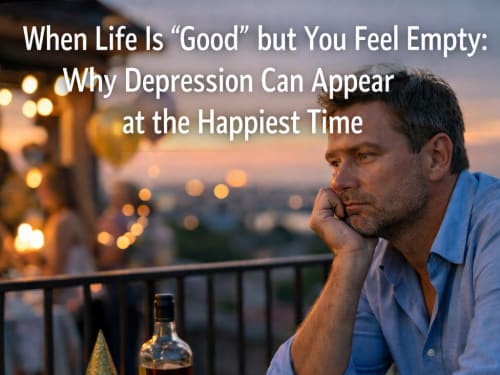
One of the most confusing experiences people describe in therapy is feeling low at a point in life when, on paper, everything looks right. There are no obvious pressures. Work is stable. Relationships may be secure. There’s a sense of having arrived at a “good place.” And yet, seemingly out of nowhere, enjoyment fades. Energy drops. Life begins to feel flat, heavy, and strangely unrewarding.
People often struggle to make sense of this because it clashes so strongly with expectation. There is a belief that happiness should automatically follow stability or success. When it doesn’t, people tend to turn the confusion inward, asking themselves why they feel ungrateful, lazy, or broken. Psychologically, however, this experience is neither rare nor meaningless.
A key feature many people are actually describing is anhedonia — the reduced ability to experience pleasure. Anhedonia is not about sadness or despair; it is about the loss of emotional reward. Things that once felt exciting, comforting, or fun no longer land in the same way. Socialising feels effortful. Going out, drinking, celebrating, or even relaxing no longer brings the expected lift. This symptom is central to several recognised mood disorders and is explicitly referenced in the DSM-5-TR, particularly in relation to Major Depressive Disorder. Importantly, this means depression does not always look like feeling low — it often looks like feeling nothing at all.
One reason this experience can emerge during periods of calm or success relates to how the brain’s reward system works. Much of modern motivation is driven by dopamine, a neurotransmitter that responds more strongly to anticipation and pursuit than to arrival. During long periods of striving — building a career, overcoming adversity, managing constant pressure — the brain becomes accustomed to operating in a high-alert, high-reward mode. When that pressure suddenly eases, the dopamine-driven sense of momentum can disappear. What follows is not relief, but emptiness. People describe feeling strangely unmotivated or bored, even though nothing is “wrong.”
This can feel particularly stark for people who have achieved external success. Reaching the top often means losing the sense of movement, challenge, or novelty that once made life feel alive. At the same time, success can subtly change social dynamics. People may notice increased distance, comparison, or even resentment from others. Small, repeated tensions — minor arguments, irritability, feeling scrutinised or judged — can quietly drain emotional energy. These experiences rarely feel significant enough to name as stress, but psychologically they accumulate. Over time, they contribute to fatigue, emotional blunting, and reduced capacity for enjoyment.
For some individuals, this shift coincides with ageing or midlife transitions. Activities that once revolved around intensity, stimulation, or escapism no longer provide the same reward. Alcohol, nights out, or constant social activity lose their appeal, but nothing meaningful has yet taken their place. This is not simply “getting older,” nor is it a personal failing. It reflects a deeper psychological transition, where pleasure increasingly depends on purpose, connection, and coherence rather than stimulation alone. When identity and meaning lag behind this shift, people can feel lost, disengaged, or quietly depressed.
Many people first assume something physical must be wrong. They describe a sense of “life lethargy” — not illness, but a persistent heaviness, lack of enthusiasm, and mental fatigue. Medical checks often come back normal, which can add to the confusion. Yet psychological lethargy is a well-recognised phenomenon. Chronic low-grade stress, unresolved emotional strain, and reward-system depletion can all produce profound tiredness without a clear physical cause.
What makes this form of depression particularly difficult is that it doesn’t come with an obvious trigger. There is no single event to point to, no clear reason to justify how someone feels. That lack of explanation often delays people seeking help. They tell themselves they should be coping better, enjoying more, feeling happier. In reality, mood disorders are not determined by circumstance alone. External stability does not protect against internal dysregulation.
Clinically, these experiences may sit within Major Depressive Disorder, Persistent Depressive Disorder, or Adjustment Disorder following a significant life transition — including positive ones. They may also fall just below diagnostic thresholds while still causing real distress. From a psychological perspective, the label matters less than understanding what the experience is communicating.
Therapy in these situations is not about forcing positivity or cultivating gratitude. It is about understanding how the nervous system has adapted, what has been lost along the way, and how pleasure, meaning, and vitality can be rebuilt in ways that are sustainable rather than driven by pressure or escape.
Depression does not always arrive with chaos. Sometimes it arrives when life finally becomes quiet. When it does, it is not a sign of failure — it is a signal that something important needs attention.