


When “Healthy Eating” Becomes Unhealthy
posted 17th April 2026
Click to enlarge
Orthorexia Nervosa: When “Healthy Eating” Becomes Unhealthy
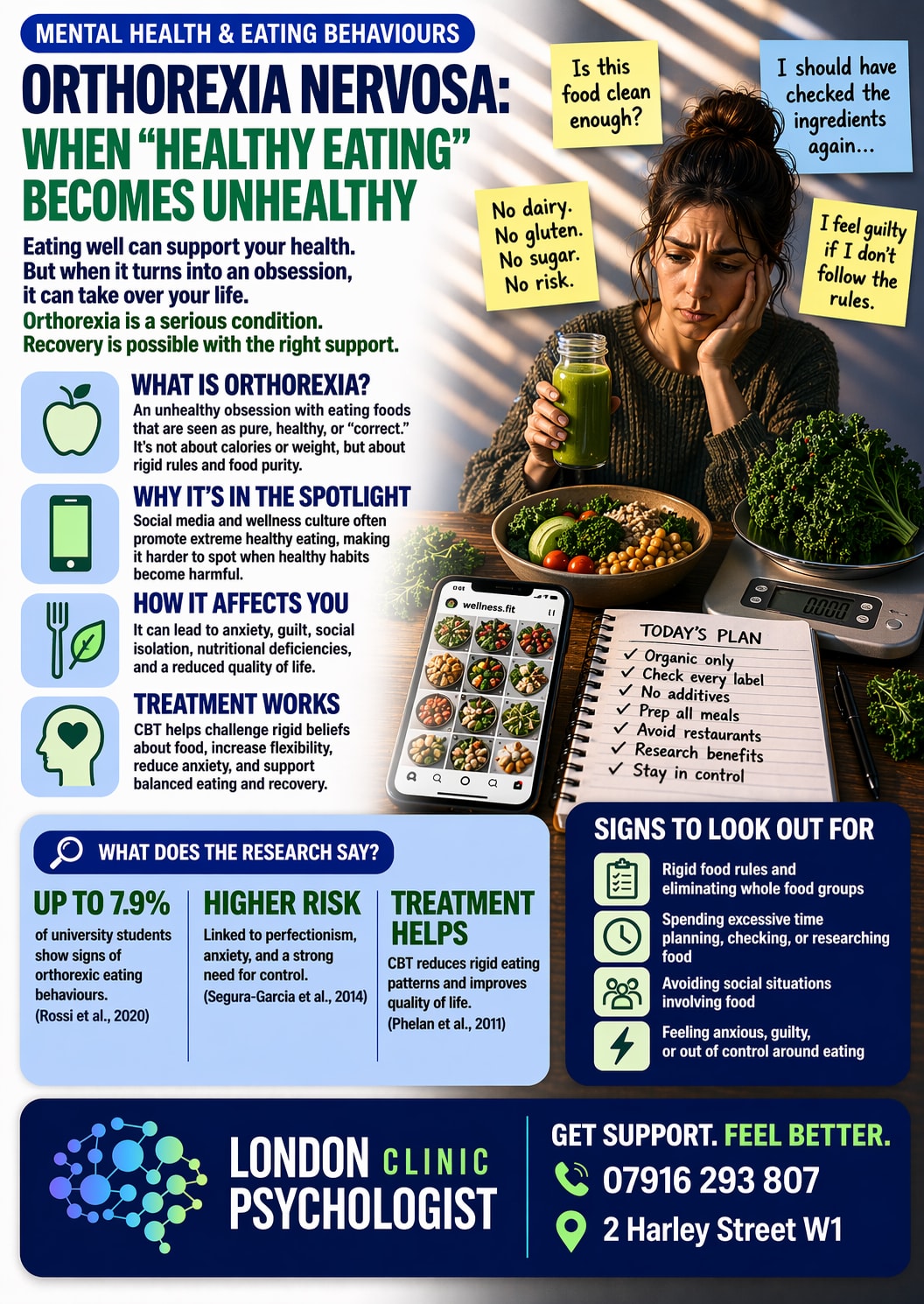
In recent years, there has been a marked increase in public interest surrounding diet, wellness, and “clean eating,” driven largely by social media, fitness culture, and the proliferation of nutritional advice online. Within this context, a more niche but clinically significant issue has emerged: orthorexia nervosa. Although not formally recognised as a distinct diagnosis in the DSM-5, orthorexia refers to an unhealthy obsession with eating foods perceived as pure, healthy, or “correct.” Increasingly discussed in both clinical literature and mainstream media, orthorexia highlights the complex boundary between adaptive health behaviours and pathological fixation.
At its core, orthorexia is characterised not by the quantity of food consumed, but by the quality and perceived purity of food. Individuals may become preoccupied with rigid dietary rules, eliminating entire food groups, and experiencing significant distress when these self-imposed standards are not met. What often begins as an intention to improve health can gradually evolve into restrictive patterns that mirror aspects of eating disorders, including nutritional deficiencies, social isolation, and impaired functioning.
Psychologically, orthorexia shares features with both eating disorders and obsessive-compulsive spectrum conditions. Cognitive-behavioural formulations suggest that individuals develop rigid beliefs about food and health, often linked to a desire for control, certainty, or self-optimisation. These beliefs are reinforced through behavioural rituals—such as excessive label checking, meal planning, or avoidance of “unclean” foods—which temporarily reduce anxiety but ultimately maintain the cycle. Over time, self-worth may become increasingly tied to adherence to dietary rules, leading to guilt, shame, or anxiety when these standards are violated.
The rise of orthorexia cannot be understood without considering the sociocultural environment. Social media platforms frequently promote idealised lifestyles centred around wellness, discipline, and dietary perfection. Influencers and online communities often present restrictive eating patterns as aspirational, blurring the line between health-conscious behaviour and disordered eating. This normalisation can make orthorexia particularly difficult to identify, both for individuals themselves and for clinicians, as behaviours may be socially reinforced rather than challenged.
Although research into orthorexia is still developing, emerging evidence suggests that it is associated with anxiety, perfectionism, and a heightened need for control. It may also co-occur with other eating disorders, particularly anorexia nervosa, or evolve into more severe restrictive patterns over time. Importantly, individuals with orthorexia may not perceive their behaviour as problematic, as it is often aligned with socially valued goals such as health, discipline, and self-improvement.
Treatment approaches for orthorexia draw on established evidence-based interventions for eating disorders and obsessive-compulsive presentations. Cognitive Behavioural Therapy (CBT) is particularly effective in addressing the underlying beliefs and behaviours that maintain the condition. Therapy focuses on increasing flexibility in eating patterns, challenging rigid rules about food, and reducing anxiety associated with perceived dietary “imperfections.” Exposure-based techniques may be used to help individuals gradually reintroduce avoided foods and reduce reliance on compulsive behaviours.
Psychoeducation is also a key component of treatment, helping individuals develop a more balanced and evidence-based understanding of nutrition. In many cases, collaboration with a dietitian is beneficial to support nutritional rehabilitation and address misconceptions about food. As with other eating-related conditions, treatment should be individualised, taking into account the person’s psychological profile, motivation for change, and any co-occurring difficulties.
In conclusion, orthorexia nervosa represents a nuanced and increasingly relevant clinical issue within contemporary health culture. While the pursuit of healthy eating is generally encouraged, it can become maladaptive when driven by rigidity, anxiety, and self-worth contingencies. For psychology clinics, recognising the signs of orthorexia and providing early, evidence-based intervention is essential. Addressing this condition requires not only individual therapeutic work but also a broader awareness of the cultural narratives that shape our relationship with food, health, and control.