


What is psychological flexibility?
posted 29th June 2026
Click image to enlarge
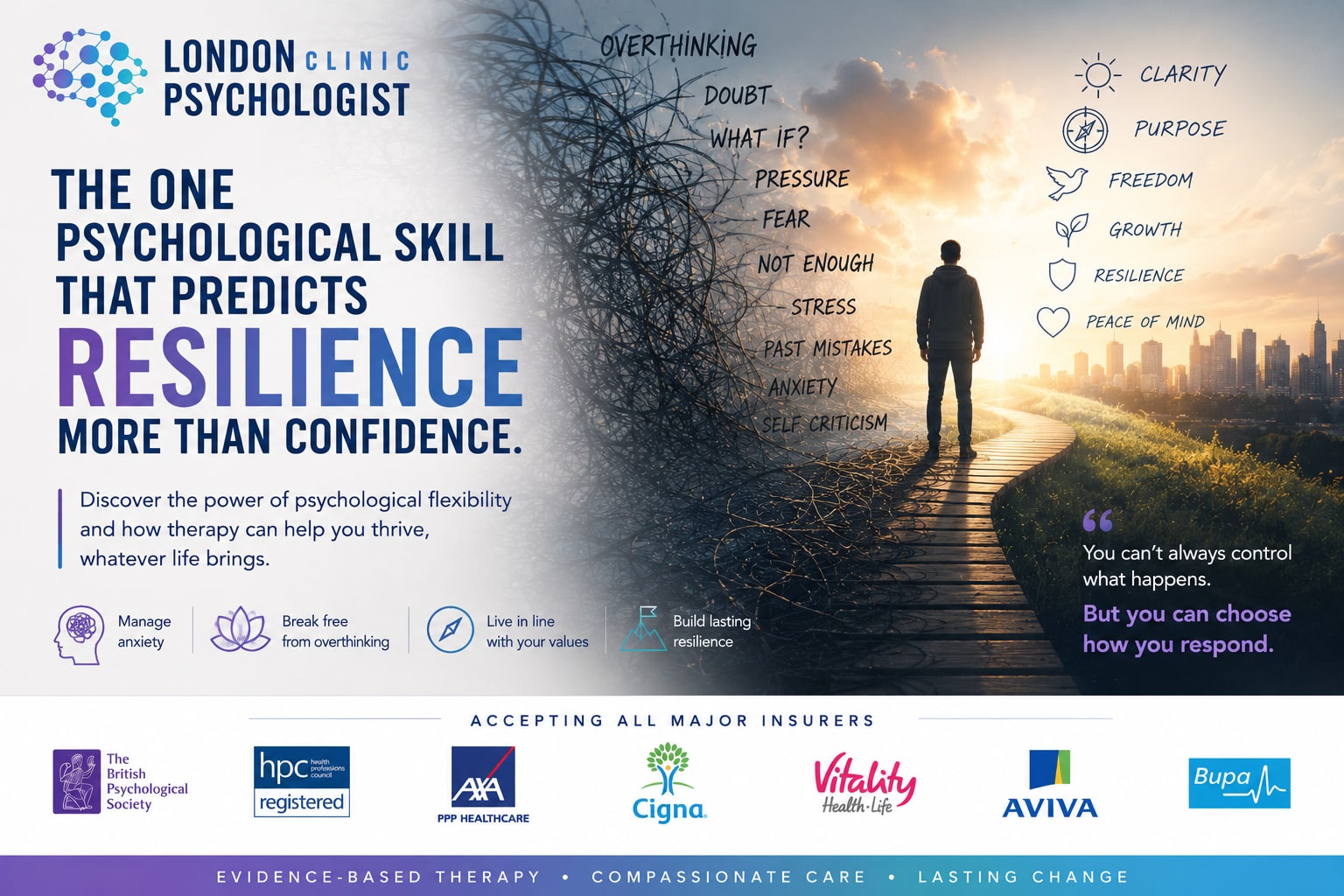
The One Psychological Skill That Predicts Resilience More Than Confidence
Most people believe that mentally strong individuals possess extraordinary confidence, endless motivation or an unusually positive outlook on life. Surprisingly, decades of psychological research suggest something quite different. One of the strongest predictors of long-term psychological wellbeing is not confidence at all—it is psychological flexibility.
Psychological flexibility refers to our ability to remain present, adapt to changing circumstances and continue acting according to our values, even when experiencing uncomfortable thoughts or emotions. Rather than trying to eliminate anxiety, sadness or self-doubt, psychologically flexible people learn how to carry these emotions without allowing them to dictate every decision they make.
This concept has become central to modern clinical psychology. Over the past two decades, researchers have consistently found that psychological flexibility predicts lower levels of depression, anxiety, stress and burnout while being associated with higher life satisfaction, healthier relationships and greater occupational performance. A comprehensive meta-analysis involving over 33,000 participants found that greater psychological flexibility was consistently associated with better mental health across numerous clinical and non-clinical populations.
Many people assume resilience means not feeling upset. In reality, resilient individuals often experience the same emotions as everyone else. The difference lies in their response. Rather than becoming trapped in endless attempts to control or suppress difficult emotions, they acknowledge them, make sense of them and continue pursuing what matters most.
One of the most influential demonstrations of this came from the work of psychologist Professor Steven C. Hayes, the founder of Acceptance and Commitment Therapy (ACT). Hayes proposed that much psychological suffering arises not from painful emotions themselves but from our struggle to avoid, suppress or control them. Ironically, the harder we fight unwanted thoughts, the more dominant they often become.
A famous psychological experiment illustrates this perfectly. In 1987, social psychologist Professor Daniel Wegner asked participants to avoid thinking about a white bear. The result was the opposite of what most expected. Participants thought about white bears significantly more often than those given no such instruction. This phenomenon became known as the White Bear Effect and remains one of psychology's most compelling demonstrations that attempting to suppress thoughts often increases their frequency.
The same principle can be observed clinically. Individuals experiencing health anxiety often repeatedly check their bodies for signs of illness. People with obsessive-compulsive disorder may perform rituals to reduce uncertainty. Those struggling with panic attacks frequently avoid situations where symptoms might occur. Although these strategies provide temporary relief, they often strengthen the underlying anxiety over time.
Psychological flexibility encourages a different approach. Instead of asking, "How can I stop feeling anxious?", therapy helps individuals ask, "How can I live the life I want even if anxiety is present?" This subtle shift fundamentally changes the relationship people have with their emotions.
Importantly, psychological flexibility is not about ignoring distress or pretending everything is fine. It also does not mean tolerating unhealthy relationships or remaining in harmful situations. Rather, it involves recognising which experiences can be changed and which must first be accepted before meaningful action becomes possible.
Although psychological flexibility itself is not listed as a diagnosis within the Diagnostic and Statistical Manual of Mental Disorders (DSM-5-TR), difficulties adapting to emotional experiences are recognised across many psychological disorders. Depression, anxiety disorders, obsessive-compulsive disorder, trauma-related disorders and personality disorders often involve rigid patterns of thinking, behavioural avoidance and emotional inflexibility. Increasing flexibility therefore becomes an important therapeutic goal across many evidence-based psychological treatments.
One particularly striking area of research concerns chronic pain. Studies have shown that individuals who develop greater psychological flexibility frequently report improved quality of life even when their physical pain remains unchanged. Rather than eliminating discomfort, therapy changes how people respond to it, allowing them to re-engage with valued activities that had gradually disappeared from their lives.
The same principle applies in everyday life. A difficult conversation, an uncertain career decision or the end of a relationship inevitably brings emotional discomfort. People who insist on waiting until they feel completely confident before taking action often remain stuck. Those with greater psychological flexibility accept uncertainty as part of life and continue moving towards personally meaningful goals.
At The London Psychologist Clinic, we frequently help individuals who feel trapped by overthinking, perfectionism, anxiety or repeated life patterns. Therapy is not simply about reducing symptoms—it is about developing the psychological flexibility to respond differently when life becomes challenging. As flexibility increases, people often discover that resilience is not the absence of emotional pain but the ability to continue living well despite it.
Ultimately, mental health is not determined by whether we experience fear, sadness or uncertainty. It is shaped by how flexibly we respond when those experiences inevitably arise. The most resilient people are rarely those who avoid emotional discomfort. They are those who have learned that emotions are experiences to understand—not commands that must always be obeyed.
References
- American Psychiatric Association (2022). Diagnostic and Statistical Manual of Mental Disorders (5th ed., Text Revision). DSM-5-TR.
- Hayes, S. C., Strosahl, K. D., & Wilson, K. G. (2012). Acceptance and Commitment Therapy: The Process and Practice of Mindful Change.
- Kashdan, T. B., & Rottenberg, J. (2010). Psychological flexibility as a fundamental aspect of health. Clinical Psychology Review, 30(7), 865–878.
- Gloster, A. T., et al. (2020). Meta-analysis examining psychological flexibility and mental health outcomes across more than 33,000 participants.
- Wegner, D. M. (1987). Paradoxical Effects of Thought Suppression.