


What is Mindfulness?
posted 7th April 2026
Mindfulness for Anxiety and Generalised Anxiety Disorder: A Balanced Clinical Perspective
Mindfulness has become an increasingly prominent feature in psychological treatment for anxiety, particularly within interventions for Generalised Anxiety Disorder (GAD). It is often presented as a simple yet powerful technique for managing worry and emotional distress. In clinical settings, structured approaches such as Mindfulness-Based Stress Reduction (MBSR) and Mindfulness-Based Cognitive Therapy (MBCT) are now routinely integrated into evidence-based care. However, while mindfulness is supported by a growing body of research, the evidence suggests a more nuanced reality than is often portrayed. It can be highly effective for some individuals, but it is not universally beneficial, nor is it a standalone solution.
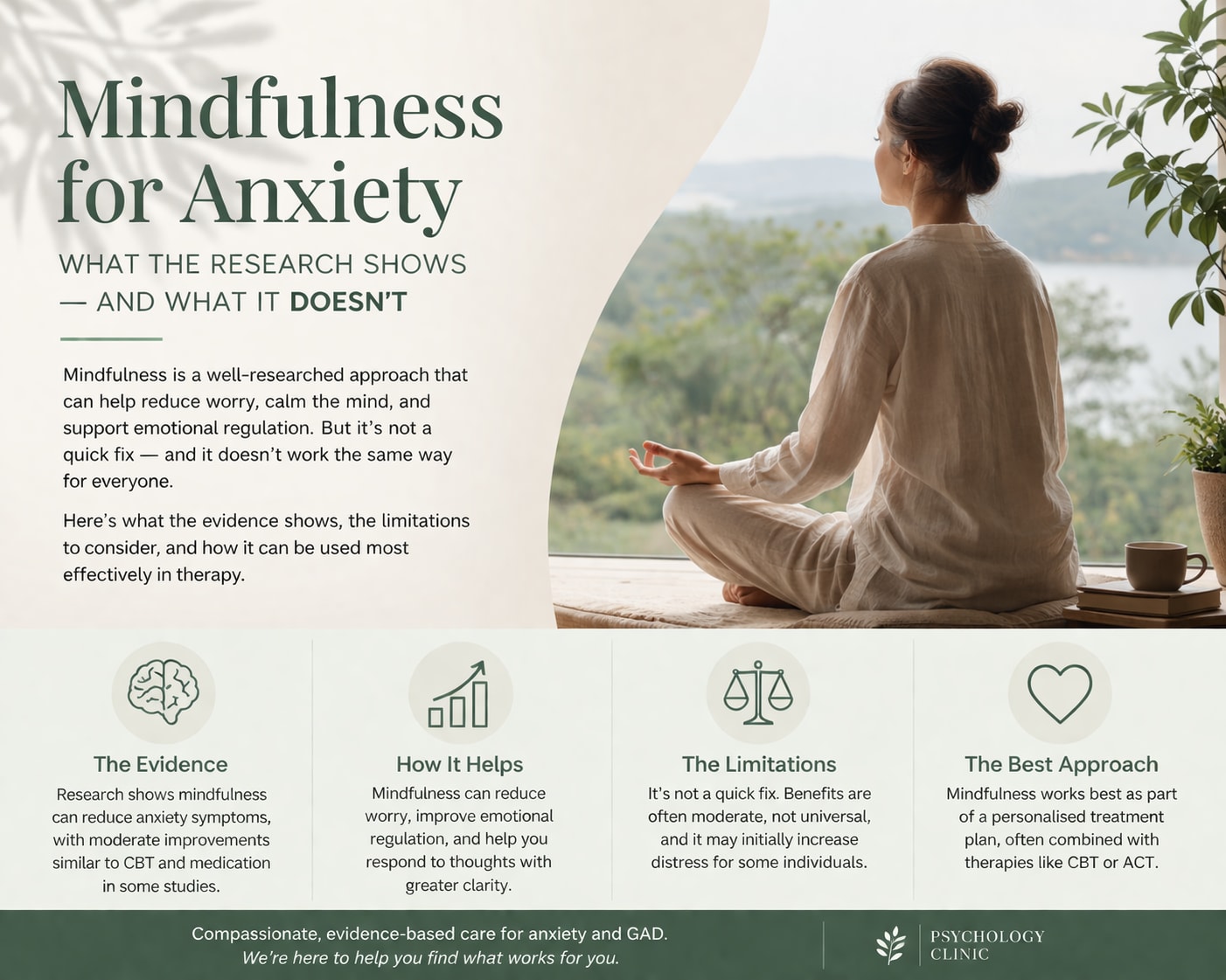
A substantial research literature supports the use of mindfulness-based interventions for anxiety. Meta-analyses of randomised controlled trials consistently show that mindfulness produces statistically significant reductions in anxiety symptoms, with effect sizes typically in the moderate range. For example, a large meta-analysis by Hofmann et al. (2010) found that mindfulness-based therapy had a moderate effect on anxiety, comparable in magnitude to established psychological treatments in some contexts. More recent systematic reviews have replicated these findings across both clinical and non-clinical populations, suggesting that mindfulness can reliably reduce symptoms of worry, stress, and emotional reactivity.
Research specifically focused on GAD has also produced encouraging results. Hoge et al. (2013), in a randomised controlled trial, found that individuals with GAD who completed an eight-week MBSR programme showed significant reductions in anxiety symptoms and improved stress reactivity compared to control groups. In a more recent large-scale clinical trial, mindfulness training was directly compared to pharmacological treatment, with results indicating that both approaches produced roughly a 30% reduction in anxiety symptoms. These findings suggest that mindfulness can be a clinically meaningful intervention, even when compared with established medical treatments.
From a psychological perspective, the effectiveness of mindfulness appears to lie in its impact on core processes that maintain anxiety. Individuals with GAD often experience persistent, uncontrollable worry driven by an intolerance of uncertainty and a tendency to become cognitively entangled with their thoughts. Mindfulness works by altering this relationship to internal experience. Rather than attempting to suppress or resolve anxious thoughts, individuals are encouraged to observe them as transient mental events. This process reduces what is often referred to as cognitive fusion, allowing thoughts to be experienced with greater distance and less emotional impact. At the same time, mindfulness strengthens attentional control, enabling individuals to disengage from repetitive worry cycles and return to the present moment.
Neuroscientific research provides further support for these mechanisms. Studies have shown that mindfulness practice is associated with changes in brain regions involved in emotional regulation, including reduced activity in the amygdala and increased engagement of prefrontal regulatory networks. These changes are consistent with improved stress tolerance and reduced reactivity to perceived threats, both of which are central to the experience of anxiety.
Despite these promising findings, it is important to adopt a critical perspective. While average outcomes in research studies are positive, there is considerable variability in individual response. Not all individuals benefit from mindfulness to the same extent, and some experience little improvement. Meta-analytic research highlights this heterogeneity, indicating that while group-level effects are significant, they do not translate uniformly at the individual level.
One important limitation is that the effects of mindfulness, while meaningful, are typically moderate rather than transformative. This distinction is clinically important, as mindfulness is sometimes presented in popular discourse as a rapid or comprehensive solution to anxiety. In practice, it is more accurately understood as one component of a broader therapeutic approach. Furthermore, some comparative studies suggest that mindfulness is not consistently superior to other active interventions, such as relaxation training or behavioural strategies, raising questions about whether its effects are unique or partly attributable to common therapeutic factors.
Methodological issues within the research literature also warrant consideration. Studies vary significantly in terms of intervention quality, duration, and participant characteristics, and there is evidence of publication bias favouring positive outcomes. Additionally, adherence can be a challenge. Mindfulness requires sustained and consistent practice, and dropout rates in clinical trials suggest that some individuals find it difficult to engage with or maintain over time.
For certain individuals, particularly those with high levels of anxiety, mindfulness can initially increase distress. By encouraging greater awareness of internal experiences, it may bring attention to thoughts and bodily sensations that individuals have previously avoided. Without appropriate guidance, this can feel overwhelming and may lead to disengagement from the practice.
In clinical settings, mindfulness appears to be most effective when delivered within a structured, supportive framework and combined with other evidence-based approaches such as cognitive behavioural therapy or acceptance and commitment therapy. It is best understood not as a quick technique, but as a skill that develops over time, requiring both practice and psychological insight.
Ultimately, mindfulness represents a valuable and well-supported intervention for anxiety and GAD, but one that must be applied with care and clinical judgement. For some individuals, it can significantly reduce worry, improve emotional regulation, and foster a greater sense of psychological flexibility. For others, alternative or complementary approaches may be more appropriate. The role of a psychologist is to assess these individual differences and develop a tailored treatment plan that reflects both the evidence base and the specific needs of the client.