


What is GAD?
posted 24th April 2026
Generalised Anxiety Disorder (GAD): Understanding, Causes, and Evidence-Based Treatment with CBT
Generalised Anxiety Disorder (GAD) is one of the most common and often misunderstood conditions within the anxiety spectrum. In clinical practice, it is rarely about “just worrying too much.” Instead, it reflects a persistent, pervasive pattern of anxiety that can significantly impair daily functioning, relationships, and overall wellbeing. At The London Psychologist Clinic, we often see individuals who have been living with GAD for years before seeking support—frequently normalising their symptoms as part of their personality rather than recognising them as treatable.
What is GAD? (DSM-5 Perspective)
According to the DSM-5 (Diagnostic and Statistical Manual of Mental Disorders, Fifth Edition), GAD is characterised by excessive, uncontrollable worry occurring more days than not for at least six months, across multiple domains such as work, health, finances, or relationships.
This worry is not only persistent but also disproportionate to the actual likelihood or impact of feared events. Individuals typically experience associated symptoms such as restlessness, fatigue, difficulty concentrating, irritability, muscle tension, and sleep disturbance.
Importantly, GAD sits within a broader spectrum of anxiety disorders in the DSM-5, which includes conditions such as panic disorder, social anxiety disorder, and specific phobias. These disorders share overlapping mechanisms—particularly heightened threat sensitivity and cognitive bias—but differ in how anxiety is triggered and maintained.
GAD is distinct because the anxiety is diffuse and future-oriented, rather than tied to a specific situation or stimulus. This makes it especially chronic and difficult to “switch off.”
What Causes GAD?
There is no single cause of GAD. Instead, it develops through a combination of biological, psychological, and environmental factors.
From a psychological perspective, GAD is strongly linked to cognitive processes such as intolerance of uncertainty, excessive threat appraisal, and worry as a coping strategy. Many individuals come to rely on worry as a way of feeling prepared or in control, even though it ultimately maintains anxiety.
Biologically, there is evidence of genetic vulnerability and dysregulation in brain systems involved in fear and emotional regulation, particularly within the amygdala and prefrontal cortex.
Environmentally, early life experiences—such as unpredictable caregiving, chronic stress, or high expectations—can shape beliefs like “the world is unsafe” or “I must always be prepared for the worst.”
GAD often co-occurs with depression, reinforcing the idea that it lies within a broader internalising disorder spectrum, rather than existing in isolation.
Can GAD Be Cured?
This is one of the most common questions we hear. The answer is nuanced.
GAD is typically considered a chronic but highly treatable condition. Rather than a simple “cure,” treatment aims to significantly reduce symptoms, improve functioning, and change the underlying processes that maintain anxiety.
Encouragingly, long-term research shows that 57–77% of individuals can be classified as recovered several years after Cognitive Behavioural Therapy (CBT).
This suggests that while vulnerability to anxiety may remain, individuals can develop the tools to manage it effectively and sustainably.
What is CBT?
Cognitive Behavioural Therapy (CBT) is the gold-standard psychological treatment for GAD and is widely recommended in clinical guidelines.
At its core, CBT is based on a simple but powerful principle:
our thoughts, feelings, and behaviours are interconnected.
In GAD, this often looks like:
Thoughts: “Something bad is going to happen”
Feelings: Anxiety, tension
Behaviours: Avoidance, reassurance-seeking, overthinking
CBT works by helping individuals identify and change these patterns.
How CBT Treats GAD
CBT for GAD is structured, collaborative, and evidence-based. It typically involves several key components:
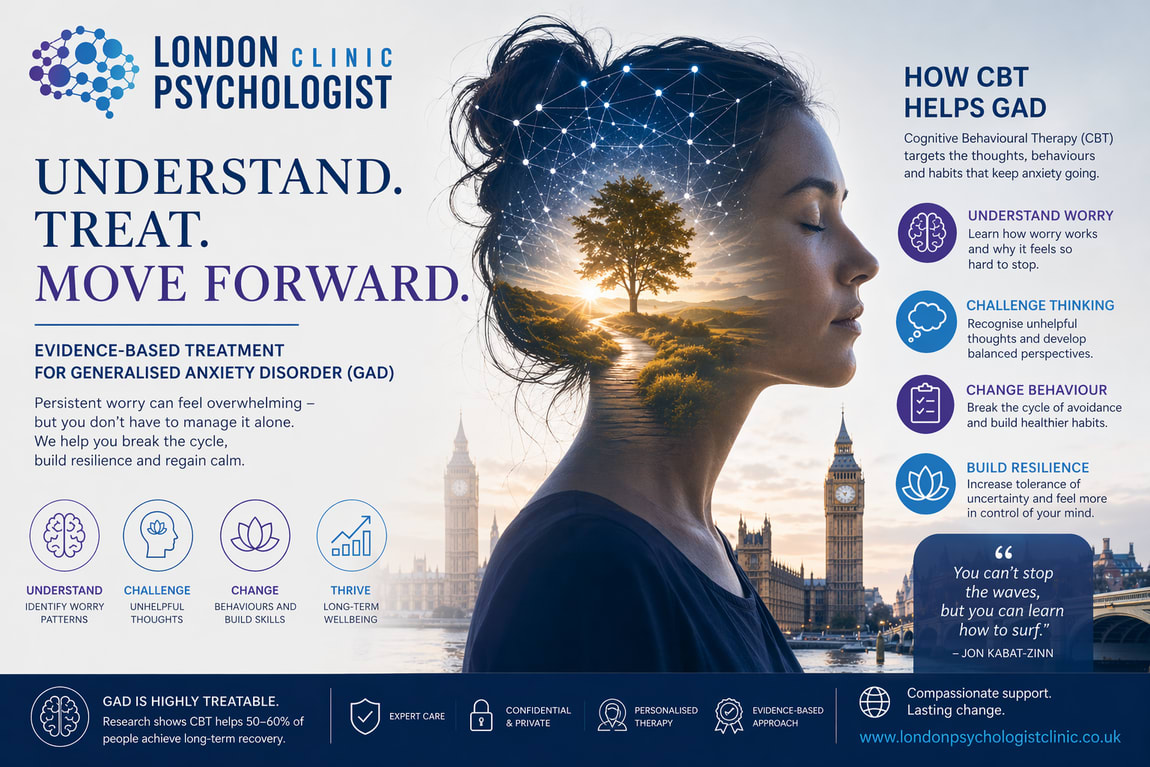
1. Understanding Worry
Clients learn how worry functions—not as a solution, but as a maintaining factor. Many discover that worry creates an illusion of control while actually increasing anxiety.
2. Cognitive Restructuring
This involves identifying and challenging unhelpful thinking patterns, such as catastrophising or overestimating risk. Over time, clients develop more balanced and realistic thinking.
3. Behavioural Experiments
Rather than avoiding feared situations, CBT encourages gradual exposure to uncertainty. This helps disconfirm feared outcomes and builds confidence.
4. Reducing Safety Behaviours
Behaviours like constant checking, reassurance-seeking, or over-preparing are addressed, as they unintentionally reinforce anxiety.
5. Tolerance of Uncertainty
A central focus in GAD treatment is helping individuals become more comfortable with uncertainty—one of the core drivers of chronic worry.
Emerging research also highlights newer “third-wave” CBT approaches (such as Acceptance and Commitment Therapy), which focus on changing one’s relationship to thoughts, rather than their content.
How Effective is CBT for GAD?
The evidence is clear: CBT is one of the most effective treatments available for GAD.
It is consistently identified as a first-line treatment in major meta-analyses.
Studies show significant reductions in anxiety symptoms across diverse populations.
Around 50–60% of individuals show meaningful improvement, with many achieving long-term recovery.
Gains are often maintained years after treatment, indicating lasting change.
Even newer delivery formats—such as digital or app-based CBT—have shown promising results, increasing accessibility while maintaining effectiveness.
Generalised Anxiety Disorder can feel overwhelming, particularly because it infiltrates so many areas of life. However, it is also one of the most understandable and treatable conditions when approached through the right psychological framework.
CBT does not simply aim to reduce anxiety in the moment—it helps individuals fundamentally change how they relate to uncertainty, worry, and perceived threat. This is why its effects are often long-lasting.
At The London Psychologist Clinic, our approach is grounded in evidence-based practice while remaining deeply personalised. If you recognise yourself in the patterns described above, it may not be “just how you are”—it may be something that can meaningfully change with the right support.