


What Does ACA Mean?
posted 17th September 2026
Click image to enlarge
Adult Children of Alcoholics: What Does ACA Actually Mean?
ACA, sometimes written as ACoA, commonly means Adult Children of Alcoholics. It may also refer to Adult Children of Alcoholics and Dysfunctional Families, an international twelve-step fellowship for people who believe that experiences within their family of origin continue to affect their adult lives.
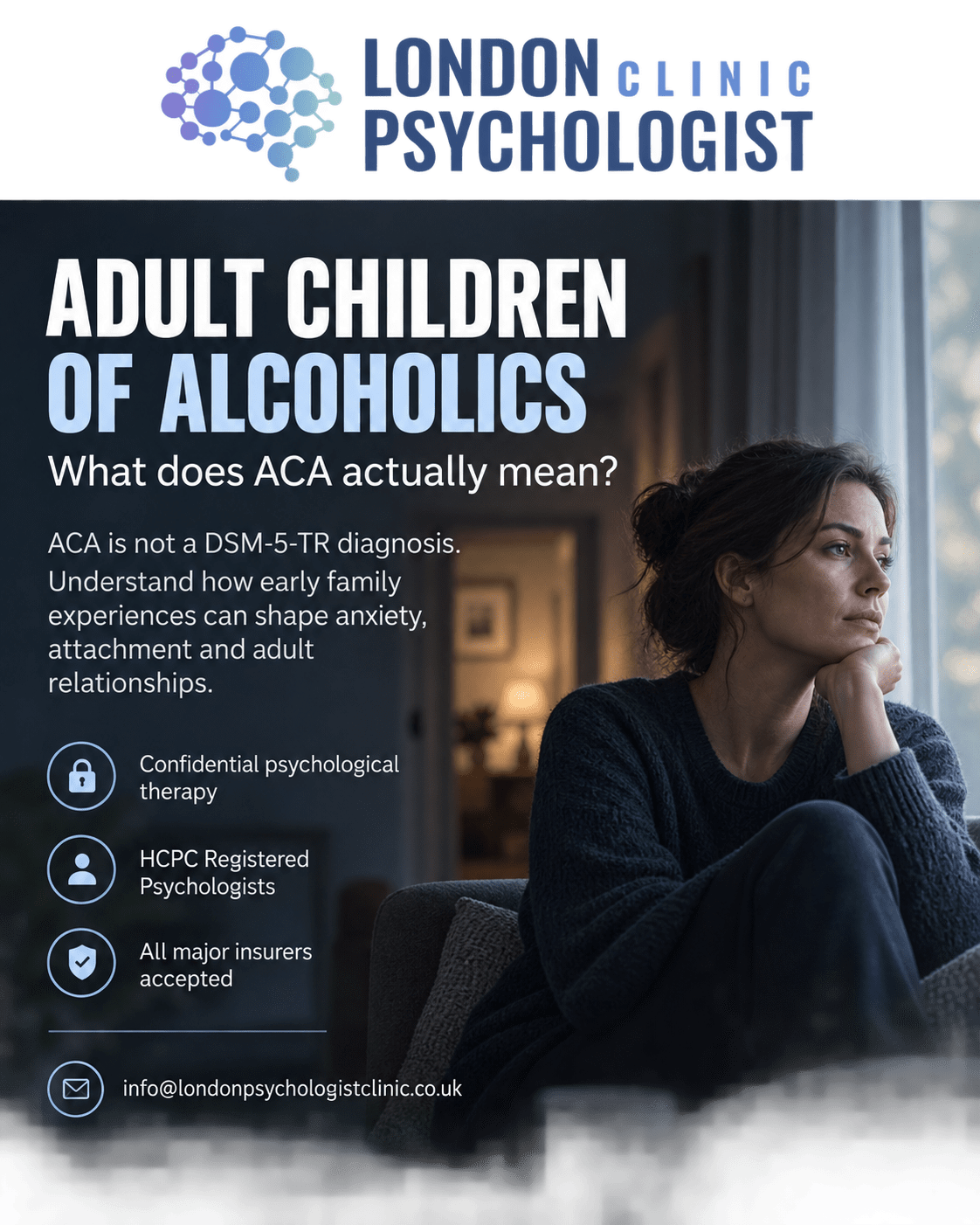
The phrase can be validating. It gives people language for experiences that may previously have felt confusing, private or difficult to explain. However, ACA is not a psychological diagnosis, and “adult child” is not a clinical disorder recognised by the DSM-5-TR.
The term should therefore be understood as a descriptive or recovery-community concept rather than an explanation for every difficulty a person experiences. A psychological assessment looks beyond the label to understand the individual’s developmental history, current symptoms, relationships, coping strategies and wider psychological functioning.
What Does “Adult Child” Mean?
The expression does not imply that the person is immature or psychologically still a child. It describes an adult who grew up with parental alcohol misuse or significant family dysfunction and who may continue to carry adaptations developed within that environment.
These adaptations often made sense during childhood. A child living with unpredictability, emotional volatility or inconsistent caregiving may learn to monitor other people’s moods, minimise their own needs or take responsibility for keeping the household stable. Such strategies can provide some protection at the time but become restrictive when carried into adult relationships.
For example, a child who learned that conflict was dangerous may become an adult who avoids disagreement, accommodates other people excessively or experiences intense anxiety when someone appears displeased. Another child may cope by becoming highly organised, self-reliant and achievement-focused. As an adult, this can appear successful while concealing chronic tension, perfectionism and difficulty accepting support.
ACA literature sometimes describes common characteristics known as the “Laundry List”. These include people-pleasing, fear of authority, excessive responsibility, difficulty identifying feelings and remaining in unhealthy relationships. Although some people strongly recognise themselves in these descriptions, *these characteristics are not DSM-5-TR diagnostic criteria*. They are also not unique to adults raised around alcohol misuse.
- Alcoholism Is Not the Current Diagnostic Term
The DSM-5-TR uses the diagnosis *Alcohol Use Disorder*, rather than dividing difficulties into “alcohol abuse” and “alcohol dependence”. Alcohol Use Disorder describes a problematic pattern of alcohol use associated with clinically significant impairment or distress. Depending on the number of diagnostic criteria present, it may be classified as mild, moderate or severe.
The language of “alcoholism” remains widely used socially and within recovery fellowships, but it is not the current DSM-5-TR diagnostic term.
Importantly, a parent does not need to have received a formal diagnosis for their alcohol use to have affected family life. Children may be influenced by intoxication, arguments, unexplained absences, financial instability, emotional unavailability, inconsistent routines or the pressure to conceal what happens at home.
The psychological effect is not determined only by how much the parent drank. It also depends on what the child experienced around the drinking, the availability of another reliable caregiver, the child’s temperament, wider family relationships and the presence of protective adults.
Is ACA a DSM-5-TR Diagnosis?
No. Adult Children of Alcoholics is not a diagnosis in the DSM-5-TR.
Identifying with ACA does not automatically mean that someone has post-traumatic stress disorder, a personality disorder or any other mental disorder. It indicates a particular developmental history that may be relevant to a broader psychological formulation.
Some adults who grew up with parental alcohol misuse meet the criteria for a recognised psychological disorder. Others experience significant relational or emotional difficulties without meeting the full criteria for any diagnosis. Some remain psychologically well and do not experience continuing problems.
Depending on the individual, a psychologist might consider whether the person is experiencing:
- *Anxiety disorders*, including generalised anxiety, panic or persistent anticipatory worry.
- *Depressive disorders*, particularly where longstanding shame, helplessness or low self-worth are present.
- *Post-traumatic stress disorder*, but only when the person’s experiences and symptoms meet the specific DSM-5-TR criteria.
- *Alcohol or other substance-use disorders*, as risk can be influenced by both genetic vulnerability and environmental learning.
- *Attachment and relationship difficulties*, including fear of rejection, emotional avoidance, mistrust or excessive dependence.
- *Problems with emotional regulation*, such as difficulty identifying, tolerating or expressing feelings.
- *Maladaptive personality traits or schemas*, which may affect self-image, boundaries and interpersonal functioning.
- *Relational problems or the effects of psychological trauma and neglect*, which may be clinically important even when no mental disorder is diagnosed.
Growing up around alcohol misuse can be considered an *adverse childhood experience*, but an adverse experience is not itself a diagnosis. It is a potential developmental risk factor whose meaning and effect vary between individuals.
Why Can the Effects Continue Into Adulthood?
Children depend on caregivers for safety, emotional regulation and the development of a stable sense of self. When caregiving is inconsistent or frightening, the child’s nervous system may become organised around anticipation and threat.
This may produce *hypervigilance*: continuous monitoring of facial expressions, tone of voice or subtle changes in the emotional atmosphere. In adulthood, the person may remain highly sensitive to signs that somebody is angry, withdrawing or becoming unpredictable.
Some children become *parentified*, meaning that they assume emotional or practical responsibilities beyond what would normally be expected for their age. They may comfort a distressed parent, care for siblings, manage household tasks or attempt to prevent conflict. As adults, they can feel responsible for everyone while experiencing guilt when attending to their own needs.
Emotional neglect may also interfere with the development of *affect identification and regulation*. If feelings were dismissed, mocked or overshadowed by the parent’s difficulties, the child may learn to suppress them. As an adult, the person may know that something feels wrong but struggle to identify whether they feel angry, frightened, disappointed or ashamed.
Within cognitive psychology, these experiences may contribute to enduring *core beliefs* such as:
- “My needs create problems.”
- “I must remain in control.”
- “Other people cannot be relied upon.”
- “If somebody is upset, it must be my fault.”
- “I am only valuable when I am useful.”
These beliefs can influence attention, interpretation and behaviour. They may be maintained through avoidance, reassurance-seeking, perfectionism, emotional suppression or repeatedly entering relationships in which familiar roles are recreated.
- The Importance of Not Overusing the ACA Label
ACA can provide recognition and community, but it can become misleading if it is treated as a complete clinical explanation.
Difficulties commonly associated with ACA are *transdiagnostic*. This means that they occur across many psychological conditions and developmental histories. Hypervigilance, for example, can occur in PTSD, anxiety disorders, attachment insecurity and chronic stress. People-pleasing may reflect fear of rejection, low self-esteem, learned family roles or interpersonal schemas.
Not everyone raised by a parent with Alcohol Use Disorder develops the same characteristics. Siblings within the same household can be affected very differently. Genetic factors, temperament, birth order, social support, relationships outside the family and the timing of events may all influence the outcome.
It is therefore important not to transform a helpful description into a fixed identity. The aim is not to conclude, “I am an ACA, so this is simply who I am.” A more psychologically useful question is: *“What happened, what did I learn to do in response, and which of those adaptations are still affecting my life?”*
A Composite Clinical Example
Consider an adult who seeks therapy because she feels anxious in relationships and becomes distressed when her partner is quiet. She describes herself as “too sensitive” and believes that she must resolve disagreements immediately.
During assessment, she explains that her father regularly drank heavily. As a child, she learned to study his expression when he returned home because his mood determined whether the evening would be peaceful or volatile. She attempted to keep everyone calm and felt responsible when arguments occurred.
In adult life, a partner’s silence activates the same threat-monitoring system. She experiences physiological arousal, assumes she has done something wrong and tries urgently to restore harmony.
“ACA” may offer a useful starting point, but it does not constitute the psychological formulation. Therapy would examine the interaction between early unpredictability, hypervigilance, responsibility beliefs, attachment insecurity and present-day safety behaviours.
How Can a Psychologist Help?
A psychologist begins with an individual assessment rather than assuming that every person from an alcohol-affected family has the same difficulties.
The assessment may explore developmental experiences, attachment relationships, traumatic events, current symptoms, alcohol use, emotional regulation, interpersonal functioning and protective factors. A psychological formulation can then identify *predisposing, precipitating, perpetuating and protective factors*.
*Cognitive behavioural therapy* may help identify automatic thoughts, core beliefs and safety behaviours that continue to maintain anxiety, shame or excessive responsibility. Behavioural experiments can allow the person to test predictions such as, “If I say no, the relationship will end,” or, “If another person is unhappy, I must immediately fix it.”
*Psychodynamic psychotherapy* may explore how early relationships have shaped internal expectations of other people. Therapy can identify unconscious repetitions, defensive strategies and relational roles that are being recreated in the present. The therapeutic relationship itself can provide an opportunity to understand fears concerning dependence, criticism, closeness and abandonment.
*Attachment-informed work* can help the person develop a more coherent understanding of how early caregiving affected emotional security and adult intimacy. The aim is not to blame parents simplistically, but to recognise the conditions in which particular coping strategies developed.
*Compassion-focused interventions* may be particularly useful where the individual experiences chronic shame, self-criticism or difficulty responding to their own distress. Therapy can support the development of an internal voice that is less punitive and more emotionally containing.
Where clinically indicated, psychologists may also work directly with traumatic memories, dissociation, avoidance and heightened arousal. However, trauma-focused treatment should follow an appropriate assessment. Growing up with parental alcohol misuse does not automatically establish a diagnosis of PTSD.
Therapy may additionally focus on recognising emotions, setting boundaries, communicating needs, tolerating interpersonal uncertainty and distinguishing care for another person from responsibility for that person.
Is an ACA Support Group the Same as Therapy?
No. ACA is a peer-led twelve-step fellowship rather than a psychological treatment or diagnostic service.
Some people find fellowship meetings valuable because they reduce isolation and provide contact with others who recognise similar family experiences. Others may prefer individual psychotherapy, group psychotherapy or a combination of professional treatment and peer support.
A psychologist can help someone consider whether a particular group is supportive and appropriate for them. Identification with a recovery community can be helpful, but it should not replace clinical assessment where there are symptoms of depression, trauma, substance misuse, self-harm, severe anxiety or significant impairment.
Recovery Does Not Require Rejecting Your Family
Psychological work is not necessarily about labelling a parent as bad or permanently defining oneself through childhood adversity. Alcohol Use Disorder is a complex condition, and many parents affected by it have their own histories of trauma, loss or psychological difficulty.
Understanding context does not mean denying harm. Therapy creates space to recognise both complexity and impact: a parent may have suffered themselves, and the child may still have been frightened, neglected or required to carry responsibilities that were not developmentally appropriate.
Recovery involves developing greater freedom in the present. This may mean establishing boundaries, reducing automatic guilt, forming safer relationships, tolerating emotional closeness and recognising that another person’s feelings are not always one’s responsibility.
When Might Psychological Support Be Helpful?
It may be helpful to speak with a psychologist if experiences within your family of origin appear to be affecting your current emotional wellbeing, relationships or use of alcohol.
You do not need to identify with the ACA label or meet the criteria for a psychiatric diagnosis before seeking support. Psychological therapy can help clarify whether current difficulties are best understood in terms of anxiety, depression, trauma, attachment, emotional neglect, substance use, relational patterns or a combination of these factors.
*The most important point is that ACA is a descriptive term, not a diagnosis.* It can offer useful language and community, but effective psychological work requires a broader and more individualised understanding of the person.
At *London Psychologist Clinic*, our psychologists can provide confidential assessment and psychological therapy for adults affected by difficult family relationships, parental alcohol misuse, anxiety, trauma and recurring interpersonal patterns.
References and Further Information
[American Psychiatric Association: Alcohol Use Disorder](https://www.psychiatry.org/patients-families/alcohol-use-disorder)
[National Institute on Alcohol Abuse and Alcoholism: Parental Alcohol Consumption and Consequences in Youth](https://www.niaaa.nih.gov/alcohols-effects-health/alcohol-topics/alcohol-facts-and-statistics/parental-alcohol-consumption-and-consequences-in-youth)
[Centers for Disease Control and Prevention: Adverse Childhood Experiences](https://www.cdc.gov/aces/about/index.html)
[Adult Children of Alcoholics and Dysfunctional Families](https://adultchildren.org/what-is-aca/)
This article provides general information and is not a substitute for an individual psychological assessment, diagnosis or treatment.