

What Do Drugs Really Do to the Brain?
posted 18th May 2026
Click image to enlarge
What Do Drugs Really Do to the Brain?
For many people, drug use begins as a way to escape, cope, relax, feel confident, feel connected, or simply feel different. Some substances temporarily reduce anxiety, numb emotional pain, increase energy, or create feelings of pleasure and emotional intensity. In the short term, drugs can appear to “work.” That is part of what makes them psychologically powerful.
What is discussed far less openly is how long-term drug use gradually changes the brain itself — affecting emotion, memory, motivation, stress responses, identity, relationships, and mental health. Over time, substances that once felt helpful can begin reshaping the nervous system in ways that leave people feeling emotionally disconnected, anxious, paranoid, depressed, impulsive, or psychologically overwhelmed.
Importantly, modern psychology no longer views addiction simply as a moral failing or lack of willpower. Research increasingly understands substance misuse as a complex interaction between brain chemistry, trauma, stress, emotional regulation, social environment, and psychological vulnerability.
What Happens to the Brain During Drug Use?
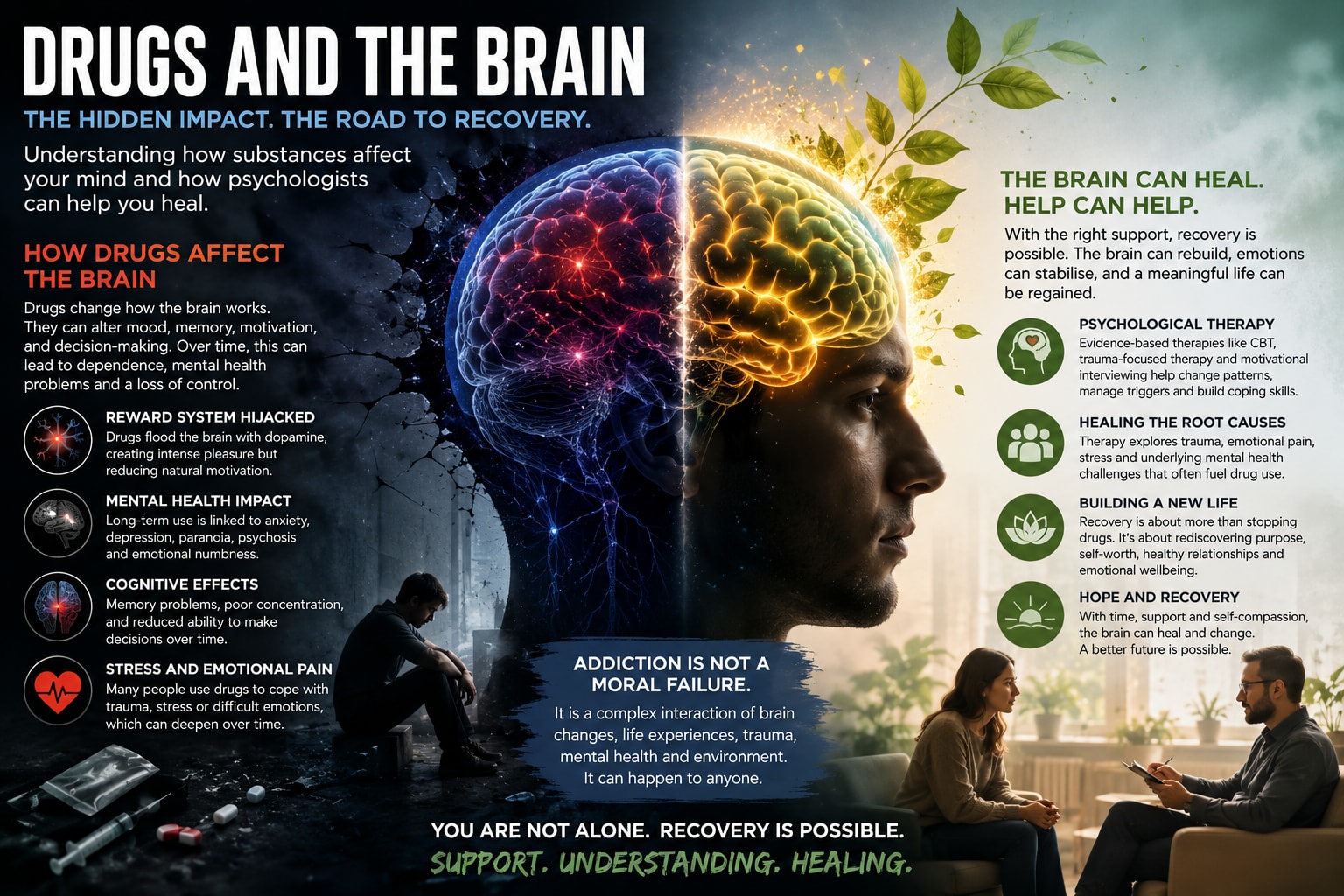
Most addictive substances directly affect the brain’s reward system, particularly pathways involving dopamine. Dopamine is a neurotransmitter associated with pleasure, motivation, reward, learning, and reinforcement.
Drugs such as cocaine, methamphetamine, cannabis, alcohol, opioids, MDMA, and nicotine artificially alter these systems, often producing intense emotional or physical effects that the brain begins to associate with relief, pleasure, or survival.
Initially, the brain experiences the substance as rewarding. However, repeated exposure gradually changes how the brain functions.
Over time, the brain begins to:
Produce less natural dopamine
Rely on substances for emotional regulation
Become more stress-sensitive
Reduce impulse control
Struggle to experience pleasure naturally
This is one reason why long-term substance use often leads people to feel emotionally flat, unmotivated, anxious, or depressed when they are not using.
The DSM-5 and Substance Use Disorders
In the DSM-5, addiction is classified under Substance-Related and Addictive Disorders. Rather than viewing addiction as simply “heavy use,” the DSM-5 focuses on how substances impair psychological functioning, behaviour, relationships, and self-control.
A diagnosis of Substance Use Disorder may involve:
Cravings
Loss of control over use
Increased tolerance
Withdrawal symptoms
Continued use despite harm
Neglecting responsibilities
Repeated unsuccessful attempts to stop
Importantly, addiction exists on a spectrum from mild to severe. Many people struggling with substances do not fit stereotypical ideas of what addiction “looks like.” Some maintain careers, relationships, and outward stability for years while privately struggling psychologically.
Why Drugs Affect Mental Health
Long-term drug use does not only affect behaviour. It alters emotional regulation, stress processing, cognition, and perception.
Research has linked chronic substance use to increased risk of:
Depression
Anxiety disorders
Panic attacks
Psychosis
Paranoia
Memory impairment
Mood instability
Emotional numbness
Sleep disturbance
For some individuals, substances temporarily mask underlying psychological distress. However, over time, they often intensify the very symptoms the person was trying to escape.
Cannabis and Mental Health
Cannabis is frequently viewed as relatively harmless, particularly because it can initially reduce anxiety and increase relaxation. However, research increasingly shows that heavy or long-term cannabis use — particularly high-potency cannabis — is associated with increased risk of anxiety, emotional blunting, cognitive difficulties, and psychosis in vulnerable individuals.
Some people report:
Feeling emotionally detached
Reduced motivation
Increased paranoia
Brain fog
Depersonalisation
Large longitudinal studies have found an association between regular cannabis use and increased risk of psychotic disorders, particularly among individuals with genetic or psychological vulnerability.
Stimulants and the Brain
Drugs such as cocaine and methamphetamine intensely stimulate dopamine systems, often creating temporary feelings of confidence, energy, focus, and euphoria.
However, repeated stimulant use can severely dysregulate emotional systems. Long-term effects may include:
Anxiety
Agitation
Paranoia
Aggression
Severe depression
Emotional crashes
Many individuals describe feeling psychologically “empty” after prolonged stimulant use because the brain struggles to regulate pleasure and motivation naturally.
Alcohol and Emotional Regulation
Alcohol is socially normalised in many cultures, yet it has profound psychological effects. While alcohol initially reduces inhibition and anxiety, chronic use can significantly worsen depression and emotional instability.
Research consistently shows strong links between alcohol misuse and:
Depression
Relationship conflict
Sleep problems
Emotional dysregulation
Suicidal thinking
Many people use alcohol to cope with stress or emotional pain, only to discover that it gradually increases both over time.
Trauma, Drugs, and Emotional Escape
One of the strongest predictors of problematic substance use is unresolved trauma.
For some individuals, drugs become a way to:
Numb emotional pain
Escape intrusive memories
Reduce anxiety
Feel emotionally connected
Quiet self-criticism
Psychologists increasingly understand addiction as deeply connected to emotional regulation and psychological survival rather than simply pleasure-seeking.
Many people using substances are not trying to “get high.” They are trying to feel:
Safe
Calm
Accepted
Emotionally relieved
A Real-Life Example
A man in his early forties described initially using cocaine socially during stressful work periods. At first, it increased his confidence and productivity. Over time, however, he began relying on it to cope with exhaustion, anxiety, and low self-esteem.
Years later, he reported severe anxiety, emotional numbness, sleep disruption, and feelings of emptiness when not using. He described no longer recognising himself emotionally.
During therapy, it became clear that the substance use had become intertwined with chronic stress, perfectionism, unresolved childhood shame, and emotional avoidance. The drug use was not the core issue alone — it had become part of a much larger psychological coping system.
Can the Brain Recover?
In many cases, yes.
The brain has significant neuroplasticity, meaning it can gradually adapt and heal over time. Research shows that many cognitive and emotional functions improve significantly with sustained recovery and psychological support.
However, recovery is rarely simply about “stopping drugs.” Many individuals must also learn:
How to regulate emotions without substances
How to tolerate distress
How to rebuild identity and relationships
How to process trauma
How to experience pleasure naturally again
This is where psychological therapy becomes extremely important.
How Psychologists Help With Long-Term Drug Use
Psychologists do far more than simply encourage abstinence. Effective therapy explores the emotional, cognitive, behavioural, and relational factors maintaining substance use.
Evidence-based approaches often include:
Cognitive Behavioural Therapy (CBT)
Motivational Interviewing
Trauma-focused therapy
Compassion-focused therapy
Relapse prevention work
Emotional regulation training
Therapy can help individuals:
Understand triggers
Manage cravings
Reduce shame
Address underlying trauma
Rebuild self-worth
Develop healthier coping mechanisms
Importantly, non-judgemental therapeutic relationships are often central to recovery. Many people struggling with addiction carry profound shame and self-criticism, which can worsen both mental health and substance use.
Why Shame Often Keeps Addiction Going
One of the most psychologically destructive aspects of addiction is shame. People frequently internalise beliefs such as:
“I’m weak.”
“I’ve ruined my life.”
“I should be able to stop.”
Yet shame itself often fuels further substance use because the person seeks escape from painful self-perception.
Modern psychological treatment increasingly focuses on helping individuals develop:
Self-understanding
Self-compassion
Emotional insight
Psychological safety
rather than relying purely on punishment or self-criticism.
The Most Important Thing to Understand
Long-term drug use changes the brain, but it also reflects something deeply human: the attempt to cope with distress, regulate emotion, escape pain, or survive psychologically difficult experiences.
Addiction is rarely just about the substance itself. It is often about emotional suffering, stress, trauma, loneliness, shame, or unmet psychological needs.
The encouraging reality is that recovery is possible. With appropriate psychological support, many people gradually rebuild emotional stability, cognitive functioning, relationships, identity, and a sense of meaning beyond substance use.