


University Stress
posted 21st August 2026
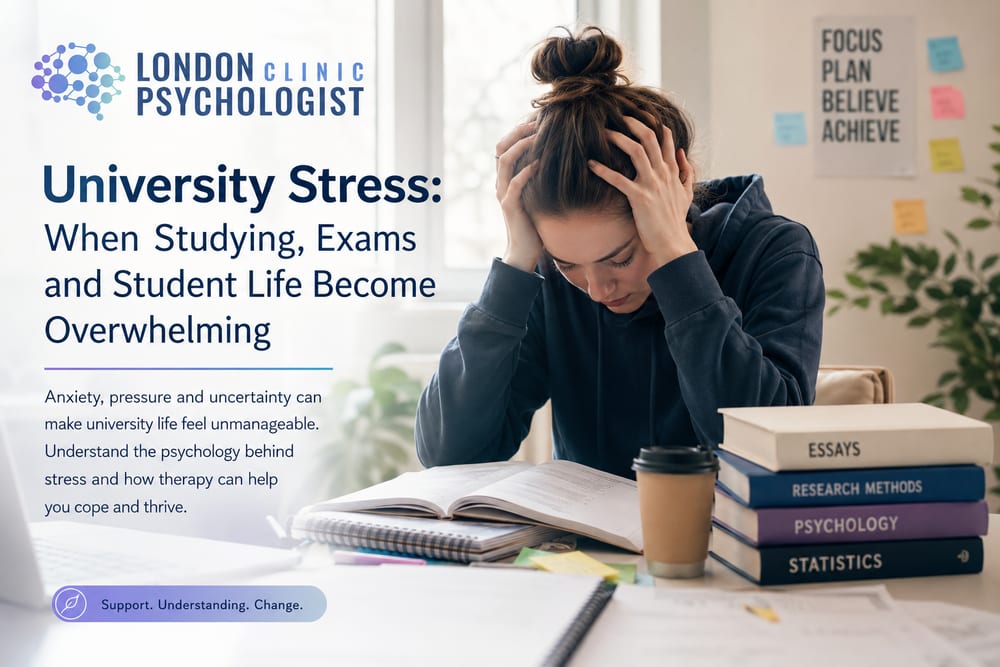
University Stress: When Studying, Exams and Student Life Become Overwhelming
University is often described as one of the most exciting periods of life. But psychologically, it can also be one of the most demanding.
For many students, university brings several major changes at once: leaving home, forming new friendships, managing money, becoming academically independent and beginning to make decisions about an uncertain future. Add examinations, deadlines and pressure to achieve, and it is unsurprising that stress and anxiety can become difficult to manage.
At the *London Psychologist Clinic*, we understand that university stress is not simply about having "too much work". Academic pressure can interact with perfectionism, anxiety, low self-esteem, family expectations, relationship difficulties and fears about the future.
Why Does University Feel So Stressful?
University requires students to cope with a level of independence that is very different from school or sixth form. There may be fewer hours of structured teaching, but considerably greater responsibility for organising study, meeting deadlines and understanding complex material independently.
At the same time, students are often adjusting to a completely new social environment.
Some appear to manage this transition effortlessly. Social media can reinforce that impression: everyone else seems to be making friends, attending events, achieving good grades and enjoying university life.
The reality can be very different.
Behind closed doors, many students experience loneliness, homesickness, anxiety, self-doubt and periods when they wonder whether they belong at university at all.
Exam Stress and the Fear of Failure
A certain amount of anxiety before an examination can be useful. Stress activates the body and can increase concentration and motivation.
The difficulty arises when anxiety becomes so intense that it begins interfering with performance.
A student may have revised thoroughly but enter an examination and suddenly struggle to remember information they knew the previous evening. Others find themselves repeatedly rereading the same material because anxiety is preventing them from concentrating.
Exam stress can also produce physical symptoms, including difficulty sleeping, nausea, headaches, muscle tension, a racing heart and changes in appetite.
Ironically, becoming frightened of these symptoms can create even more anxiety.
A student might think:
"I can't concentrate. I'm going to fail."
That thought increases anxiety, making concentration even harder. The resulting difficulty studying then appears to confirm the original fear.
A psychological cycle has developed.
Perfectionism: When Doing Well Never Feels Good Enough
Some of the students who experience the greatest academic anxiety are not struggling academically at all.
They are high achievers.
Perfectionism can make a good mark feel like a disappointing one. A student receiving 68% might immediately focus on why they did not achieve 70%. Someone receiving 72% may begin worrying about whether they can maintain it.
Success therefore provides surprisingly little reassurance.
Psychologically, perfectionism often involves shifting standards. Each achievement simply creates another expectation.
Instead of thinking:
"I would like to do well."
the underlying belief becomes:
"I must do well, otherwise something is wrong."
Grades can gradually become connected to identity and self-worth. An examination is no longer simply testing knowledge. It begins to feel as though it is testing the person.
Procrastination Is Not Always Laziness
Students frequently describe themselves as lazy when they procrastinate, but procrastination can sometimes be better understood as an emotional avoidance strategy.
Imagine a student who is frightened that an essay will not be good enough.
Opening the document immediately activates anxiety.
Watching television, scrolling through social media or cleaning the kitchen removes that uncomfortable feeling temporarily.
The brain learns something important:
Avoiding the work reduces anxiety.
Unfortunately, the deadline continues approaching.
Anxiety then increases, making the work feel even more threatening and encouraging further avoidance.
This can produce the familiar cycle of procrastination, guilt, panic and last-minute studying.
Understanding the psychological function of procrastination is often more useful than simply telling someone to "be more disciplined".
Comparison Can Make University Anxiety Worse
University places students alongside people who were often high achievers themselves.
A student who was consistently near the top of their school may suddenly find themselves surrounded by equally capable students.
That adjustment can be psychologically difficult.
Students may begin comparing revision hours, essay marks, internships, graduate schemes and career plans.
Someone else's success can then be interpreted as evidence of personal failure.
Social media magnifies the problem because students rarely see the entire picture. They see the internship announcement, not the rejected applications. They see the graduation photographs, not the anxiety before examinations.
This creates an extremely distorted comparison: *our internal struggles against somebody else's external presentation.*
The Pressure to Know What Comes Next
University anxiety is not confined to examinations.
As graduation approaches, another question can become increasingly prominent:
"What am I going to do with my life?"
Applications for postgraduate courses, training contracts, graduate schemes and employment can create another layer of competition.
Students may interpret rejection very personally.
Yet rejection is an inevitable feature of competitive recruitment. An unsuccessful application does not necessarily provide meaningful information about someone's intelligence, ability or future potential.
Learning to separate an outcome from one's identity can therefore become an important psychological skill.
When Does Normal University Stress Become a Problem?
Occasional stress around examinations and deadlines is normal. However, it may be worth seeking additional support when anxiety begins significantly affecting everyday functioning.
This might include persistent sleep difficulties, panic attacks, avoiding lectures or seminars, being unable to begin assignments, repeatedly seeking reassurance, withdrawing socially, feeling constantly overwhelmed or experiencing anxiety long after an examination or deadline has passed.
Some students also become trapped in excessive checking behaviours — repeatedly checking submissions, university portals, emails or examination information because uncertainty feels intolerable.
The checking provides brief reassurance, but the anxiety quickly returns.
How Psychological Therapy Can Help Students
Therapy does not remove examinations, deadlines or academic expectations. Instead, it can help change the way a student responds to them.
*Cognitive Behavioural Therapy (CBT)* can be particularly helpful for identifying patterns of catastrophic thinking, perfectionism, avoidance and excessive worry.
A thought such as:
"If I fail this exam, my entire future is ruined."
can be examined rather than automatically accepted as fact.
Therapy may also involve developing more effective approaches to procrastination, uncertainty, revision and performance anxiety.
For some students, however, academic anxiety connects with deeper patterns.
A person who has learned to associate approval strongly with achievement may discover that university activates longstanding fears about disappointing other people or not being "good enough".
In these circumstances, psychological therapy can explore not only *what someone is thinking, but also why achievement has become so emotionally important*.
Practical Ways to Reduce Exam Stress
One useful change students can make is moving away from enormous, undefined goals.
"Revise psychology" is psychologically overwhelming.
"Review lecture three for 30 minutes and answer five practice questions" is specific and achievable.
It can also help to practise retrieving information rather than repeatedly reading it. Testing yourself recreates some of the psychological demands of an examination and makes uncertainty more familiar.
Sleep should not be regarded as time stolen from revision. Adequate sleep is important for memory, concentration and emotional regulation.
Students should also be cautious about measuring productivity entirely by hours spent sitting at a desk. Eight anxious hours of distracted revision are not necessarily more productive than several focused periods separated by proper breaks.
Your Degree Matters — But It Does Not Define You
University can create an unusual psychological environment in which numbers begin to feel extraordinarily important.
A few marks can determine a classification. An examination may influence progression. An application can affect the next stage of a career.
These things genuinely matter.
But there is an important distinction between *something being important and something defining your worth as a person*.
An examination measures performance on a particular task, under particular conditions, on a particular day.
It does not measure someone's complete intelligence, creativity, resilience, personality or future potential.
Learning to maintain that distinction can make academic pressure considerably easier to tolerate.
Psychological Support for University Students
If university stress, examination anxiety, perfectionism or worries about academic performance are becoming difficult to manage, psychological therapy can provide a confidential space to understand what is happening and develop more effective ways of coping.
At the *London Psychologist Clinic*, psychological therapy can help students understand the patterns underlying anxiety, manage academic and examination pressure, address perfectionism and procrastination, and develop a healthier relationship with achievement.
Support is available for students experiencing difficulties including *university stress, exam anxiety, generalised anxiety, panic, low mood, perfectionism, procrastination, low self-esteem and difficulties adjusting to university life.*
London Psychologist Clinic
Psychological therapy and support for university students in London and online.