


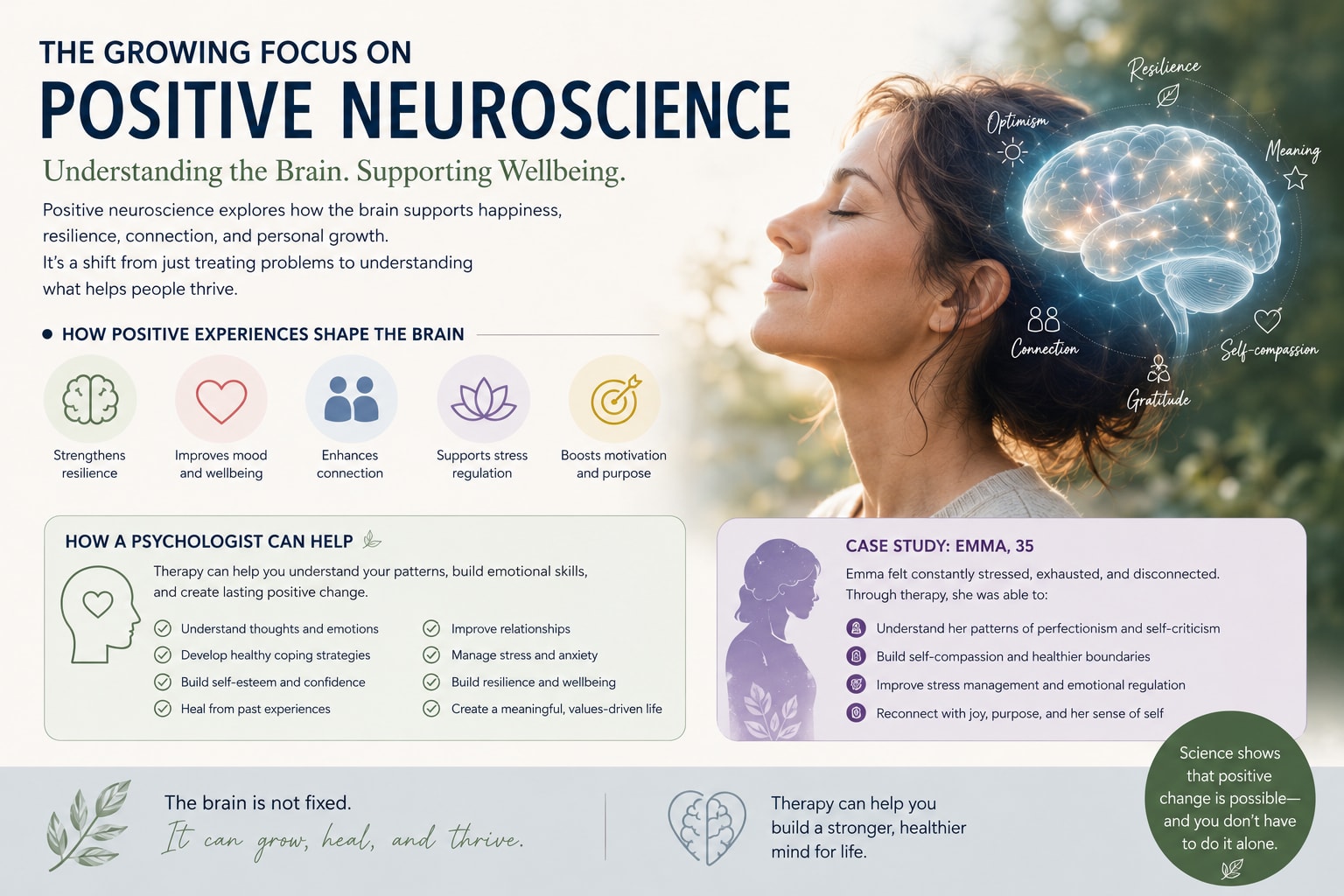
Understanding the Brain. Supporting Wellbeing.
posted 26th May 2026
Click to enlarge
The Rise of Positive Neuroscience: How the Brain Can Support Happiness, Resilience, and Emotional Wellbeing
For many years, psychology and neuroscience focused primarily on mental illness, trauma, anxiety, and emotional difficulties. While understanding psychological disorders remains incredibly important, researchers are now increasingly exploring another question:
What helps people truly thrive?
This growing field, known as *positive neuroscience*, examines how the brain supports positive emotions, resilience, wellbeing, motivation, connection, and psychological growth.
Rather than focusing only on what goes wrong in the brain, scientists are now studying what helps people feel emotionally healthy, fulfilled, and psychologically strong.
What Is Positive Neuroscience?
Positive neuroscience is an emerging area of research that combines neuroscience, psychology, and wellbeing science to understand the biological foundations of positive mental health.
Researchers are exploring how the brain contributes to:
- Happiness and emotional wellbeing
- Resilience during stress
- Motivation and goal achievement
- Compassion and empathy
- Optimism and hope
- Meaning and purpose
- Healthy relationships
- Emotional regulation
The goal is not to ignore psychological struggles, but to better understand the brain processes that help people cope, recover, and flourish.
Why This Research Matters
Mental health is not simply the absence of anxiety or depression.
Increasingly, psychologists recognise that emotional wellbeing also involves:
- Feeling connected to others
- Having purpose and direction
- Experiencing emotional balance
- Feeling psychologically safe
- Developing confidence and resilience
Positive neuroscience research suggests that the brain is capable of adapting and strengthening through positive emotional experiences, supportive relationships, and healthy psychological habits.
This concept is closely linked to *neuroplasticity* — the brain’s ability to reorganise and form new neural connections throughout life.
How Positive Experiences Affect the Brain
Researchers have found that positive experiences can influence brain systems involved in emotion, stress regulation, motivation, and memory.
Studies suggest that activities such as mindfulness, exercise, social connection, gratitude, and therapy may positively affect brain functioning over time.
Research has linked positive emotional experiences to:
- Improved stress regulation
- Greater emotional resilience
- Reduced chronic stress responses
- Stronger emotional regulation skills
- Increased feelings of safety and connection
Importantly, this does not mean people can simply “think positively” to overcome mental health difficulties. Rather, the research highlights how emotional experiences and supportive environments can gradually shape brain functioning.
How Can a Psychologist Help?
A psychologist can help individuals better understand the emotional, behavioural, and thought patterns that may be contributing to stress, anxiety, low mood, burnout, or emotional overwhelm.
Using evidence-based psychological approaches, therapy can support people in developing healthier coping strategies, improving emotional resilience, and creating more balanced ways of thinking and living.
Psychological treatment may help with:
- Anxiety and chronic stress
- Burnout and emotional exhaustion
- Low self-esteem and self-criticism
- Emotional regulation difficulties
- Relationship challenges
- Trauma and past experiences
- Confidence and identity issues
- Building resilience and emotional wellbeing
Depending on individual needs, treatment approaches may include:
- Cognitive Behavioural Therapy (CBT)
- Compassion-Focused Therapy (CFT)
- Psychodynamic Therapy
- Mindfulness-based approaches
- Trauma-informed therapy
- Stress management and emotional regulation strategies
Therapy is not simply about reducing distress — it can also help individuals build greater self-awareness, confidence, emotional balance, and long-term psychological wellbeing.
Positive neuroscience research increasingly shows that supportive therapeutic relationships and healthy emotional experiences may help strengthen resilience, improve stress responses, and support healthier brain functioning over time.
Case Study: Rebuilding Emotional Wellbeing
Emma, a 35-year-old teacher, sought therapy after years of chronic stress and burnout. Although she was highly successful professionally, she constantly felt emotionally drained, anxious, and disconnected from herself.
Through therapy, Emma began exploring patterns of perfectionism, self-criticism, and emotional suppression that had developed over many years.
Therapy helped her:
- Build healthier boundaries
- Develop self-compassion
- Improve stress management
- Reconnect with activities she enjoyed
- Feel more emotionally balanced and resilient
Over time, Emma reported not only reduced anxiety, but also greater confidence, emotional clarity, and overall wellbeing.
Positive Neuroscience and Modern Mental Health
The rise of positive neuroscience reflects a broader shift within psychology toward a more balanced understanding of mental health.
Rather than focusing only on symptoms and diagnoses, psychologists are increasingly exploring:
- What helps people emotionally thrive?
- What strengthens resilience?
- How can emotional wellbeing be supported long-term?
- What role do relationships, meaning, and self-awareness play in mental health?
This approach does not minimise emotional struggles. Instead, it recognises that mental health also involves growth, adaptability, connection, and psychological strength.
A More Holistic View of Psychological Wellbeing
Positive neuroscience reminds us that the brain is not only shaped by stress and trauma — it is also shaped by safety, support, connection, and positive emotional experiences.
For psychologists and mental health professionals, this growing field offers exciting new insights into how therapy, relationships, lifestyle, and emotional experiences may help support long-term wellbeing.
As research continues, positive neuroscience may help create more compassionate, empowering, and holistic approaches to mental health — focused not only on surviving, but on truly flourishing emotionally and psychologically.