

Understanding Pathological Narcissism in Men
posted 20th March 2026
Understanding Pathological Narcissism in Men: A Psychological Perspective
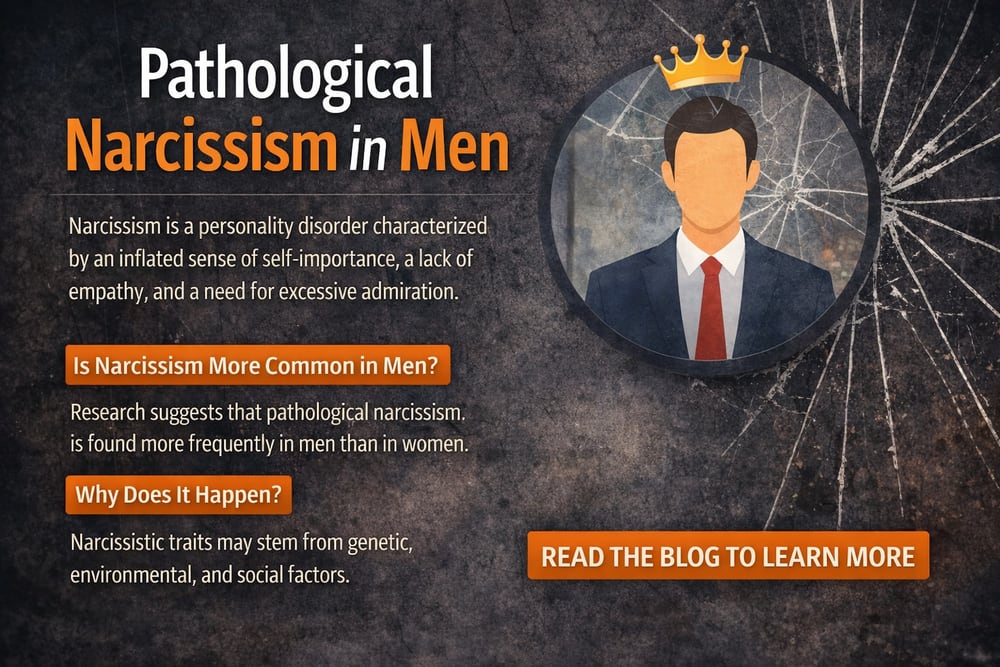
Narcissism is a term that has become increasingly prevalent in everyday language, often used to describe individuals who appear self-centred, entitled, or emotionally unavailable. However, from a clinical perspective, narcissism exists on a spectrum. While some degree of self-focus and confidence is both normal and adaptive, pathological narcissism represents a more rigid and maladaptive pattern of thinking, feeling, and relating to others. This raises an important question: is pathological narcissism more common in men, or is this perception shaped by cultural narratives and bias?
From a diagnostic standpoint, the DSM-5 defines Narcissistic Personality Disorder (NPD) as a pervasive pattern of grandiosity (in fantasy or behaviour), a need for admiration, and a lack of empathy, beginning in early adulthood and present across contexts. Individuals must meet a number of criteria, including an exaggerated sense of self-importance, fantasies of unlimited success or power, a belief in being “special” or superior, interpersonal exploitiveness, and difficulty recognising or responding to the needs of others. Importantly, these traits must lead to clinically significant impairment in functioning, distinguishing pathological narcissism from everyday confidence or ambition.
Epidemiological data suggests that NPD is relatively uncommon in the general population, with prevalence estimates typically ranging between 0.5% and 1%, although some studies report slightly higher rates depending on methodology. Notably, research has consistently found that men are more likely than women to meet diagnostic criteria, with some estimates suggesting that up to 50–75% of diagnosed cases are male. However, interpreting this gender difference requires caution. It does not necessarily mean that narcissism is inherently “a male trait,” but rather that its more overt and externally expressed forms may be more socially reinforced—or more easily recognised—in men.
Psychological research increasingly distinguishes between different presentations of narcissism, particularly grandiose and vulnerable narcissism. Grandiose narcissism is characterised by overt confidence, dominance, entitlement, and a strong need for admiration. Vulnerable narcissism, by contrast, is associated with hypersensitivity, defensiveness, insecurity, and a fragile sense of self-worth. Some researchers argue that men are more likely to exhibit grandiose traits, which align with traditional masculine norms such as assertiveness, dominance, and status-seeking. Women, on the other hand, may be more likely to present with vulnerable narcissistic features, which can be less visible and therefore underdiagnosed.
This distinction highlights an important issue: diagnostic criteria may be more attuned to grandiose presentations, potentially contributing to gender disparities in diagnosis. If the clinical lens is calibrated to detect more overt expressions of narcissism, subtler or internalised forms may be overlooked. Therefore, the apparent gender imbalance may reflect not only real differences in expression, but also how narcissism is defined, measured, and socially interpreted.
The development of pathological narcissism is typically understood as multifactorial, involving both early relational experiences and broader sociocultural influences. From a developmental perspective, narcissistic traits may emerge in environments characterised by either excessive admiration without realistic feedback or, conversely, chronic criticism and emotional invalidation. In both cases, the child’s developing sense of self becomes unstable, leading to compensatory strategies aimed at protecting self-esteem. In some men, particularly within cultures that emphasise achievement, control, and emotional restraint, these strategies may take the form of grandiosity, emotional detachment, or dominance in relationships.
Sociocultural factors also play a significant role. Traditional masculine norms often discourage vulnerability and emotional expression, while rewarding competitiveness, status, and self-reliance. These expectations can shape how narcissistic traits are expressed and maintained. For example, behaviours such as assertiveness or confidence may be socially rewarded in men, even when they cross into entitlement or lack of empathy. Over time, this can blur the line between adaptive traits and maladaptive patterns, making pathological narcissism harder to recognise.
However, it is important to maintain a balanced perspective. Not all men with confidence, ambition, or strong self-belief are narcissistic, and not all narcissism is pathological. The key distinction lies in rigidity, lack of empathy, and the impact on relationships and functioning. Pathological narcissism often leads to difficulties in maintaining close relationships, as interactions may become transactional, exploitative, or emotionally one-sided. Individuals may struggle to tolerate criticism, react defensively or with anger, and experience underlying fragility despite outward confidence.
From a clinical perspective, individuals with narcissistic traits rarely present for therapy solely because of narcissism. More commonly, they seek help for associated difficulties such as relationship breakdowns, anxiety, depression, or work-related stress. Psychological work in this area requires a nuanced and non-confrontational approach, focusing on building insight, emotional awareness, and more adaptive ways of relating to self and others. Approaches such as schema therapy, psychodynamic therapy, and adapted forms of CBT have shown promise in addressing the underlying mechanisms that maintain narcissistic patterns.
In conclusion, while men are more frequently diagnosed with Narcissistic Personality Disorder, it would be an oversimplification to view pathological narcissism as inherently male. Rather, it is more accurate to understand it as a complex interplay of personality, early experience, and cultural context. Recognising the spectrum of narcissistic traits—and the different ways they can present—is essential for both accurate diagnosis and effective intervention. Ultimately, the goal is not to pathologise confidence or ambition, but to identify when these traits become inflexible, harmful, and limiting, both for the individual and those around them.