


Understanding Low Mood
posted 24th April 2026
Click to enlarge
Depression: Understanding Low Mood and How CBT Can Help You Feel Like Yourself Again
Depression is one of the most common mental health difficulties, yet it is often misunderstood. It is not simply feeling sad or having a bad day—it is a persistent and often overwhelming experience that can affect how you think, feel, and function. At The London Psychologist Clinic, we work with many individuals who describe feeling stuck, disconnected, and unable to enjoy life in the way they once did. What can make depression particularly difficult is how it gradually takes hold, often leading people to blame themselves rather than recognise it as a treatable condition.
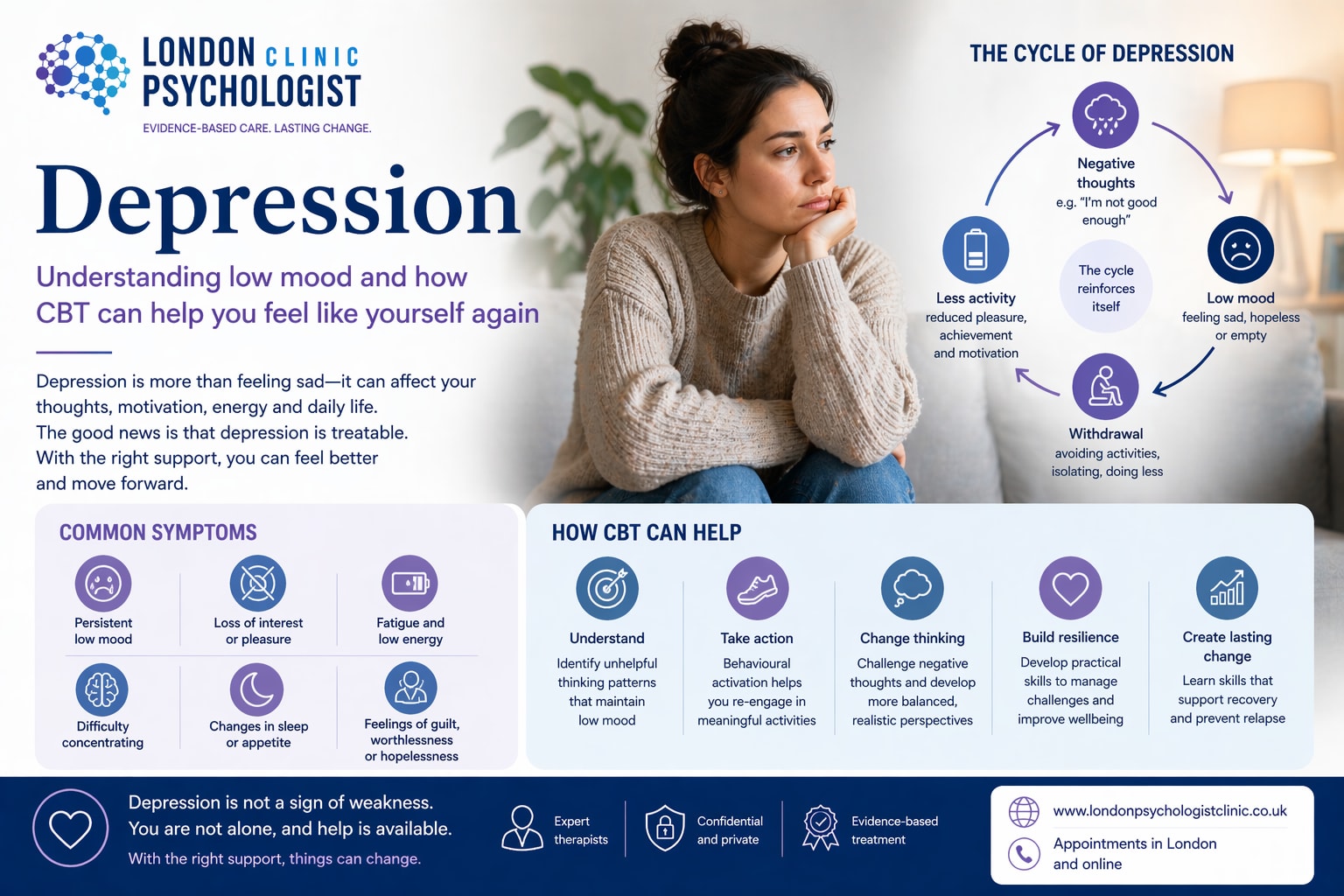
According to the DSM-5, depression—clinically referred to as Major Depressive Disorder—is characterised by a persistent low mood or loss of interest or pleasure (anhedonia), alongside symptoms such as fatigue, changes in sleep or appetite, difficulty concentrating, feelings of worthlessness or guilt, and, in some cases, thoughts of death or suicide. These symptoms must be present for at least two weeks and represent a change from previous functioning.
Depression exists on a spectrum. Some individuals experience mild but persistent low mood, while others may go through more severe and debilitating episodes. It is also common for depression to co-occur with anxiety, reinforcing the idea that these conditions share underlying psychological processes. One of the key features of depression is the way it alters thinking patterns—often leading to negative beliefs about the self, the world, and the future. This is sometimes referred to as the “cognitive triad.”
The causes of depression are complex and multifactorial. Biologically, there may be genetic vulnerability and changes in brain chemistry related to mood regulation. Psychologically, patterns such as negative thinking, self-criticism, and rumination play a central role. Life experiences—such as loss, stress, trauma, or prolonged pressure—can also contribute to the onset of depression. Importantly, depression is not a sign of weakness or failure; it is a condition that arises from the interaction of these different factors.
A common question is whether depression can be cured. The encouraging answer is that depression is highly treatable. Many individuals experience significant improvement with the right support, and recovery is entirely possible. Treatment focuses not only on reducing symptoms but also on addressing the underlying patterns that maintain low mood.
Cognitive Behavioural Therapy (CBT) is one of the most effective and widely recommended treatments for depression. CBT is based on the understanding that thoughts, feelings, and behaviours are interconnected. In depression, this often creates a cycle where negative thinking leads to low mood, which leads to withdrawal or inactivity, which in turn reinforces negative thinking.
CBT works to break this cycle in several ways. One of the key components is behavioural activation, which involves gradually increasing engagement in meaningful and rewarding activities. Depression often leads to withdrawal, which reduces opportunities for positive experiences. By reintroducing activity in a structured way, individuals can begin to rebuild a sense of motivation and pleasure.
Another important element is identifying and challenging negative thought patterns. Individuals with depression often experience automatic thoughts such as “I’m not good enough” or “Nothing will change.” CBT helps to examine these thoughts more critically and develop more balanced perspectives. Over time, this reduces the intensity and frequency of negative thinking.
CBT also addresses underlying beliefs and patterns such as perfectionism, self-criticism, and hopelessness. Clients learn practical skills to manage rumination, improve problem-solving, and develop a more compassionate and realistic view of themselves.
The effectiveness of CBT for depression is strongly supported by research. Many individuals experience significant reductions in symptoms, improved functioning, and long-term resilience. Importantly, the skills learned in therapy can be applied beyond treatment, helping to prevent relapse and support ongoing wellbeing.
Depression can feel isolating, particularly because it often changes how individuals see themselves and the world. Many people struggle in silence, believing they should be able to “snap out of it.” However, depression is not something that can simply be willed away—it requires understanding, support, and evidence-based treatment.
At The London Psychologist Clinic, we provide personalised, evidence-based therapy designed to help you move out of the cycle of depression and reconnect with your life. With the right support, it is possible to regain a sense of clarity, energy, and hope—and to feel like yourself again.