


Understanding Intrusive Thoughts
posted 24th April 2026
Obsessive-Compulsive Disorder (OCD): Understanding Intrusive Thoughts and How CBT Can Help
Obsessive-Compulsive Disorder (OCD) is often misunderstood as simply being “neat,” “organised,” or particular about things. In reality, OCD is a complex and distressing psychological condition that can significantly impact daily life. At The London Psychologist Clinic, we frequently work with individuals who feel trapped in cycles of intrusive thoughts and repetitive behaviours—often aware that their fears may be irrational, yet unable to break free from them.
According to the DSM-5, OCD is characterised by the presence of obsessions, compulsions, or both. Obsessions are unwanted, intrusive thoughts, images, or urges that cause significant anxiety or distress. Common examples include fears of contamination, harming others, making mistakes, or things not being “just right.” Compulsions are repetitive behaviours or mental acts performed in response to these obsessions, such as excessive washing, checking, counting, or seeking reassurance.
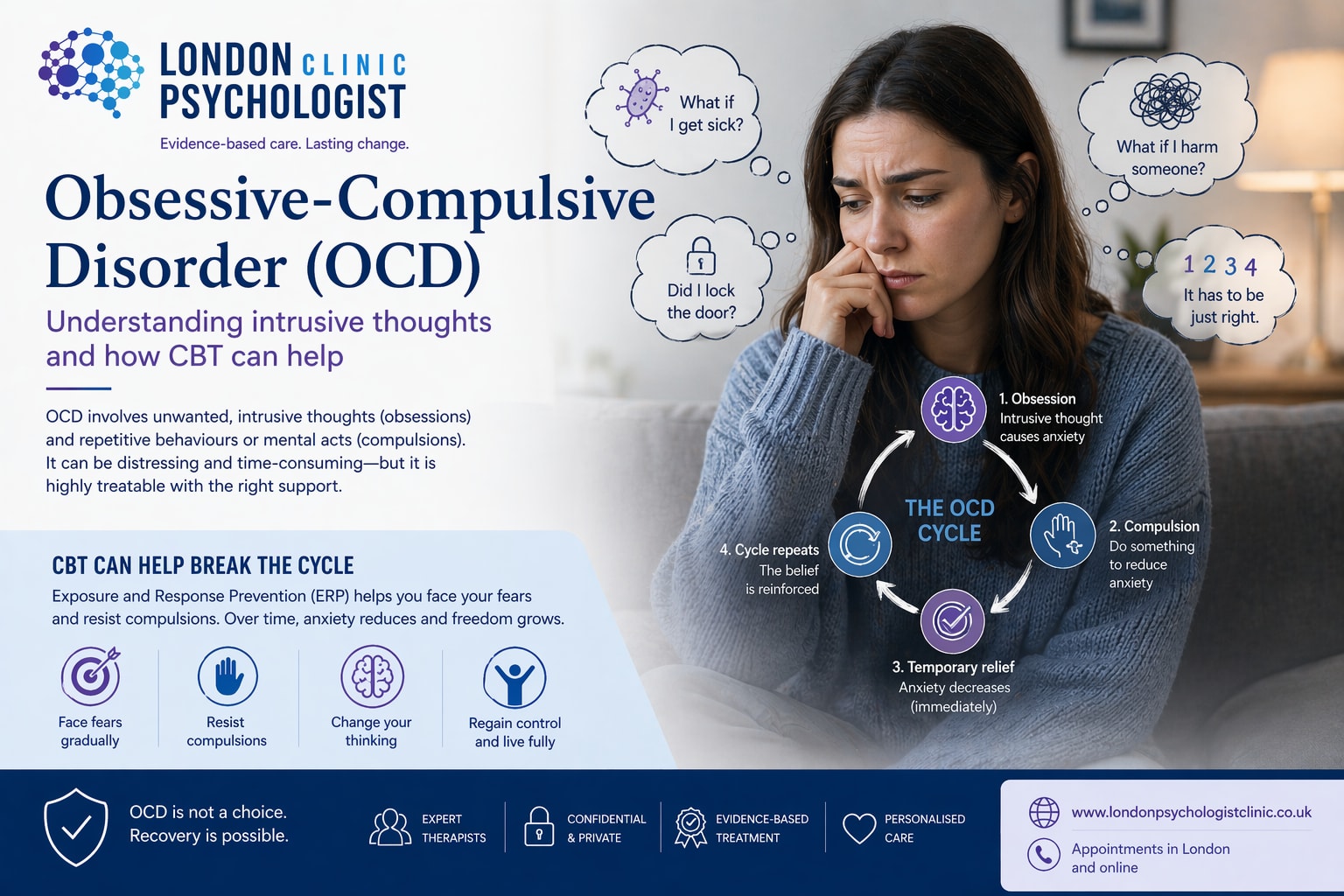
What makes OCD particularly challenging is the cycle it creates. An intrusive thought triggers anxiety, which leads to a compulsion aimed at reducing that anxiety. While the compulsion may provide temporary relief, it reinforces the belief that the thought was dangerous or meaningful. Over time, this strengthens the cycle, making the obsessions more frequent and the compulsions more difficult to resist.
OCD sits within a related group of disorders in the DSM-5, distinct from general anxiety disorders but still sharing underlying features such as heightened threat perception and difficulty tolerating uncertainty. A key feature of OCD is the misinterpretation of intrusive thoughts. Importantly, intrusive thoughts are a normal part of human experience—everyone has them. The difference in OCD is the meaning attached to these thoughts. Individuals may believe that having a thought is morally equivalent to acting on it, or that it increases the likelihood of something bad happening.
The causes of OCD are multifactorial. Biologically, research suggests differences in brain circuits involved in error detection and habit formation, particularly within the cortico-striatal pathways. Psychologically, factors such as inflated responsibility, perfectionism, and intolerance of uncertainty play a significant role. Environmental influences, including stressful life events or early experiences, can also contribute to the development and maintenance of symptoms.
A common question is whether OCD can be cured. The answer is that OCD is highly treatable, and many individuals experience substantial improvement with the right intervention. Rather than eliminating intrusive thoughts entirely—which is neither realistic nor necessary—treatment focuses on changing how individuals respond to these thoughts. When the response changes, the cycle weakens.
Cognitive Behavioural Therapy (CBT), specifically a form known as Exposure and Response Prevention (ERP), is the gold-standard treatment for OCD. CBT helps individuals understand that thoughts are not dangerous and do not require action. Through therapy, clients learn to face their fears in a gradual and structured way while resisting the urge to perform compulsions.
Exposure involves deliberately confronting feared situations or thoughts—for example, touching a surface perceived as “contaminated” or allowing an intrusive thought to be present without trying to neutralise it. Response prevention involves resisting the compulsion that would normally follow, such as washing or checking. While this initially increases anxiety, it allows the brain to learn that the feared outcome does not occur, and that anxiety naturally decreases on its own.
Over time, this process leads to habituation and cognitive change. The individual begins to experience intrusive thoughts as less threatening, and the urge to perform compulsions diminishes. This is a powerful shift—from feeling controlled by thoughts to recognising them as mental events that do not require action.
CBT for OCD also addresses underlying beliefs, such as the need for certainty or the importance of controlling thoughts. Clients learn to develop a more flexible and accepting relationship with their internal experiences, reducing the power those experiences hold.
The effectiveness of CBT with ERP is strongly supported by research. A significant proportion of individuals experience meaningful reductions in symptoms, and many achieve long-term improvement. Importantly, the skills learned in therapy provide ongoing tools for managing future challenges.
OCD can be exhausting, isolating, and often misunderstood by others. Many individuals feel ashamed of their thoughts or behaviours, which can prevent them from seeking help. However, OCD is not a reflection of character—it is a recognised psychological condition with well-established, effective treatments.
At The London Psychologist Clinic, we provide specialist, evidence-based treatment for OCD tailored to each individual. With the right support, it is entirely possible to break free from the cycle of obsessions and compulsions and regain a sense of control, clarity, and peace of mind.
Click to enlarge