


Understanding Face Blindness
posted 22nd June 2026
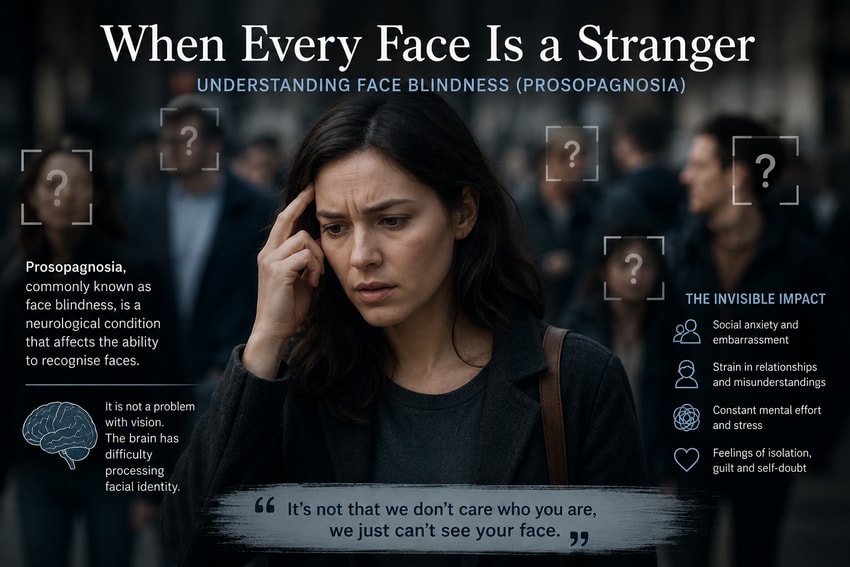
When Every Face Is a Stranger: Understanding Face Blindness (Prosopagnosia)
Imagine walking into your workplace every morning and being unable to recognise your colleagues. Imagine passing your spouse in a supermarket without knowing it was them, or failing to recognise your own child when collecting them from school. For most people, facial recognition happens so effortlessly that it feels automatic. Yet for individuals living with Prosopagnosia, commonly known as "face blindness", recognising faces can be a daily struggle.
Despite affecting an estimated 2% of the population, Prosopagnosia remains relatively unknown. Many people live with the condition for decades before receiving a diagnosis, often believing there is something wrong with them socially rather than neurologically. As a result, the psychological consequences can be significant, impacting confidence, relationships and mental health.
What Is Prosopagnosia?
Prosopagnosia is a neurological condition that impairs an individual's ability to recognise faces. The condition exists on a spectrum. Some people can recognise close family members but struggle with acquaintances, while others have difficulty recognising even their own reflection in a mirror or photographs of themselves.
Importantly, people with Prosopagnosia do not have problems seeing faces. They can identify eyes, noses, mouths and other facial features perfectly well. The difficulty lies in integrating these features into a recognisable identity.
Many individuals learn to compensate by relying on alternative cues such as hairstyle, clothing, voice, posture, mannerisms or context. However, these strategies are often imperfect and can fail when circumstances change.
The Neuroscience of Face Recognition
Research suggests that facial recognition relies heavily on an area of the brain known as the fusiform face area (FFA), located within the temporal lobe. Neuroimaging studies have demonstrated that this region becomes highly active when individuals view faces.
In people with Prosopagnosia, abnormalities in the neural networks involved in facial processing appear to disrupt this recognition system. Some individuals acquire the condition following brain injury, stroke or trauma, while others are born with developmental Prosopagnosia despite having no obvious neurological damage.
The condition illustrates something remarkable about the human brain: recognising faces is not a simple visual task but a highly specialised cognitive process. What most of us experience as effortless actually relies upon sophisticated neural machinery operating beneath conscious awareness.
The Hidden Psychological Impact
At first glance, face blindness may appear to be a minor inconvenience. In reality, it can have profound social and emotional consequences.
Human relationships are built upon recognition. Recognising someone signals familiarity, belonging and connection. Failing to recognise people can therefore create repeated experiences of social embarrassment and misunderstanding.
Many individuals with Prosopagnosia report chronic anxiety in social situations. They worry about offending people, appearing rude or forgetting important relationships. Some become hypervigilant, constantly scanning their environment for clues about who they are interacting with.
Research has found elevated rates of social anxiety among people with Prosopagnosia. Many describe avoiding social gatherings altogether because the cognitive effort required to identify others becomes exhausting.
One participant in a study described social events as feeling like "walking into a room full of strangers every single time."
Misunderstood and Misjudged
Because Prosopagnosia is largely invisible, people often misinterpret its effects.
A colleague may assume disinterest.
A neighbour may perceive aloofness.
A friend may feel hurt.
A romantic partner may interpret repeated recognition failures as evidence that they are not valued.
Consequently, individuals with the condition frequently report feelings of guilt, shame and self-criticism. Many spend years blaming themselves before discovering that their difficulties have a neurological explanation.
Receiving a diagnosis can therefore be transformative. What was previously interpreted as personal inadequacy suddenly makes sense.
Living With Face Blindness
Although there is currently no cure for Prosopagnosia, awareness and compensatory strategies can significantly improve quality of life.
Individuals often develop sophisticated methods of identification, including focusing on distinctive voices, clothing preferences, body language and contextual information. Some use technology, photographs and social media to familiarise themselves with faces before important events.
Most importantly, open communication can reduce misunderstanding. Explaining the condition to friends, colleagues and family members often generates relief for everyone involved.
People are generally far more understanding when they realise that a recognition difficulty stems from a neurological condition rather than a lack of interest or care.
What Face Blindness Teaches Us About Human Connection
Perhaps the most fascinating aspect of Prosopagnosia is what it reveals about the complexity of everyday human experience. It reminds us that abilities we take for granted are often highly specialised cognitive achievements.
The condition also highlights how deeply social recognition is woven into our sense of belonging. To be recognised is to feel seen. To recognise others helps create the bonds that underpin relationships, communities and identity itself.
For those living with Prosopagnosia, social interactions require a level of conscious effort that most people never appreciate. Yet many develop extraordinary resilience, adaptability and empathy as they navigate a world built upon a skill their brains process differently.
Ultimately, face blindness serves as a powerful reminder that not all disabilities are visible and that some of the greatest psychological challenges occur beneath the surface, hidden behind experiences that others may never notice.
The next time someone appears not to recognise you, it may not be forgetfulness, indifference or rudeness. It may simply be that every face, including yours, looks like a stranger.