


Understanding Abandonment Issues
posted 15th June 2026
Abandonment Issues and the Smoke Alarm: When Relationships Never Feel Safe
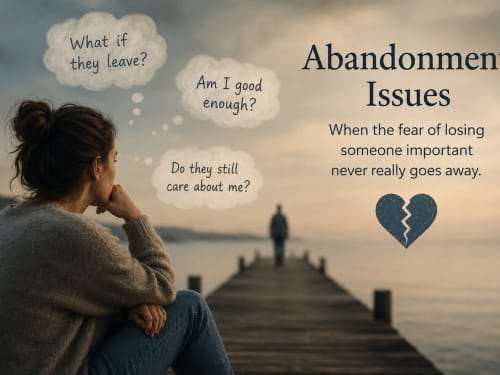
Most people experience fears of rejection or loss at some point in their lives. Relationships matter to us, and naturally we can feel upset when they change or come to an end. For some people, however, the fear of being abandoned becomes much more intense. A delayed text message can trigger panic. A partner needing space can feel like the beginning of the end. A small disagreement can create overwhelming fears of rejection. Even when relationships are stable and healthy, the mind continues searching for signs that something is wrong.
One helpful way to understand abandonment issues is through the analogy of a smoke alarm.
The Smoke Alarm That Became Too Sensitive
Imagine a smoke alarm installed to protect a house. Its job is simple. If there is a genuine fire, the alarm sounds and alerts everyone to danger. A well-functioning alarm is helpful because it only activates when there is a real threat.
Now imagine an alarm that has become overly sensitive. Instead of responding only to fire, it goes off whenever someone burns toast, boils a kettle, or lights a candle. The alarm sounds repeatedly, even when there is no genuine danger. Life becomes exhausting because everyone is constantly alert, waiting for the next alarm to sound.
This is often what happens with abandonment issues. The mind develops an alarm system designed to detect rejection, loss, or emotional distance. The problem is that the alarm becomes so sensitive that it begins responding to situations that are not actually threatening.
How Abandonment Issues Develop
Most people are not born fearing abandonment. These fears often develop through painful experiences. Perhaps someone experienced emotional neglect as a child. Perhaps a parent was inconsistent, unavailable, or left unexpectedly. Perhaps there was a difficult divorce, bullying, betrayal, or a painful relationship breakdown later in life.
The brain learns an important lesson from these experiences: relationships are not safe. As a result, it begins monitoring for signs that the same pain might happen again. The emotional alarm system becomes hypervigilant, constantly scanning for evidence that someone may leave, reject, or withdraw.
When the Alarm Misinterprets Everyday Events
Once abandonment fears take hold, ordinary relationship experiences can begin to feel threatening. A partner takes longer than usual to reply to a message. A friend cancels plans. A colleague seems quieter than normal. Most people may notice these events and move on, recognising that there are many possible explanations.
Someone struggling with abandonment fears, however, may immediately begin questioning what is wrong. They may wonder whether they have upset the other person, whether the relationship is changing, or whether they are about to be rejected. The emotional alarm sounds long before there is any genuine evidence of danger.
The Search for Reassurance
When the alarm is activated, it is natural to seek reassurance. People may repeatedly ask whether everything is okay, seek constant validation from partners, analyse conversations in detail, or carefully monitor other people's behaviour for signs of rejection.
Although reassurance often provides temporary relief, it can unintentionally strengthen the problem. Each time reassurance becomes necessary to feel safe, the brain learns that the threat must have been important. As a result, the alarm becomes even more sensitive and begins activating more frequently in the future.
How Abandonment Issues Affect Relationships
Ironically, abandonment fears can sometimes create the very difficulties a person hopes to avoid. Constant reassurance-seeking can place pressure on relationships and leave both people feeling frustrated. Fear of rejection may lead someone to become overly dependent on others for their sense of security and self-worth.
Some individuals respond in the opposite way. Rather than risk being hurt, they avoid emotional closeness altogether. They keep people at a distance, avoid vulnerability, or end relationships prematurely to protect themselves from potential rejection. Although these strategies may feel protective, they often prevent genuine connection from developing.
Learning That Not Every Alarm Means Danger
One of the most important parts of healing abandonment issues is recognising that emotional alarms are not always accurate. Just because anxiety is present does not mean rejection is occurring. Just because the alarm sounds does not mean there is a fire.
Therapy helps individuals learn the difference between genuine relationship difficulties and fears that are being driven by past experiences. Over time, the alarm system becomes less reactive, allowing relationships to feel safer and more manageable.
How Therapy Can Help
Therapy provides a safe space to explore the origins of abandonment fears and understand how they continue to influence present-day relationships. Many people discover that their current reactions make sense when viewed through the lens of earlier experiences.
Evidence-based approaches such as Cognitive Behavioural Therapy (CBT), Compassion-Focused Therapy (CFT), and attachment-focused therapies can help individuals challenge fears of rejection, improve self-esteem, build emotional resilience, and develop healthier relationship patterns. Therapy is not about becoming emotionally detached. Rather, it is about learning to respond to relationships in ways that are guided by the present rather than by past wounds.
Recovery Is About Feeling Secure, Not Certain
Many people with abandonment fears believe they need complete certainty before they can feel safe in a relationship. Unfortunately, certainty is something that no relationship can fully provide. Relationships always involve some degree of vulnerability, trust, and uncertainty.
Healing comes from developing confidence in your ability to cope with uncertainty rather than trying to eliminate it altogether. It means learning that moments of doubt do not automatically signal danger and recognising that your worth is not determined by whether someone stays or leaves.
Seeking Professional Support
If fears of abandonment are affecting your relationships, self-esteem, or emotional wellbeing, you are not alone. These patterns are often rooted in understandable experiences and can be changed with the right support.
At The London Psychologist Clinic, we help individuals understand the origins of their abandonment fears, build healthier relationships, and develop a stronger sense of emotional security. You do not have to live with a smoke alarm that is constantly sounding. With support, it is possible to feel safer, more confident, and more secure in your relationships.