


The Success Paradox
posted 29th May 2026
Click image to enlarge
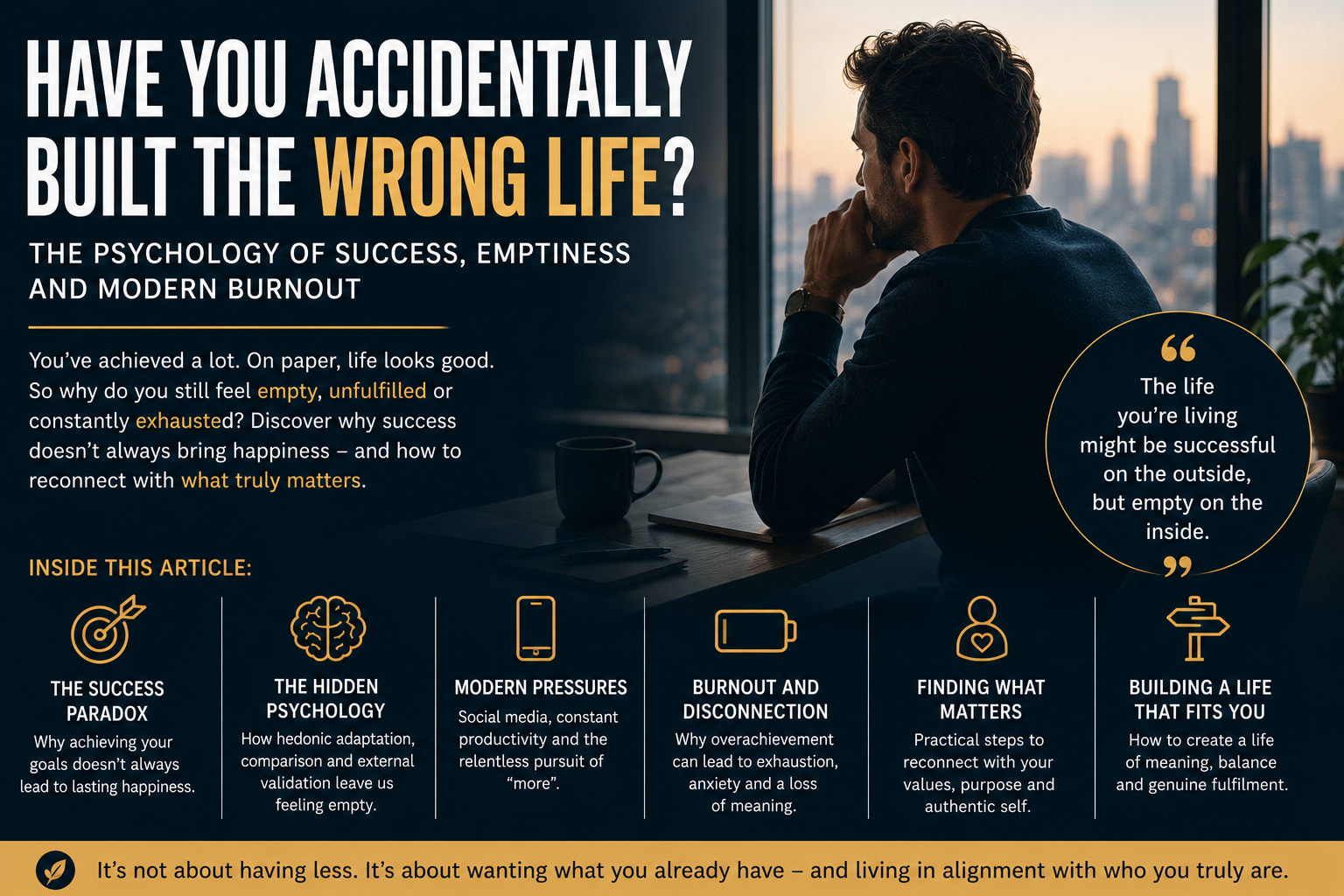
Why Does Life Feel Empty Even When Everything Is Going Well? The Hidden Psychology of Modern Discontent
Many people assume that happiness follows a simple formula. Work hard, build a career, find a partner, buy a home, create financial security and happiness should naturally follow. Yet psychologists increasingly encounter individuals who have achieved many of these goals and still find themselves asking a troubling question:
"Why don't I feel happier?"
On paper, everything looks fine. They may have a successful career, supportive relationships, financial stability and good physical health. Friends describe them as fortunate. Family members admire what they have accomplished. Yet privately, they experience a lingering sense of emptiness, dissatisfaction or emotional flatness that is difficult to explain.
This experience can feel confusing and even shameful. People often tell themselves they have no right to feel unhappy. After all, others are facing far greater challenges. The result is that many suffer in silence, believing there must be something wrong with them.
In reality, this experience is remarkably common.
One reason is that human beings are surprisingly poor at predicting what will make them happy. We frequently believe that achieving a particular goal will provide lasting fulfilment. We imagine that the promotion, relationship, house or salary increase will create a permanent shift in how we feel.
Often it does—briefly.
Psychologists refer to this phenomenon as hedonic adaptation. Human beings quickly become accustomed to positive changes. The promotion becomes normal. The new house becomes familiar. The achievement that once felt extraordinary gradually becomes part of everyday life.
The problem is not that these accomplishments are meaningless. The problem is that they rarely provide the lasting emotional transformation people expect.
Many individuals spend years climbing what they believe is the right ladder, only to discover they are leaning it against the wrong wall.
Another factor is that modern society places enormous emphasis on achievement but relatively little emphasis on meaning. From an early age, people are encouraged to focus on grades, careers, productivity and measurable success. These goals are not inherently problematic, but they can leave little room for deeper questions.
What gives my life purpose?
What kind of person do I want to be?
What genuinely matters to me?
Without these foundations, people can find themselves constantly moving forward without understanding why.
Technology has intensified this problem. We live in an age of unprecedented convenience, yet many people feel increasingly disconnected. Social media allows us to observe thousands of lives whilst feeling less connected to our own. Endless entertainment provides distraction but not necessarily fulfilment. We are busier than ever, yet many struggle to identify moments of genuine presence and contentment.
Perhaps the greatest irony is that many people spend years chasing freedom only to fill every spare moment with more activity.
Silence becomes uncomfortable.
Stillness feels unproductive.
Being alone with our thoughts can feel unsettling.
As a result, many people remain constantly distracted, rarely pausing long enough to understand what they are actually feeling.
This is where emptiness often begins.
It is not always a sign that something is missing from your life. Sometimes it is a sign that something is missing from your relationship with yourself.
Psychologists frequently find that individuals experiencing chronic dissatisfaction have become disconnected from their values. They are living according to expectations inherited from family, culture or social media rather than pursuing what genuinely matters to them.
The career may be successful, but not meaningful.
The relationship may be stable, but emotionally distant.
The lifestyle may appear impressive, but feel strangely hollow.
When people begin exploring these discrepancies, they often discover that the emptiness is not random. It is information. It is the mind's way of signalling that certain emotional needs are not being met.
This does not necessarily mean making dramatic life changes. Sometimes the solution is not changing careers, ending relationships or moving to another country. More often, it involves reconnecting with neglected parts of ourselves.
Meaningful relationships.
Creativity.
Personal growth.
Contribution.
Authenticity.
Play.
Curiosity.
These experiences tend to provide a deeper form of fulfilment than external achievements alone.
Importantly, feeling empty is not the same as being depressed. Depression often involves persistent low mood, hopelessness, loss of pleasure and significant impairment in daily functioning. Emptiness can exist alongside a perfectly functional life. The individual continues working, socialising and meeting responsibilities, yet something feels absent beneath the surface.
However, if left unaddressed, chronic emptiness can contribute to anxiety, burnout, depression and unhealthy coping strategies.
Many people attempt to fill the void through work, spending, food, alcohol, social media or constant busyness. These solutions may provide temporary relief, but they rarely address the underlying issue.
The more sustainable approach involves curiosity rather than avoidance.
Instead of asking, "How do I stop feeling this way?" it can be more helpful to ask, "What is this feeling trying to tell me?"
Often, the answer reveals something important.
Perhaps you have spent years pursuing goals that no longer matter.
Perhaps you have neglected relationships that once brought joy.
Perhaps you have become so focused on achievement that you have forgotten how to simply experience life.
The feeling of emptiness is uncomfortable, but it is not necessarily an enemy. Sometimes it is an invitation. A signal that part of you wants to be heard.
The people who ultimately find fulfilment are not always those with the most success, wealth or recognition. More often, they are the individuals who understand what genuinely matters to them and have the courage to build a life around those values.
The question is not whether your life looks successful from the outside.
The question is whether it feels meaningful from the inside.
And sometimes, that is the most important psychological question of all.