


The Spotlight Effect: Why We Think Everyone Is Watching Us
posted 5th June 2026
The Spotlight Effect: Why We Think Everyone Is Watching Us
Have you ever tripped in public and felt as though everyone noticed?
Perhaps you've given a presentation and spent the rest of the day replaying a small mistake that nobody else seemed to remember. Maybe you've worried about a stain on your shirt, a typo in an email, or an awkward comment during a conversation, convinced that everyone is still thinking about it.
If so, you've experienced what psychologists call The Spotlight Effect.
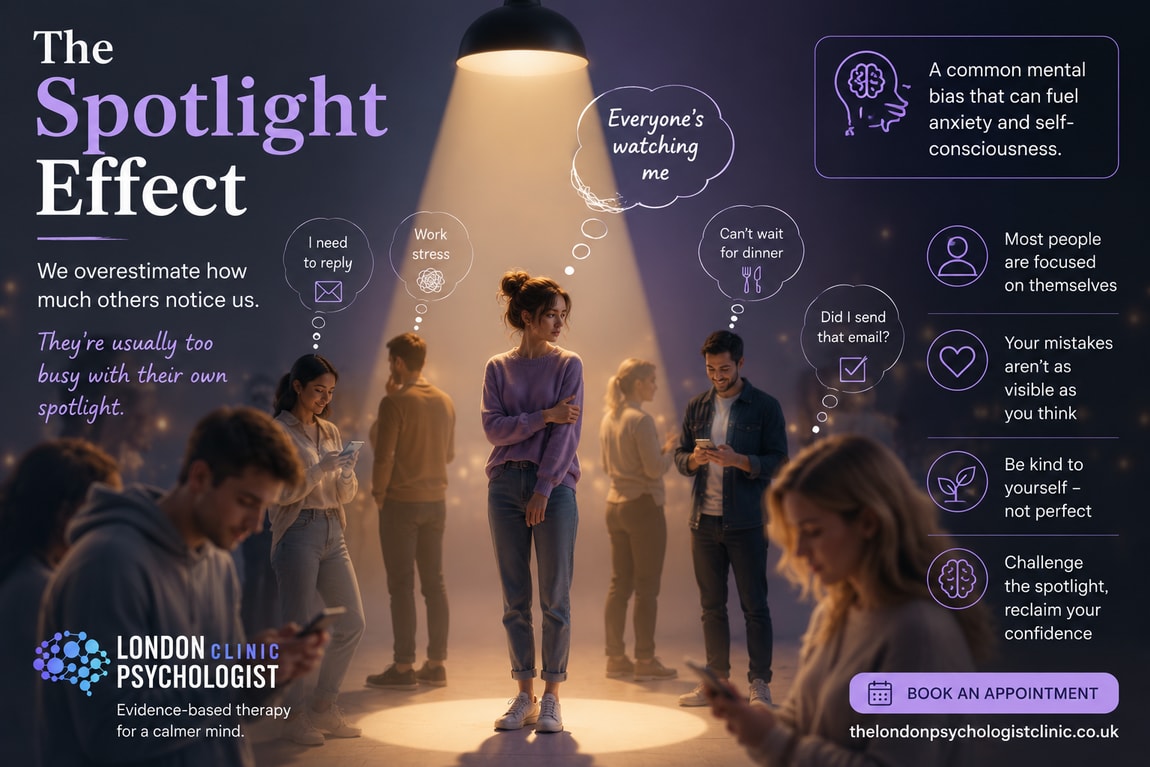
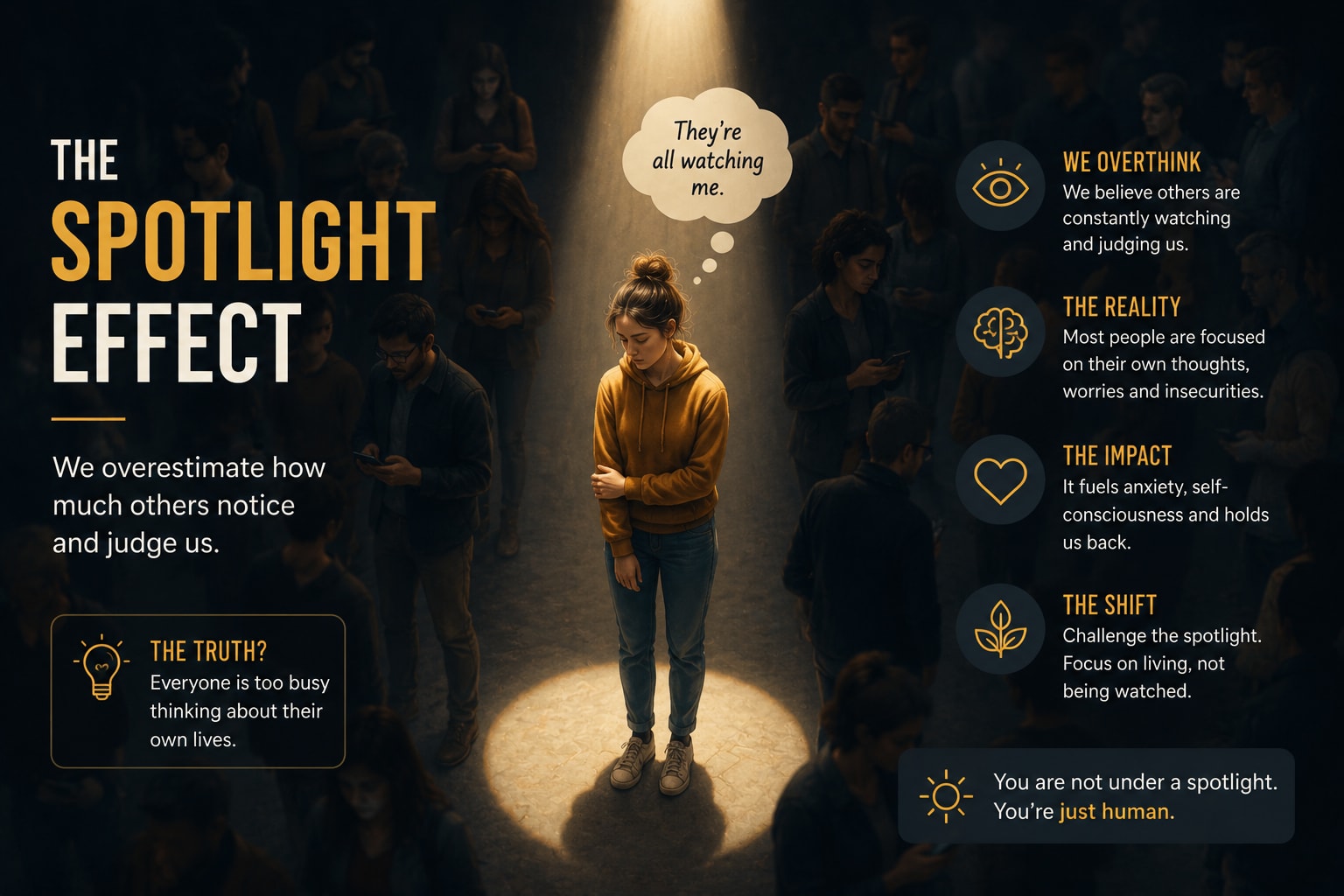
The Spotlight Effect is a common cognitive bias that causes us to overestimate how much other people notice, judge and remember our actions. In reality, most people are far more focused on themselves than they are on us.
At The London Psychologist Clinic, we often see how the Spotlight Effect can contribute to social anxiety, self-consciousness and low self-confidence. Understanding this psychological phenomenon can be surprisingly liberating.
What Is the Spotlight Effect?
The Spotlight Effect refers to our tendency to believe that we are being observed more closely than we actually are.
We behave as though a spotlight is constantly shining on us, highlighting our mistakes, flaws and embarrassing moments for everyone to see.
In reality, other people are usually paying far less attention than we imagine.
This bias was first explored by psychologists Thomas Gilovich and colleagues, who found that individuals consistently overestimated how many people noticed things about them, including embarrassing clothing and mistakes.
Why Does It Happen?
The answer lies in the way the brain processes information.
Each of us experiences life from our own perspective. Our thoughts, emotions and actions occupy the centre of our attention throughout the day.
Because our own experiences feel so vivid and important to us, we naturally assume they are equally noticeable to everyone else.
Psychologists refer to this as egocentric bias.
This doesn't mean we are selfish. It simply means that our brains use our own perspective as a starting point when trying to understand the world.
The result is that we often overestimate our significance within other people's thoughts.
Common Examples of the Spotlight Effect
The Spotlight Effect appears in everyday situations.
- Believing everyone noticed a mistake during a presentation
- Worrying excessively about a bad haircut
- Feeling embarrassed after stumbling over words
- Thinking people are judging your appearance
- Obsessing over a social media post
- Assuming others remember your mistakes long after they have forgotten them
Many people spend hours worrying about events that others barely noticed.
The Link Between Social Anxiety
For individuals experiencing social anxiety, the Spotlight Effect can become particularly powerful.
The DSM-5-TR describes Social Anxiety Disorder as involving a marked fear of social situations where an individual may be scrutinised by others.
People with social anxiety often:
- Overestimate how negatively they are being evaluated
- Focus intensely on perceived flaws
- Replay social interactions repeatedly
- Avoid situations where they might be judged
The Spotlight Effect can reinforce these fears, making social situations feel far more threatening than they actually are.
The Reality: Everyone Has Their Own Spotlight
One of the most reassuring discoveries in psychology is that most people are experiencing their own Spotlight Effect.
While you are worrying about how you appeared in a meeting, somebody else is worrying about what they said.
While you are thinking about a mistake you made yesterday, another person is focused on their own concerns.
In other words, people are generally too busy thinking about themselves to spend much time analysing you.
How the Spotlight Effect Affects Mental Health
When left unchecked, the Spotlight Effect can contribute to:
- Social anxiety
- Low self-esteem
- Perfectionism
- Fear of embarrassment
- Avoidance behaviours
- Excessive self-criticism
Many individuals limit opportunities, relationships and experiences because they overestimate how closely others are paying attention.
How to Reduce the Spotlight Effect
Fortunately, there are ways to challenge this bias.
- Ask yourself what evidence exists that people noticed
- Consider how often you remember other people's mistakes
- Shift attention away from yourself and onto the situation
- Practice self-compassion when mistakes occur
- Accept that occasional embarrassment is a normal part of being human
Many clients find it helpful to ask themselves:
"If somebody else made this mistake, how long would I think about it?"
The answer is usually: not very long.
How Therapy Can Help
Therapy can be particularly helpful for individuals whose fear of judgement is affecting their quality of life.
Evidence-based approaches such as Cognitive Behavioural Therapy (CBT) can help individuals:
- Challenge unhelpful assumptions
- Reduce self-focused attention
- Build confidence in social situations
- Develop healthier thinking patterns
- Overcome avoidance behaviours
Learning that you are not under constant scrutiny can be an incredibly freeing experience.
Final Thoughts
The Spotlight Effect reminds us that our minds are not always accurate observers of reality.
Although it often feels as though everyone is watching, judging and remembering our mistakes, the truth is usually much simpler: most people are occupied with their own lives, concerns and insecurities.
Recognising this can reduce anxiety, increase confidence and make it easier to participate fully in life without fear of constant judgement.
The spotlight is rarely as bright as we think it is.
Click image to enlarge