


The Spotlight Effect at Work
posted 24th July 2026
Click image to enlarge
The Spotlight Effect at Work: Why You Think Everyone Is Watching You (When They're Probably Not)
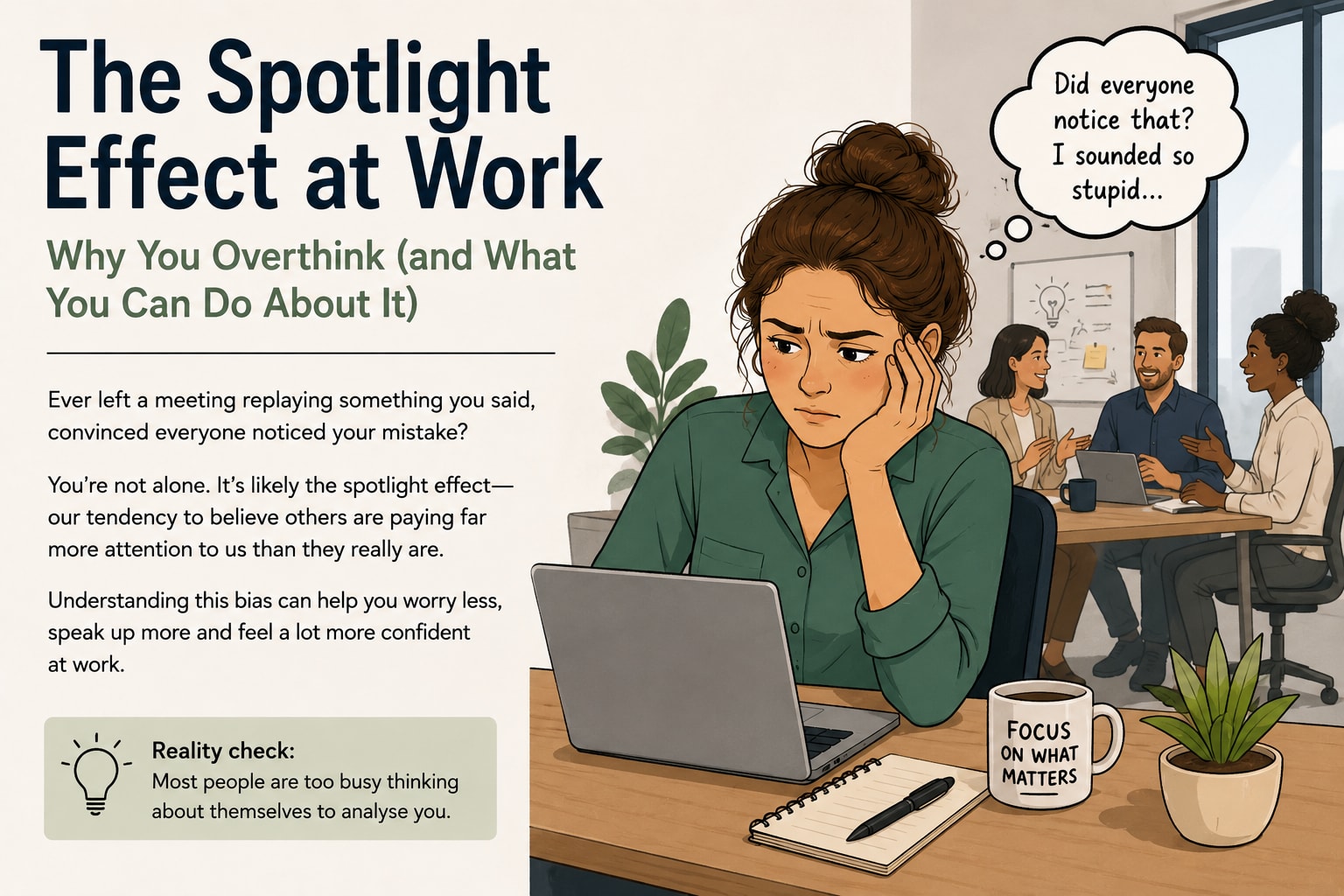
Have you ever walked out of a meeting convinced everyone noticed you stumble over a sentence? Perhaps you forgot someone's name during a presentation, spotted a typo in an email moments after pressing send, or asked a question that felt obvious the second the words left your mouth. Long after the meeting has finished, you're still replaying the moment in your mind, wondering whether your colleagues now see you differently. Meanwhile, they have almost certainly moved on to thinking about their own workload, their next deadline or what they are having for lunch.
This surprisingly common experience is known in psychology as *the Spotlight Effect*. It describes our tendency to overestimate how much other people notice our appearance, behaviour and mistakes. In simple terms, we often feel as though there is a spotlight shining directly on us, when in reality most people are paying far less attention than we imagine.
The reason this happens lies in the way our brains process the world. We experience every conversation, every presentation and every awkward moment from our own perspective. Our thoughts and emotions are vivid because we are living them in real time. We cannot step outside our own minds, so our experiences naturally feel significant. Without realising it, we assume those experiences are equally significant to everyone else. Psychologists describe this as an egocentric bias. Despite the name, it has nothing to do with arrogance or selfishness. It simply reflects the fact that we use our own perspective as the starting point for understanding the world around us.
One of the most influential studies on the Spotlight Effect was carried out by psychologists Thomas Gilovich, Victoria Medvec and Kenneth Savitsky at Cornell University. Participants were asked to wear an embarrassing Barry Manilow T-shirt before entering a room full of strangers. Afterwards, they estimated that around half the people in the room had noticed what they were wearing. In reality, only a relatively small number of people remembered the T-shirt at all. The participants felt as though everyone was looking at them because they were highly aware of the shirt themselves. Everyone else, however, was preoccupied with their own thoughts and concerns.
Exactly the same process happens every day in workplaces across the world. A manager loses their train of thought during a presentation and assumes everyone noticed. A graduate employee worries they sounded inexperienced after asking a question. Someone accidentally calls a colleague by the wrong name or sends an email with a spelling mistake and imagines it has damaged their professional reputation. Another employee spends the entire journey home replaying an awkward interaction with their manager, convinced they came across as incompetent. Yet the people involved have often forgotten the moment almost as quickly as it happened.
The Spotlight Effect can have a surprisingly powerful influence on workplace behaviour. Many people begin holding themselves back because they believe every mistake will be remembered and judged. They contribute less during meetings, avoid presentations, hesitate before sharing new ideas or spend excessive amounts of time checking work that is already good enough. Others become reluctant to ask questions because they fear appearing less knowledgeable than their colleagues. Ironically, it is often this self-imposed silence that limits confidence and career progression, rather than the small mistakes they are trying so hard to avoid.
For people with perfectionistic tendencies, the Spotlight Effect can feel even more intense. Perfectionists often believe that competence means getting everything right the first time. A small error is interpreted not as a normal part of working life but as evidence that they are inadequate or not intelligent enough. A presentation that goes well overall can become overshadowed by one sentence that did not come out quite as planned. Instead of remembering the positive feedback they received, they become fixated on a single imperfection that almost nobody else noticed.
Modern working life has made this tendency even stronger. Video conferencing means we often spend meetings looking at our own faces as much as everyone else's. Emails can be reread repeatedly before being sent, encouraging overanalysis, while instant messaging allows conversations to be revisited again and again. Technology has increased our self-awareness, and with it, the mistaken belief that everyone else is scrutinising us just as closely.
One of the simplest ways to challenge the Spotlight Effect is to reverse the situation. Think about the people you work with every day. Can you remember every time they hesitated during a presentation? Every typo they sent in an email? Every awkward comment they made during a meeting? Most people cannot, because they were too busy thinking about their own work. The same is almost certainly true for your colleagues. They are far more focused on managing their own responsibilities than analysing yours.
Understanding the Spotlight Effect encourages a more compassionate way of thinking about ourselves. Confidence is not about never making mistakes. It is about recognising that mistakes are an inevitable part of being human and that they are rarely as memorable to others as they are to us. Some of the most respected professionals occasionally lose their train of thought, forget a colleague's name or ask a question they later wish they had phrased differently. Their credibility comes from their consistency, integrity and expertise over time—not from appearing flawless in every interaction.
The next time you find yourself replaying an awkward moment at work, pause and ask yourself one question: "Will anyone else still be thinking about this tomorrow?" More often than not, the answer is no. Most people are not spending their day analysing your mistakes. They are far too busy worrying about whether anyone noticed their own.
Recognising this can be remarkably liberating. It allows us to contribute more confidently, speak up without fearing every imperfection and accept that professional success is built on learning, adapting and growing—not on never getting anything wrong. The spotlight we imagine shining on us is usually much dimmer than we think, and in many cases, it was never switched on in the first place.