


The Psychology of Workplace Provocation
posted 24th July 2026
Click image to enlarge
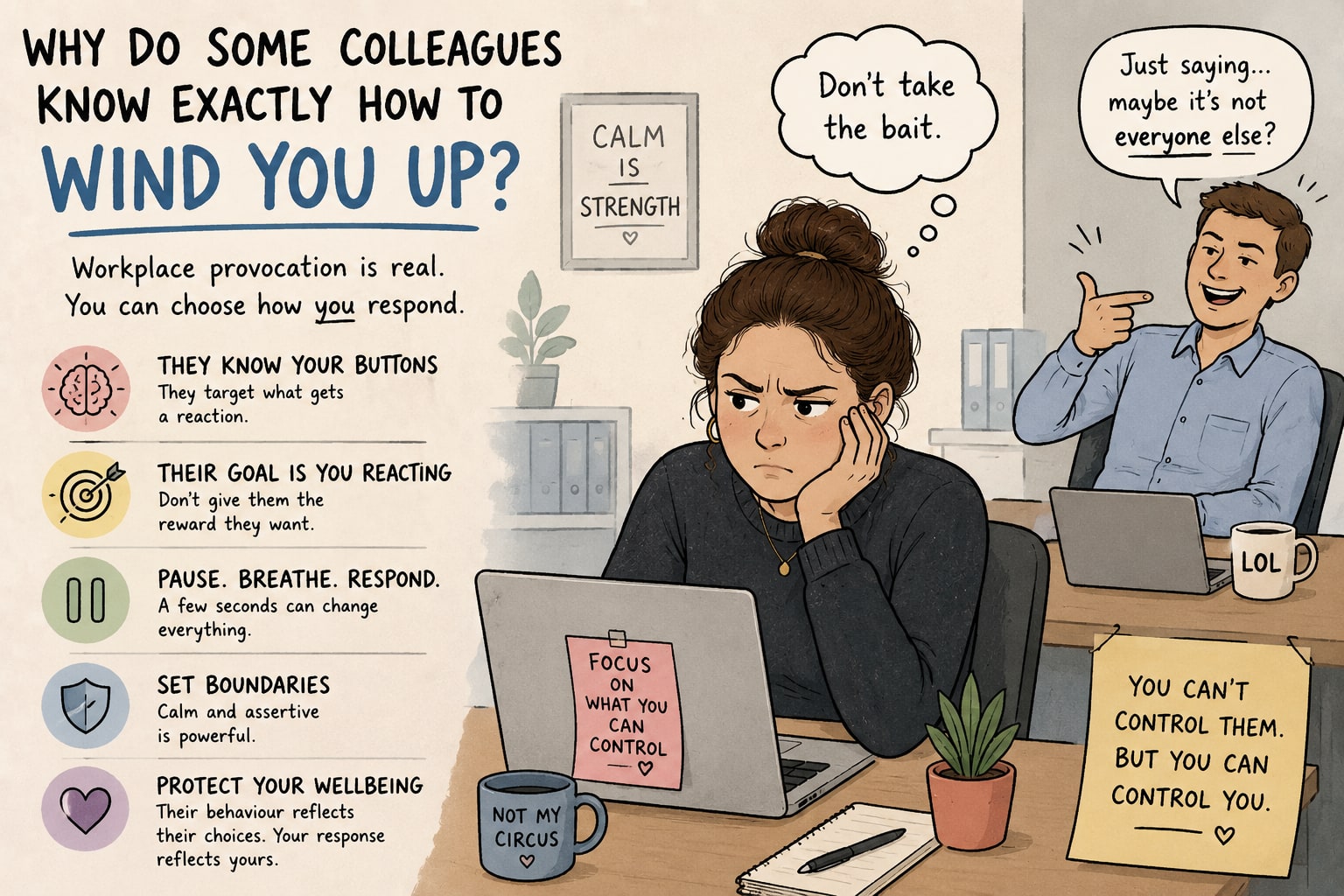
Why Do Some Colleagues Know Exactly How to Wind You Up? The Psychology of Workplace Provocation
Most of us have encountered them at some point in our careers. The colleague who makes subtle digs during meetings. The manager who always seems to question your work in front of others. The team member who disguises criticism as humour before quickly adding, "I'm only joking." Perhaps they interrupt you repeatedly, dismiss your ideas, take credit for your contributions or deliberately say something they know will provoke a reaction. What makes these interactions particularly frustrating is that you often recognise exactly what is happening. You know they are trying to get under your skin, yet you still find yourself becoming upset. The question is why.
The answer lies in how the human brain responds to social threat. Many people believe emotional regulation is simply a matter of self-control, but psychology tells us that our emotional brain reacts long before our rational brain has had time to evaluate the situation. When someone publicly criticises you, questions your competence or undermines your credibility, your brain does not simply process the words they have spoken. It interprets the interaction as a potential threat to your professional reputation, social standing and even your future within the organisation. Within seconds your nervous system begins releasing stress hormones, your heart rate increases and your attention narrows as your brain prepares you to defend yourself. Only afterwards does your logical mind catch up and remind you that reacting emotionally is unlikely to help.
Not every difficult colleague is intentionally manipulative. High workloads, poor communication skills, personality differences and workplace pressures can all lead to conflict. However, there are individuals who appear to gain something from provoking emotional reactions in others. For some, it creates a sense of control. Others use it to establish dominance within the team, while some project their own insecurities onto colleagues in an attempt to feel more competent themselves. Whatever their motivation, the pattern is often remarkably similar. They learn which comments affect you most and repeatedly return to those same vulnerabilities.
These behaviours are rarely obvious acts of aggression. Instead, they are often subtle enough to be dismissed if challenged. A colleague may publicly correct a minor mistake while overlooking their own. Someone might repeatedly interrupt you during meetings but become offended if you do the same. Another person may present your idea as their own or make sarcastic remarks that leave you feeling belittled while insisting that you have "no sense of humour." Others may exclude you from important conversations, question your judgement in front of senior staff or imply that you are overreacting whenever you express concern. Over time these seemingly small interactions accumulate, gradually eroding confidence and increasing anxiety.
Many people become frustrated with themselves because they recognise the pattern but still react emotionally. They tell themselves, "I knew exactly what they were trying to do," or "I promised myself I wouldn't let them get to me." This can lead to feelings of self-criticism, as though they have somehow failed. In reality, there is nothing unusual about this response. Knowing something intellectually is very different from regulating it emotionally. The emotional centres of the brain respond automatically, whereas the areas responsible for reasoning and self-control require more time to become involved. Recognising manipulation is therefore only the first step. Learning to respond differently takes practice.
Repeated workplace provocation can have a significant psychological impact. People often begin dreading meetings, replaying conversations long after they have finished or constantly anticipating criticism before it even happens. Confidence gradually declines, concentration becomes more difficult and work that once felt enjoyable can begin to feel emotionally exhausting. Some individuals become hypervigilant, analysing every interaction for signs of conflict or rejection. When this happens, the workplace no longer feels psychologically safe, and the emotional cost can extend far beyond office hours.
One of the biggest mistakes people make is believing they must win the argument. They explain themselves repeatedly, defend every decision and attempt to convince the other person that they are being unreasonable. Unfortunately, someone whose objective is to provoke is rarely interested in finding a solution. They are interested in keeping you emotionally engaged. Every defensive explanation, every visible frustration and every angry response confirms that they still have influence over your emotional state.
A more helpful question to ask yourself is not, "How do I prove them wrong?" but rather, "What outcome are they hoping for?" This simple shift in perspective changes the nature of the interaction. If the other person is seeking an emotional reaction, refusing to provide one often removes the reward that maintains their behaviour. This does not mean pretending you are unaffected. Instead, it means recognising that you have a choice about how and when you respond.
One of the most effective psychological skills is creating a small pause between emotion and action. Taking a slow breath before replying, allowing a brief silence after a provocative comment or deliberately slowing your speech gives your rational brain time to become involved. These moments may only last a few seconds, but they significantly improve your ability to choose a response rather than simply reacting impulsively. Emotional regulation is not about suppressing feelings. It is about preventing those feelings from dictating your behaviour.
Remaining calm should never be confused with weakness. Many people worry that staying composed means allowing poor behaviour to continue, yet the opposite is usually true. Calm, assertive communication is often far more effective than emotional confrontation. Saying, "I'd appreciate the opportunity to finish my point," or "I'd prefer feedback to be given privately," establishes clear boundaries while maintaining professionalism. Assertiveness protects both your credibility and your wellbeing without escalating unnecessary conflict.
It is also important to remember that another person's behaviour is not an objective reflection of your ability. Many of us invest a significant part of our identity in our work. We want to be respected, competent and valued by those around us. Consequently, repeated criticism or humiliation can begin affecting how we see ourselves. However, some of the loudest critics in the workplace are driven by their own insecurities rather than by an accurate assessment of someone else's performance. Protecting your self-esteem requires recognising the difference between constructive feedback designed to help you improve and comments intended simply to undermine your confidence.
There is also a point at which workplace provocation becomes something more serious. Occasional disagreements are an inevitable part of working life, but persistent patterns of humiliation, intimidation, exclusion or deliberate undermining may constitute workplace bullying. If these behaviours are repeated and begin affecting your mental health, it is important to document incidents, seek advice from trusted colleagues or managers and familiarise yourself with your organisation's policies on bullying and harassment. Psychological safety is not a luxury in the workplace; it is fundamental to both wellbeing and performance.
Therapy can also play an important role in helping people navigate these situations. Rather than simply teaching relaxation techniques, psychological therapy helps individuals understand why certain behaviours affect them so deeply, strengthen emotional regulation, build healthier self-esteem and develop assertive communication skills. It also helps reduce the tendency to ruminate after difficult interactions, allowing people to leave work at work instead of carrying emotional distress into their personal lives.
Ultimately, you cannot control whether another person chooses to behave unprofessionally. You cannot stop every sarcastic remark, every unnecessary criticism or every attempt to undermine your confidence. What you can control is whether they continue to dictate your emotional state. Psychological resilience is not about becoming emotionless. It is about recognising your emotional response, understanding why it has been triggered and choosing a response that protects both your wellbeing and your self-respect. In the workplace, one of the greatest signs of emotional strength is not the absence of emotion, but the ability to remain grounded when someone else is trying to knock you off balance.