


The Psychology of Exams
posted 5th March 2026
The Final Weeks Before Exams: Understanding the Psychology of GCSE and A-Level Stress
There is a fairly predictable psychological pattern many students go through in the last 6–8 weeks of school, particularly when a clear endpoint like exams or leaving day is approaching. It’s not an official diagnostic model, but teachers, psychologists, and education researchers frequently observe the same sequence of motivation shifts as the brain processes an approaching deadline.
1. The “Plenty of Time” Phase
This usually happens when the end is still about 7–8 weeks away. Students know the finish line exists, but it still feels psychologically distant. The brain treats the deadline as abstract rather than urgent, which means motivation tends to be moderate but inconsistent. Procrastination is common during this phase because the perceived cost of delaying work feels low.
From a cognitive perspective, the brain is still operating under what psychologists call temporal discounting—future consequences don’t feel as important as present comfort.
2. The Motivation Dip
Around 5–6 weeks before the end, motivation often drops. This is the stage where students become more distracted, restless, or disengaged from routine work. The brain is aware that the end of school is approaching, which can reduce the perceived importance of normal classroom activities. At the same time, the deadline still doesn’t feel immediate enough to trigger urgency.
Teachers often notice increased daydreaming, reduced focus, or students mentally “checking out” during this period.
3. The Awareness Shift
At around 3–4 weeks remaining, something changes psychologically. The deadline stops feeling distant and starts feeling real. Students begin to mentally calculate how much time is left and what still needs to be done.
This is when anxiety often begins to rise slightly. It isn’t necessarily negative—moderate anxiety can actually improve focus because the brain starts prioritising tasks that matter.
4. The Panic Productivity Phase
With 2–3 weeks left, the brain enters what many people recognise as “panic productivity.” The perceived time pressure becomes strong enough to override procrastination habits. Students often become noticeably more focused and productive during this stage because the cost of not acting now feels high.
This phase is driven by a combination of deadline pressure and adrenaline, which increases attention and task persistence.
5. The Final Push
During the last week, motivation usually peaks again, but it can look different from earlier productivity. Students often become very aware that a chapter of life is ending. Some feel relief, others excitement, and some experience a surprising amount of nostalgia.
The brain is essentially transitioning from a performance mindset to a closure mindset, preparing for change.
Why this pattern happens
The brain responds strongly to clear deadlines, but it tends to ignore them until they become psychologically close. Humans are not very good at sustaining long-term urgency, so motivation naturally rises and falls depending on how near the end feels.
In practical terms, that’s why many people do their most focused work when a deadline suddenly feels real.
The interesting part
Ironically, the period that feels the most stressful—the final few weeks—is often when people produce their best work, because the brain is operating at maximum focus.
So if someone feels their motivation fluctuating in the last weeks of school, it’s actually a very normal cognitive response to approaching deadlines, not a personal failing.
The Final Weeks Before Exams: Understanding the Psychology of GCSE and A-Level Stress
Every spring across the UK, a familiar tension begins to build in homes with teenagers preparing for GCSEs and A-levels. Revision timetables appear on kitchen tables, conversations increasingly revolve around grades and university options, and many families feel the emotional pressure rising together. For students the stakes can feel enormous. For parents—particularly those already managing their own stress or mental health difficulties—the period leading up to exams can become just as challenging.
From a psychological perspective, however, many of the emotional patterns that emerge during the final weeks of exam preparation are not unusual. In fact, they often follow a surprisingly predictable rhythm linked to how the brain processes deadlines, pressure and motivation. Understanding this pattern can help both students and parents interpret what they are experiencing more calmly and respond in healthier ways.
Why the Last Weeks Feel So Intense
The human brain does not respond to distant deadlines in the same way it responds to immediate ones. Psychologists describe this phenomenon as temporal discounting—the tendency to treat future consequences as less urgent than present ones. When exams are several months away, even highly motivated students may struggle to sustain consistent focus because the brain does not yet perceive the deadline as immediate.
As exams approach, however, the brain’s perception of urgency changes. Stress hormones such as cortisol and adrenaline increase slightly, sharpening attention and increasing motivation. In moderate amounts this stress response is actually helpful. It improves concentration, memory consolidation and task persistence—mechanisms that are essential during periods of intensive study.
The difficulty arises when the stress response becomes too strong or when families misinterpret normal fluctuations in motivation as signs of failure or laziness. In reality, many students move through several predictable phases in the weeks before exams.
The Psychological Stages of the Final Exam Period
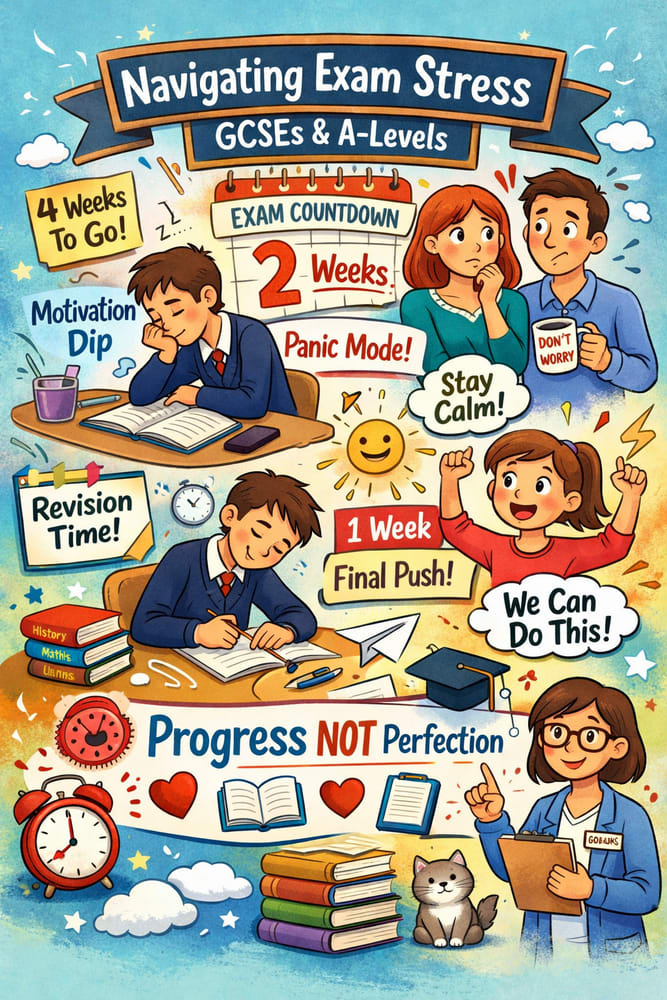
Several weeks before exams, students often experience what might be called a motivation dip. Even when they know exams are approaching, the deadline can still feel psychologically distant. During this stage concentration may fluctuate and students may appear disengaged from routine work. Parents sometimes worry that this reflects a lack of seriousness, but in many cases it is simply the brain responding normally to a deadline that does not yet feel urgent.
Around four weeks before exams, something tends to shift. The deadline begins to feel real rather than theoretical. Students start calculating how much time remains and what still needs to be learned. This stage often brings a modest increase in anxiety. While anxiety is frequently viewed negatively, research in educational psychology shows that moderate levels of stress can enhance performance by increasing alertness and motivation.
In the final two to three weeks, many students enter what teachers often recognise as a period of intense productivity. The approaching deadline activates the brain’s threat-response system in a controlled way, encouraging sustained focus. This is why students sometimes accomplish large amounts of revision in a relatively short period. The brain is prioritising what matters most.
The final week often brings a mixture of emotions: relief, exhaustion, anticipation and sometimes nostalgia as a major chapter of life comes to an end. For many families this emotional intensity can feel overwhelming, particularly when everyone has invested so much energy in the outcome.
Why Parents Often Feel the Pressure Too
Exam periods are not stressful only for students. Parents frequently experience their own form of performance anxiety, particularly if they feel responsible for creating the right conditions for success. Concerns about future opportunities, university admissions or career paths can lead parents to monitor revision closely or worry about whether their child is doing enough.
For parents already managing anxiety, depression or chronic stress, this period can amplify existing pressures. It is not uncommon for parents to feel as though the entire household atmosphere revolves around exam performance.
From a psychological perspective, it is helpful to remember that adolescents are still developing their executive functioning skills—the cognitive abilities that regulate planning, organisation and impulse control. What appears to be procrastination is sometimes simply the developmental reality of a teenage brain that is still learning to manage long-term goals.
Understanding this can reduce unnecessary conflict between parents and teenagers during an already demanding time.
Supporting Students Without Increasing Pressure
Research consistently shows that the most helpful parental role during exam periods is not constant monitoring but emotional stability. Students tend to perform better when they feel supported rather than scrutinised.
Creating a calm environment can be far more valuable than enforcing rigid revision schedules. Encouraging balanced routines that include breaks, sleep, exercise and social contact helps regulate the brain’s stress response and improves cognitive functioning.
Sleep is particularly important. Memory consolidation—the process by which information studied during the day becomes stored in long-term memory—occurs primarily during sleep. Students who sacrifice sleep to study late into the night often find that their recall suffers as a result.
Parents can also help by reframing exams as important but not defining events. While GCSEs and A-levels are significant milestones, they rarely determine the entirety of a person’s future opportunities. When young people believe that a single set of exams will define their life trajectory, anxiety can become overwhelming.
Recognising When Stress Becomes a Problem
Although some stress is normal during exam periods, there are times when additional support may be helpful. Warning signs can include persistent sleep disruption, significant mood changes, panic attacks, or a student becoming completely unable to study due to anxiety.
Parents may also notice their own stress levels escalating, particularly if they are already coping with mental health challenges. In these situations, seeking guidance from a psychologist can help families develop strategies to manage pressure more effectively.
Professional support can assist students in developing healthy coping mechanisms, realistic thinking patterns and effective revision habits, while also helping parents maintain a supportive environment at home.
A Healthier Perspective on Exams
Exams represent an important step in a young person’s educational journey, but they are not the sole measure of intelligence, capability or future success. Many successful careers follow pathways that are far from linear. What matters far more in the long term are qualities such as resilience, curiosity and adaptability.
The weeks before exams can feel intense for families, but understanding the psychology behind motivation, stress and deadlines can make the experience more manageable. When students feel supported rather than judged, and when parents allow themselves to approach the period with perspective, exam season becomes less of a crisis and more of a temporary challenge that can be navigated together.
For both students and parents, the most helpful message during this time may simply be this: the goal is not perfection, but progress.