


The Psychology of Endless Scrolling
posted 25th June 2026
Click image to enlarge
Why You Can't Put Your Phone Down: The Psychology of Endless Scrolling
Have you ever opened your phone intending to reply to one message, only to discover that forty minutes have passed and you are still scrolling? Most of us have experienced this at some point. It is easy to blame a lack of willpower, but psychology tells a very different story. The truth is that modern social media platforms are not simply entertaining—they are carefully engineered to capture and maintain our attention using principles that behavioural psychologists first described decades ago.
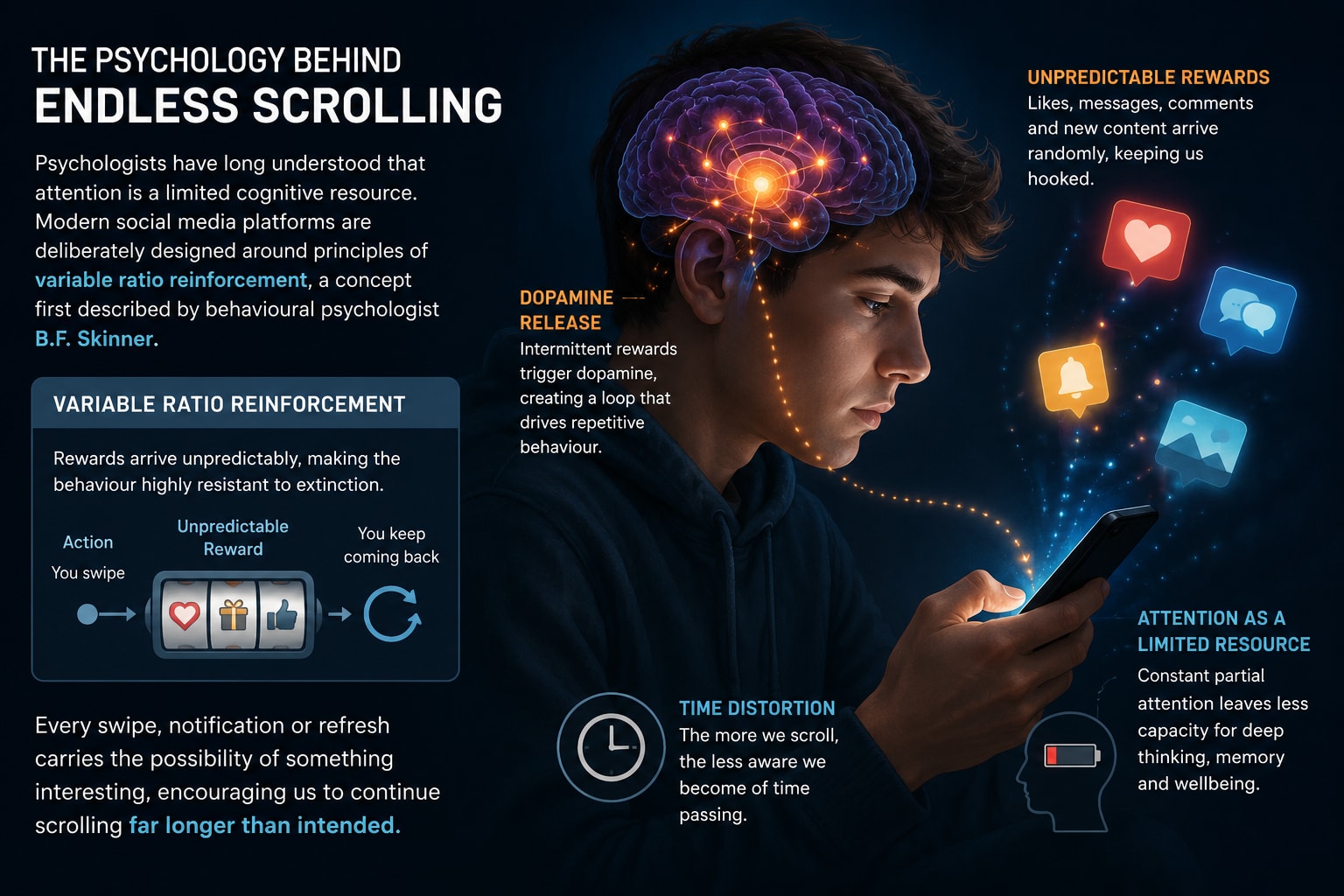
One of the most powerful psychological concepts behind social media is known as variable ratio reinforcement. First identified by behavioural psychologist B.F. Skinner, this pattern of reinforcement occurs when rewards are delivered unpredictably rather than consistently. Skinner demonstrated that behaviours reinforced on an unpredictable schedule become remarkably persistent because individuals never know when the next reward will appear. In his laboratory experiments, animals continued responding for long periods because the possibility of a reward always remained.
Although humans are far more complex than laboratory animals, the same psychological principle influences many everyday behaviours. Every time we refresh a social media feed, open a messaging app or check our notifications, we are presented with uncertainty. There may be an interesting post, a flattering comment, exciting news, or there may be nothing at all. It is precisely this unpredictability that makes the behaviour so difficult to stop.
Unlike receiving a reward every single time, unpredictable rewards create anticipation. Neuroscientists have shown that the brain's reward system responds particularly strongly when outcomes are uncertain. Dopamine, a neurotransmitter involved in motivation, learning and reward prediction, becomes active not simply when we receive something enjoyable, but when we anticipate the possibility of receiving it. This anticipation encourages us to continue checking, refreshing and scrolling, even when there is little of genuine value to discover.
Modern social media companies understand this principle exceptionally well. Infinite scrolling, personalised recommendations, algorithmically selected content and intermittent notifications all encourage users to remain engaged for longer periods. Every swipe represents another opportunity to encounter something emotionally significant. Perhaps the next video will be hilarious, perhaps the next message will bring good news, or perhaps the next post will validate our opinions. Because we never know what comes next, we continue searching.
Psychologists have long understood that attention is a limited cognitive resource. Our brains cannot maintain deep concentration indefinitely. Every notification, every vibration and every visual interruption competes for that limited resource. As we repeatedly switch between tasks, our cognitive system becomes increasingly fragmented. Rather than maintaining sustained attention on one activity, we begin operating in a state of continuous partial attention, where our focus constantly shifts between multiple competing sources of information.
Research conducted by psychologist Dr Gloria Mark at the University of California has found that our average attention on a single screen before switching tasks has declined dramatically over the past two decades. Importantly, this does not necessarily mean our brains are becoming permanently damaged. Instead, our brains are adapting to an environment characterised by constant novelty and rapid changes in information. Neuroplasticity allows the brain to strengthen whichever attentional habits we repeatedly practise—for better or worse.
This distinction is particularly important in clinical psychology. Many people worry that their inability to concentrate means they have Attention-Deficit/Hyperactivity Disorder (ADHD). However, according to the Diagnostic and Statistical Manual of Mental Disorders (DSM-5-TR), ADHD involves a persistent pattern of inattention and/or hyperactivity-impulsivity beginning in childhood, causing impairment across multiple areas of life. Temporary concentration difficulties caused by chronic digital distraction, poor sleep, stress or emotional overload are not sufficient to meet diagnostic criteria. A thorough psychological assessment is essential before any diagnosis can be made.
Similarly, although many people describe themselves as being 'addicted' to their phones, the DSM-5-TR does not currently recognise social media addiction or smartphone addiction as formal psychiatric disorders. Instead, psychologists focus on understanding why technology has become difficult to control. For some individuals, scrolling provides distraction from anxiety or loneliness. For others, it becomes a way of regulating difficult emotions or avoiding stressful situations. Understanding the psychological function of the behaviour is often far more helpful than simply measuring the number of hours spent online.
Fortunately, the very flexibility that allows our brains to adapt to constant scrolling also allows them to recover. Deliberately engaging in activities requiring sustained concentration—such as reading, creative hobbies, learning new skills or spending uninterrupted time with other people—helps strengthen attentional control. Many people find that reducing notifications, creating phone-free periods and becoming more intentional about technology use leads to noticeable improvements in concentration within weeks.
The goal is not to eliminate technology from our lives. Smartphones have transformed communication, education and access to information in countless positive ways. Rather, the challenge is to ensure that we remain in control of our technology, rather than allowing technology to shape our behaviour without conscious awareness. Understanding the psychology behind endless scrolling is the first step towards reclaiming our attention.
If you find yourself repeatedly distracted, struggling to concentrate at work, experiencing increased anxiety or wondering whether your difficulties reflect something more significant than digital distraction, a comprehensive psychological assessment can help distinguish between everyday attentional challenges and clinically significant conditions. Therapy can also help explore the emotional factors that may be driving compulsive technology use and develop healthier, more sustainable habits.
References
- American Psychiatric Association (2022). Diagnostic and Statistical Manual of Mental Disorders (5th ed., Text Revision). DSM-5-TR.
- Skinner, B. F. (1953). Science and Human Behavior.
- Mark, G. (2023). Attention Span: A Groundbreaking Way to Restore Balance, Happiness and Productivity.
- American Psychological Association. Research on attention, technology use and psychological wellbeing.