

The Power of Talking Therapy

posted 22nd June 2026
Click image to enlarge
More Than Just Talking: The Science Behind Why Therapy Works
One of the most common misconceptions about psychological therapy is that it involves little more than talking about problems. Many people assume that discussing their difficulties with a psychologist is unlikely to achieve anything they could not accomplish by speaking to a friend or family member. While social support is undoubtedly valuable, decades of psychological research demonstrate that effective psychotherapy is a structured, evidence-based intervention capable of producing profound and lasting changes in mental health.
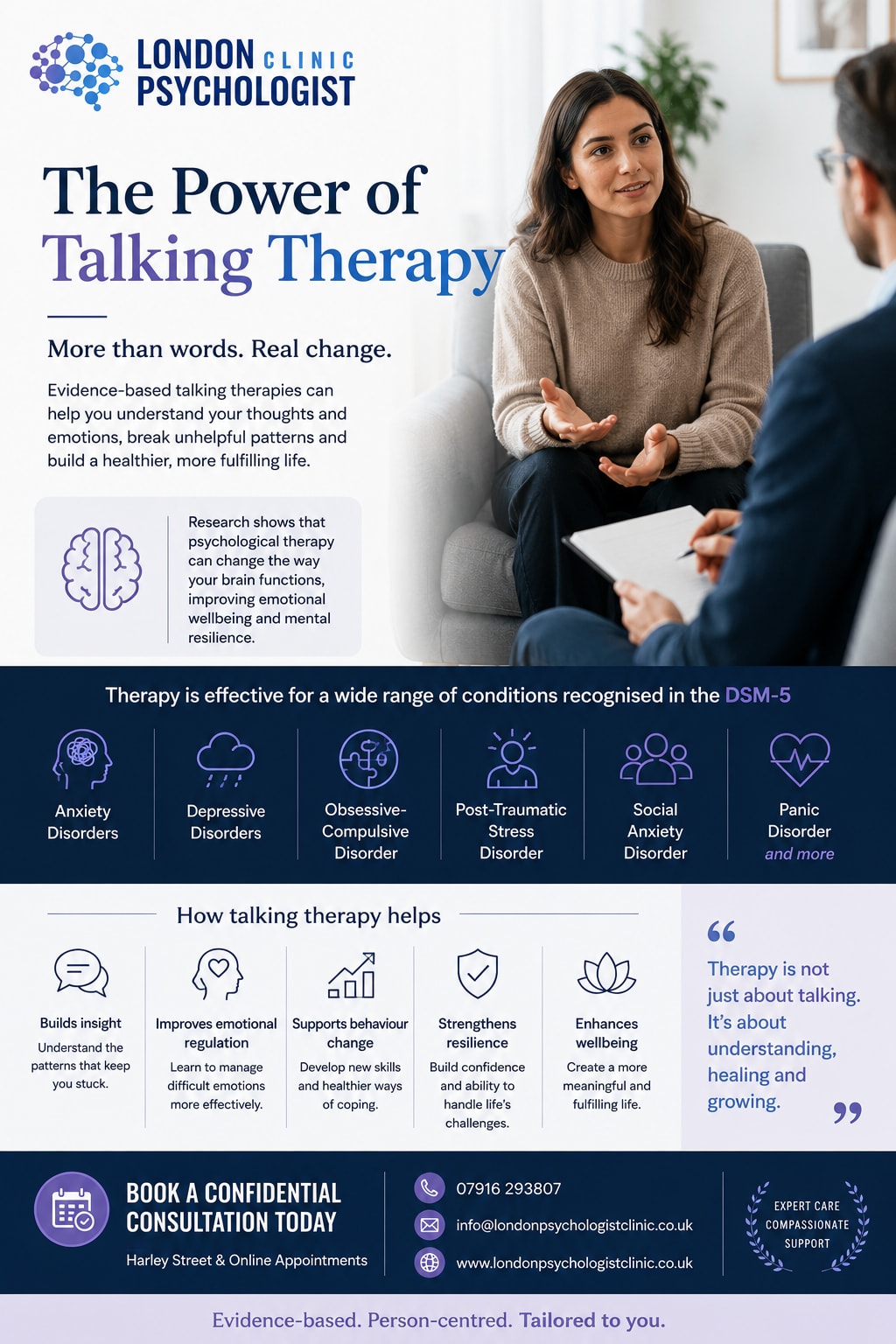
Today, talking therapies are recommended as first-line treatments for many of the psychological disorders recognised within the Diagnostic and Statistical Manual of Mental Disorders, Fifth Edition (DSM-5-TR). Conditions such as Major Depressive Disorder, Generalised Anxiety Disorder, Social Anxiety Disorder, Obsessive-Compulsive Disorder, Post-Traumatic Stress Disorder and Panic Disorder all have substantial evidence supporting psychological interventions. In many cases, therapy is as effective as medication and may provide longer-lasting benefits by addressing underlying psychological processes rather than simply reducing symptoms.
Why Talking Changes the Brain
For many years, mental health difficulties were mistakenly viewed as either purely biological or purely psychological. Modern neuroscience has demonstrated that this distinction is largely artificial. Thoughts, emotions, behaviours and brain functioning continuously influence one another.
Research using functional magnetic resonance imaging (fMRI) has shown that successful psychotherapy is associated with measurable changes in brain activity. Studies examining individuals receiving Cognitive Behavioural Therapy (CBT) for anxiety disorders have identified changes in the amygdala, a brain region involved in threat detection and fear processing. Similarly, psychotherapy for depression has been linked to alterations in neural networks associated with emotional regulation, self-reflection and cognitive control.
In other words, therapy does not simply help people feel better psychologically. It appears to facilitate genuine neurobiological change. Every time an individual challenges an unhelpful belief, tolerates uncertainty, confronts an avoided situation or develops a healthier coping strategy, new neural pathways are strengthened through a process known as neuroplasticity.
The brain changes in response to experience. Therapy provides structured experiences that encourage healthier patterns of thinking, feeling and behaving.
The Limits of Insight Alone
Many people assume that understanding the origins of their difficulties should automatically solve them. However, psychological research suggests that insight alone is rarely sufficient.
Consider an individual with Social Anxiety Disorder. They may fully understand that their fear of embarrassment stems from earlier experiences of criticism or rejection. Yet despite this insight, they continue to avoid social situations, overanalyse conversations and experience intense anxiety.
Knowledge does not automatically produce change.
Therapy works because it combines understanding with behavioural and emotional learning. Clients are not simply encouraged to talk about their difficulties. They are helped to identify patterns, challenge assumptions, develop new skills and test alternative ways of responding to situations.
This active process distinguishes psychotherapy from ordinary conversation.
The Therapeutic Relationship: An Often Overlooked Factor
One of the most robust findings in psychotherapy research is the importance of the therapeutic relationship itself.
Across different therapeutic approaches, studies consistently demonstrate that the quality of the relationship between therapist and client is one of the strongest predictors of positive outcomes. Individuals who feel understood, accepted and psychologically safe are more likely to engage honestly with difficult emotions and experiences.
Psychologist Carl Rogers argued that empathy, authenticity and unconditional positive regard create conditions that facilitate growth and psychological healing. Modern research continues to support this view.
For many individuals, therapy may be one of the few environments in which they can openly discuss fears, insecurities and painful experiences without fear of judgement. This experience alone can be profoundly corrective, particularly for those whose emotional needs have historically been dismissed or invalidated.
What the Evidence Shows
The effectiveness of psychotherapy is supported by thousands of scientific studies conducted over several decades.
Large-scale meta-analyses consistently demonstrate that psychological therapy produces significant improvements across a wide range of mental health difficulties. Research by Professor Jonathan Shedler has shown that psychodynamic psychotherapy produces benefits comparable to those observed in other evidence-based therapies, with gains often continuing after treatment has ended.
Similarly, extensive evidence supports Cognitive Behavioural Therapy for anxiety disorders, depression and obsessive-compulsive disorder. CBT has become one of the most researched psychological treatments in the world and is recommended by organisations such as the National Institute for Health and Care Excellence (NICE).
Importantly, therapy is not only effective for individuals who meet full DSM-5 diagnostic criteria. Many people seek support for relationship difficulties, low self-esteem, stress, perfectionism, burnout, career challenges and life transitions. These concerns may not always constitute a formal psychiatric disorder, yet they can significantly affect wellbeing, performance and quality of life.
Why Avoidance Keeps People Stuck
One of the central themes running through many psychological difficulties recognised within the DSM-5 is avoidance.
People avoid situations that trigger anxiety.
They avoid painful memories.
They avoid uncertainty.
They avoid difficult conversations.
They avoid emotions they fear they cannot tolerate.
Although avoidance often provides short-term relief, it tends to maintain problems over time. Therapy helps individuals gradually confront experiences they have been avoiding and discover that they are often more capable of coping than they previously believed.
This process can feel uncomfortable initially, but it is frequently where the most meaningful growth occurs.
Therapy Is Not About Being Broken
Perhaps the greatest barrier preventing people from seeking psychological support is the belief that therapy is only for those who are seriously unwell.
In reality, therapy is often most effective when viewed not as a treatment for weakness but as a tool for growth, self-understanding and resilience.
Elite athletes work with coaches despite already performing at a high level. Business leaders seek mentoring despite significant success. Likewise, psychological therapy can help individuals understand themselves more deeply, develop healthier coping strategies and navigate challenges more effectively.
Seeking support is not evidence that something is wrong with you.
It is evidence that you are investing in your psychological wellbeing.
The Real Power of Talking
The power of therapy lies not simply in talking, but in talking with purpose. Through evidence-based interventions, psychological insight, emotional processing and behavioural change, therapy creates opportunities for transformation that extend far beyond symptom reduction.
The DSM-5 provides a framework for understanding mental health difficulties, but no diagnostic manual can fully capture the complexity of human experience. Behind every diagnosis is a unique individual with their own story, strengths, struggles and aspirations.
Therapy offers something increasingly rare in modern life: a dedicated space to understand that story, make sense of it and begin writing the next chapter with greater clarity, resilience and self-awareness.
And sometimes, that conversation changes everything.