


The Influencer Illusion
posted 4th March 2026
The Influencer Illusion: FOMO, AI, and the Psychology of Comparing Yourself to a Fiction
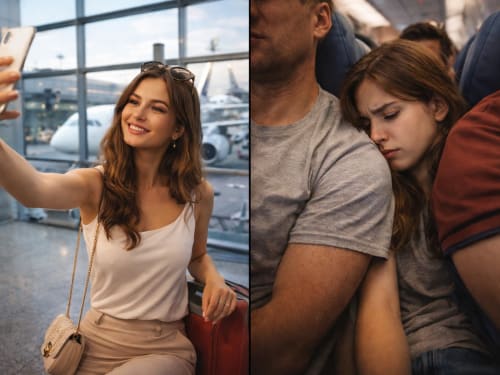
Scroll through social media for a few minutes and a particular version of life begins to emerge. Rooftop pools in Dubai. Perfectly lit beach clubs. Entrepreneurs announcing they have “escaped the system”. Influencers documenting glamorous lives that seem permanently suspended between luxury hotels and airport lounges.
To many young people this looks like reality. To many older people it looks like theatre.
The difference between those interpretations is psychologically important.
Social media has created a world in which millions of people quietly measure their own lives against an endless stream of curated success. What used to be occasional comparison has become a daily cognitive habit. But a more troubling development is beginning to emerge: an increasing amount of that aspirational content may not represent a real life at all.
People are not just comparing themselves to highly edited lives anymore.
They are sometimes comparing themselves to lives that were never lived.
The Curated Life
Human beings are wired for comparison. The psychologist Leon Festinger described this decades ago in social comparison theory. We evaluate our status, success and attractiveness relative to those around us.
Historically this happened within small communities. People compared themselves to friends, neighbours or colleagues. The reference group was limited and broadly realistic.
Social media removed that boundary. Now the reference group includes professional athletes, celebrities, entrepreneurs and influencers whose livelihoods depend on producing aspirational imagery. Algorithms reward whatever captures attention, and attention is captured most effectively by wealth, beauty, status and spectacle.
Gradually, something subtle happens in the mind. Exceptional lives begin to look typical. The extraordinary begins to appear normal.
When this happens, ordinary life starts to feel like failure.
When Comparison Becomes Psychological Distress
In clinical practice the consequences appear in quiet ways. Clients often report a vague but persistent sense that their life is somehow “behind”. They believe they should be travelling more, earning more, looking better, socialising more, doing something more exciting.
The source of these beliefs is rarely their real environment. It is the environment they inhabit online.
Research increasingly links heavy social media use with symptoms associated with Major Depressive Disorder, particularly negative cognitive appraisals about personal worth and achievement. Exposure to idealised bodies and appearance standards also overlaps with patterns seen in Body Dysmorphic Disorder, where individuals become preoccupied with perceived flaws in their appearance.
In other cases the problem is not what people believe about themselves but how they regulate their emotions. Compulsive scrolling, repeated checking for validation, and anxiety when disconnected from social platforms resemble the behavioural patterns seen in emerging forms of internet and social media addiction.
The DSM-5 does not formally recognise social media addiction as a diagnostic category, but it does acknowledge Internet Gaming Disorder as a condition requiring further study. Clinically, many psychologists now observe similar patterns in compulsive social media use.
When someone spends four, five or six hours a day scrolling through curated lifestyles, the platform is no longer just entertainment. It has become a psychological environment that shapes how they evaluate their own life.
The Distortion of Reality
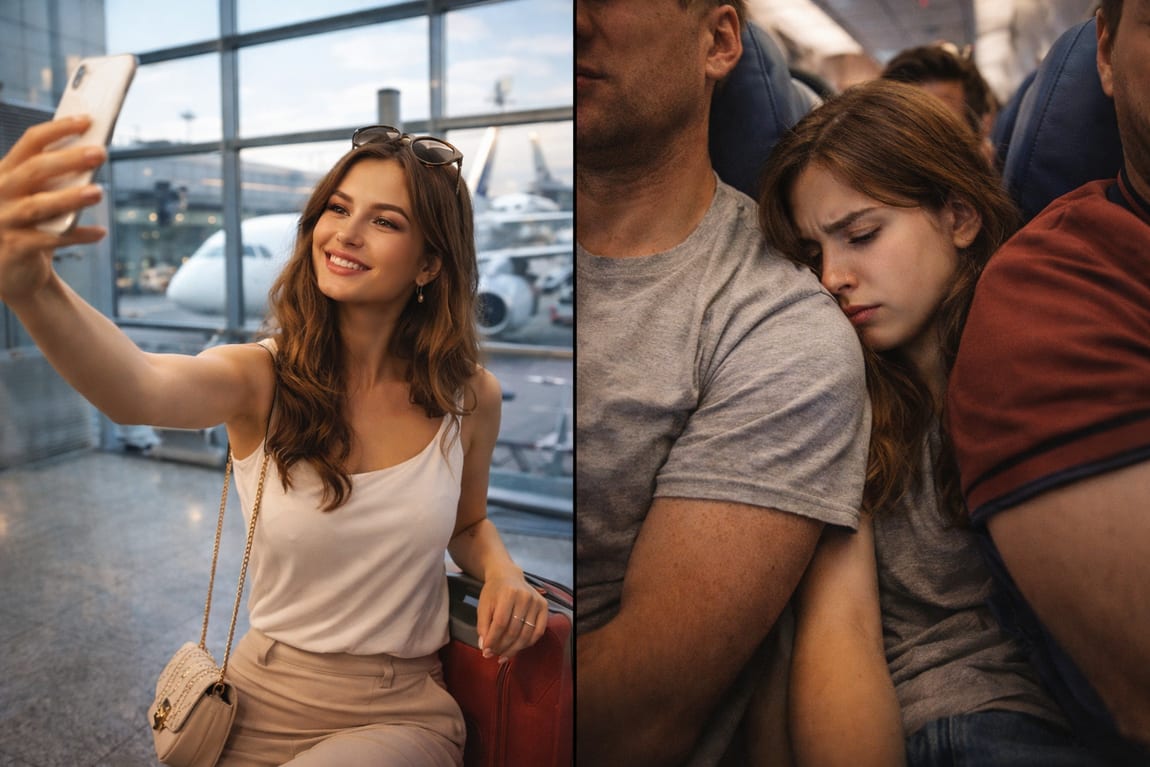
One of the most striking elements of influencer culture is the way it compresses reality into something visually perfect. The difficult parts of life rarely appear. Debt does not photograph well. Loneliness is not algorithmically rewarded. The ordinary routines that make up most of life rarely trend.
The result is a powerful distortion. People compare the unfiltered complexity of their own lives to the most polished moments of someone else's.
Older adults often recognise this instinctively. With more life experience they understand that public presentation and private reality are rarely the same thing. Younger users, however, encounter these images during key stages of identity formation. For them the lifestyle being presented can look less like performance and more like a social norm.
And the internet supplies that norm endlessly.
The Rise of the Synthetic Life
What makes the situation more psychologically complex is a development that has accelerated dramatically in the past two years.
A growing portion of the internet is no longer produced entirely by human beings.
AI tools now generate blog posts, captions, travel photography, marketing content and even entire online personalities. Estimates suggest that hundreds of millions of posts are created daily across social media platforms, and a significant proportion already involve AI in some way. In a single morning, tens of millions of posts circulating online may have been written or assisted by machine learning systems.
In some cases the entire influencer is artificial.
There are now fully synthetic influencers with millions of followers, complete with backstories, personalities and lifestyles that never existed outside of a rendering engine. Their photos appear in luxury hotels. Their bodies are digitally flawless. Their travels are unlimited. Their lives appear effortless.
Because they are not constrained by reality.
From a psychological perspective this creates a strange and troubling situation.
People are increasingly comparing their lives not just to curated realities, but to algorithmically manufactured ones.
The Algorithmic Amplification of Envy
Envy has always been part of human psychology. In moderate amounts it can even be motivating. Seeing someone achieve something remarkable can inspire ambition.
The problem arises when the comparison becomes constant and the standard becomes impossible.
Social media algorithms amplify the most visually striking and emotionally stimulating content because it keeps users engaged. That means luxury, beauty and spectacle rise to the top of the feed while ordinary life sinks to the bottom.
Over time the brain absorbs a distorted picture of reality. If every second image suggests that young people are launching businesses, travelling the world or living permanently glamorous lives, it becomes easy to assume that everyone else is thriving while you are standing still.
Of course this is not true. But repeated imagery functions as psychological evidence.
And the internet provides that evidence all day.
The Performance of Success
There is also an irony embedded in influencer culture. Many influencers are not simply documenting their lives. They are producing aspirational imagery as a business model.
Luxury settings, travel locations and lifestyle displays generate engagement, and engagement generates income through advertising and sponsorships. The lifestyle is not just being lived. It is being performed.
Psychologically this transforms parts of the internet into something closer to theatre than reality.
The audience, however, often forgets that they are watching a performance.
Reclaiming Perspective
None of this means that social media is inherently harmful. For some people aspirational content can be genuinely motivating. It can introduce new ideas, encourage travel, inspire creativity or expose people to different cultures.
The crucial difference lies in interpretation.
When people understand that what they are seeing is a curated fragment of reality, they can enjoy it without internalising it as a standard for their own worth. When they treat it as a benchmark for how life should look, dissatisfaction becomes almost inevitable.
Perspective acts as a psychological buffer.
No life is as perfect as it appears online. No city is as glamorous as a photograph suggests. And increasingly, no influencer feed can even be assumed to represent a real person.
A Strange New Comparison
One of the most remarkable psychological features of the modern internet is this:
Many people are now measuring their own lives against images that were partly written by machines and partly designed to trigger envy.
Real human experience — with its routine, uncertainty, relationships and quiet meaning — is being compared to a highly optimised digital performance.
It is not a fair comparison.
And perhaps it was never meant to be.
The Real World Still Matters
Human wellbeing has always depended on things that rarely appear in curated feeds: meaningful relationships, purpose, belonging, and engagement with the real world.
These things do not photograph well. They are rarely algorithmically amplified. But psychologically they are the foundations of a satisfying life.
The danger of the influencer illusion is not that it is glamorous.
The danger is that it convinces people their ordinary life is somehow inadequate.
In reality, ordinary life is where almost all genuine happiness is built.