


The Friends Who Hurt Us
posted 24th July 2026
The Friends Who Hurt Us: Why We Keep Returning to Toxic Friendships
Friendship is often portrayed as one of life's greatest protective factors. Research consistently shows that supportive friendships are associated with better mental health, lower stress, improved physical wellbeing, and even increased longevity. Healthy friends provide encouragement during difficult times, celebrate our successes, and offer a sense of belonging that strengthens our psychological resilience.
Yet not all friendships are healthy.
Many people find themselves repeatedly returning to friends who criticise them, exploit their generosity, undermine their confidence, or publicly humiliate them. From the outside, the solution can seem obvious: simply walk away. For the person caught in the relationship, however, leaving often feels surprisingly difficult.
The more psychologically interesting question is not simply why do toxic people behave this way? It is why do intelligent, capable people keep giving them another chance?
The answer lies in the way our brains form attachments, our early life experiences, and the unconscious emotional needs that friendships can fulfil.
When Friendship Becomes Psychological Harm
A toxic friendship is not defined by occasional disagreements or misunderstandings. Every friendship experiences conflict. Toxicity develops when there is a consistent imbalance of respect, empathy, and emotional safety.
Examples include:
- A friend who regularly belittles your achievements.
- Someone who makes jokes at your expense in front of others.
- A person who ignores your boundaries but expects you to respect theirs.
- Someone who only contacts you when they need emotional support, money or favours.
- A friend who shares your private information or repeatedly excludes you from social events.
Over time, these interactions begin to influence how we see ourselves. What starts as irritation can slowly develop into self-doubt, anxiety and diminished confidence.
The Brain Confuses Familiarity With Safety
Attachment Theory
One of the strongest explanations comes from attachment theory.
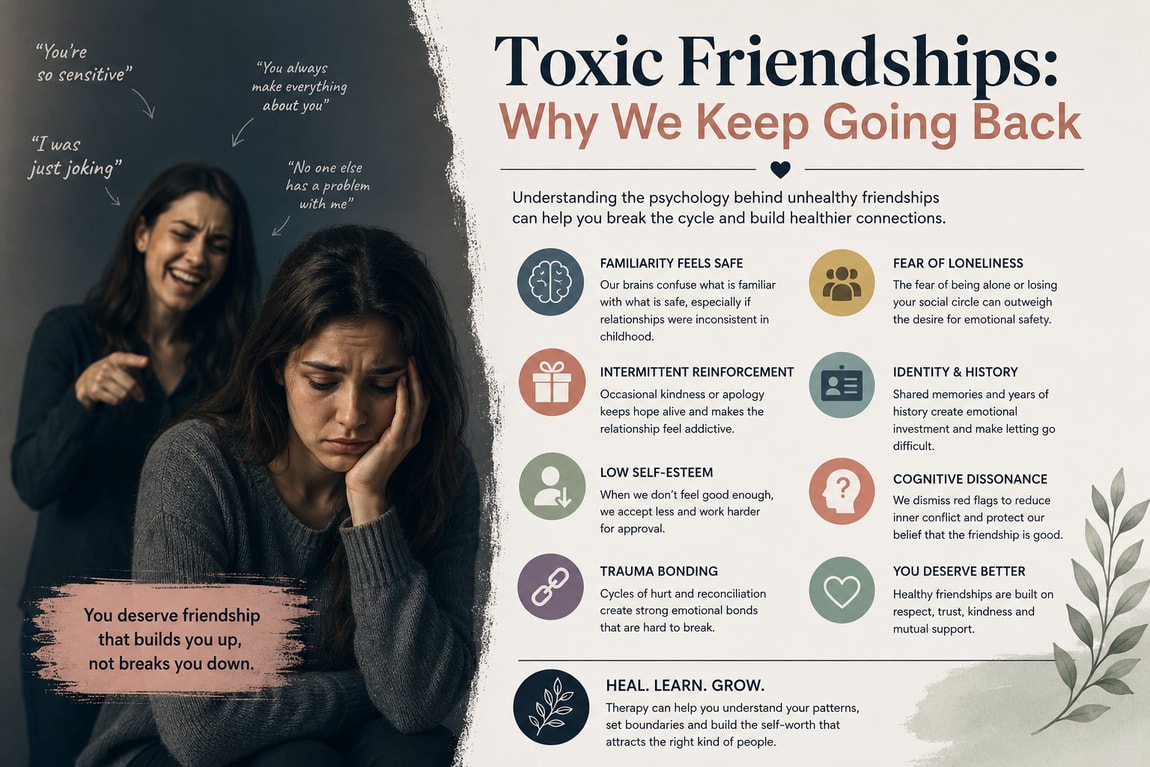
Our earliest relationships create internal templates for how relationships work. If affection, approval or attention during childhood was inconsistent or conditional, the adult brain may unconsciously experience similar inconsistency as familiar.
This does *not* mean people consciously seek mistreatment.
Instead, the nervous system often mistakes familiarity for emotional safety.
A friendship that alternates between warmth and rejection can feel strangely compelling because it activates old attachment patterns. Rather than viewing inconsistency as a warning sign, the brain experiences it as something that must be solved.
The individual often works harder to regain acceptance instead of questioning whether the friendship is healthy.
Why We Keep Going Back
Intermittent Reinforcement
Behavioural psychology provides another powerful explanation through a concept known as intermittent reinforcement.
When rewards arrive unpredictably, they become more psychologically powerful. This is the same principle that makes gambling addictive.
A toxic friend may ignore you for weeks before suddenly becoming warm, apologetic or generous.
Those occasional positive interactions create hope.
Instead of remembering the repeated disrespect, the brain remembers the rare moments when everything felt normal.
People often find themselves saying:
- "They're not always like this."
- "We have so many good memories."
- "When they're nice, they're really lovely."
These statements often reflect intermittent reinforcement rather than evidence of a healthy friendship.
When Self-Esteem Is Low
People with healthy self-esteem usually interpret repeated disrespect as useful information.
They think:
- "This relationship isn't good for me."
People with chronically low self-esteem often reach a very different conclusion.
Instead of questioning the friendship, they question themselves.
- "Maybe I'm too sensitive."
- "Perhaps I overreacted."
- "I should have been a better friend."
Over time, self-worth becomes dependent upon earning approval from someone who rarely gives it freely.
Ironically, the less approval they receive, the harder they work for it.
Trauma Bonds Can Exist In Friendships Too
Although trauma bonding is usually discussed in romantic relationships, similar patterns can develop within friendships.
A toxic friend may:
- Hurt you.
- Apologise.
- Become affectionate.
- Hurt you again.
Each reconciliation temporarily removes emotional distress, making the friendship feel rewarding despite being psychologically damaging.
The nervous system begins associating relief with reconnection rather than recognising that the same individual created the distress in the first place.
The Fear Of Being Alone
Humans evolved as social beings.
For thousands of years, exclusion from the group threatened survival. Although life has changed dramatically, our brains continue to respond to rejection as though it represents danger.
Brain imaging studies have demonstrated that social rejection activates many of the same neural pathways involved in physical pain.
For some people, the fear of loneliness becomes stronger than the desire for emotional safety.
Remaining in an unhealthy friendship feels less frightening than facing the uncertainty of being alone.
When Your Identity Becomes Attached To The Friendship
Long-term friendships become part of our identity.
Shared holidays, birthdays, family events and years of memories create enormous emotional investment.
People frequently tell themselves:
- "We've been friends for twenty years."
- "They're like family."
- "We've been through everything together."
History explains why a friendship exists.
It does *not* justify ongoing emotional harm.
The Psychology Of Humiliation
Public humiliation can be particularly damaging because it attacks both self-esteem and social identity.
Whether through sarcasm, ridicule, embarrassing stories or subtle put-downs, repeated humiliation communicates one underlying message:
"You are less important than me."
Eventually, people begin monitoring everything they say, anticipating criticism before it happens.
Friendship becomes associated with anxiety rather than comfort.
Why Leaving Feels So Difficult
Many people describe ending a toxic friendship as feeling similar to withdrawal.
This experience is not imaginary.
Relationships influence brain chemicals involved in attachment, reward and stress regulation. When an important relationship ends, even an unhealthy one, the brain requires time to adapt.
Feeling grief after leaving does *not* mean you have made the wrong decision.
Often, it reflects the nervous system adjusting to the loss of an attachment rather than the loss of a healthy relationship.
Building Healthier Friendships
Recovery rarely begins by finding better friends.
It begins by changing the relationship we have with ourselves.
Psychological therapy often focuses on:
- Understanding attachment patterns.
- Building healthier self-esteem.
- Learning assertive communication.
- Developing healthy boundaries.
- Recognising manipulation more quickly.
- Becoming comfortable walking away from relationships that repeatedly undermine wellbeing.
Healthy friendships feel remarkably different.
They are:
- Predictable rather than confusing.
- Respectful rather than humiliating.
- Supportive rather than competitive.
- Emotionally safe rather than emotionally exhausting.
Most importantly, healthy friends do not require you to earn basic kindness.
Final Thoughts
One of the greatest myths about toxic friendships is that people remain because they are weak.
The opposite is often true.
Many people stay because they are deeply loyal, compassionate, forgiving and hopeful. These are admirable qualities. However, without healthy boundaries, these strengths can be exploited by individuals who repeatedly place their own needs above those of others.
Recognising a toxic friendship is not about becoming cynical. It is about understanding an essential psychological truth: relationships should enhance our wellbeing, not steadily diminish it.
A genuine friend does not leave you questioning your worth.
They remind you of it.