


Solving Social Anxiety Disorder
posted 24th April 2026
Click to Enlarge
Social Anxiety Disorder: Understanding Fear of Judgement and How CBT Can Help
Social situations are a normal part of life, yet for some individuals they can feel overwhelming, exposing, and even intolerable. Social Anxiety Disorder—sometimes referred to as social phobia—is far more than shyness or introversion. At The London Psychologist Clinic, we often work with individuals who are highly capable and insightful, yet experience an intense fear of being judged, criticised, or negatively evaluated by others. This fear can quietly shape decisions, limit opportunities, and erode confidence over time.
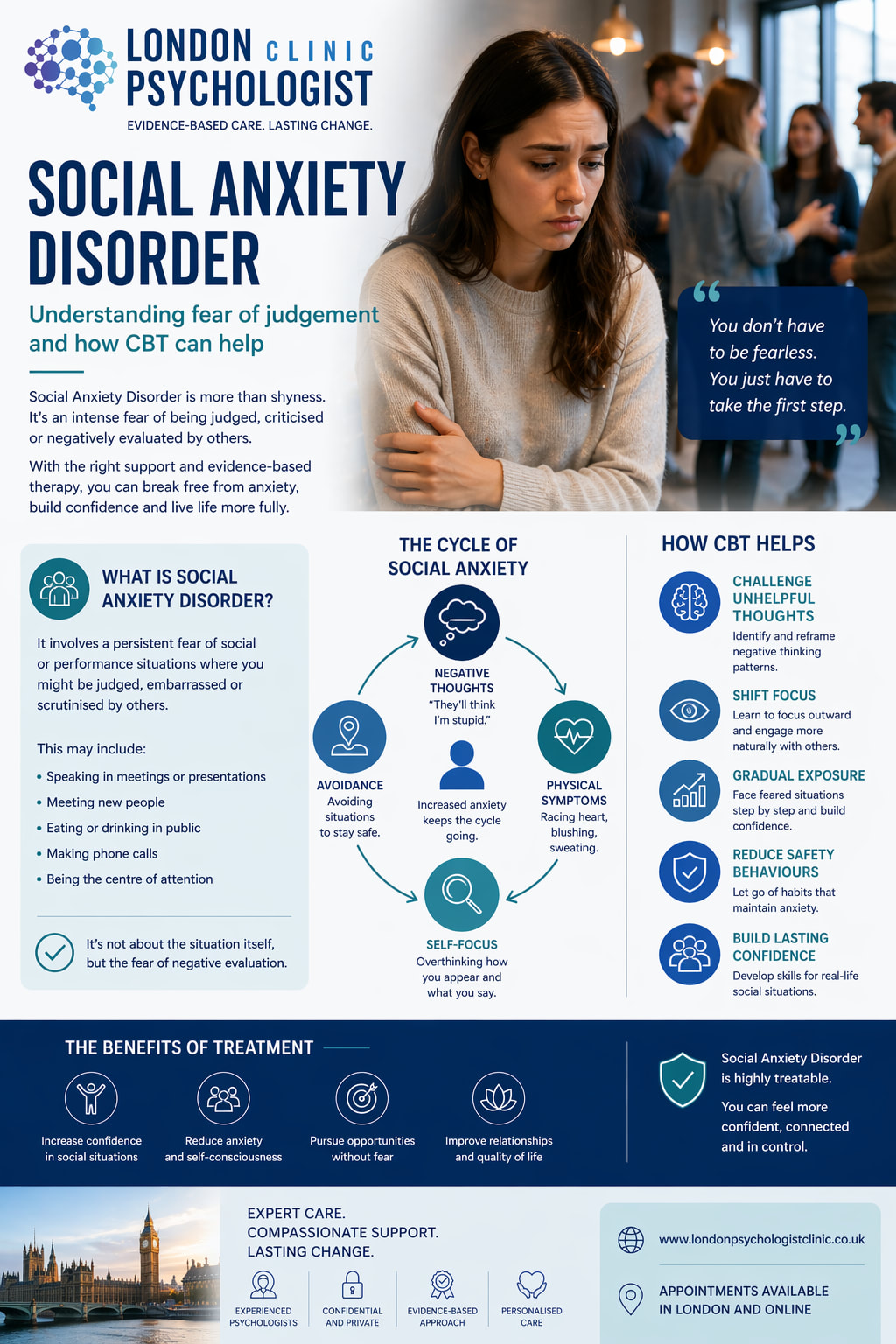
According to the DSM-5, Social Anxiety Disorder is characterised by a marked and persistent fear of social or performance situations in which an individual is exposed to possible scrutiny. This might include speaking in meetings, attending social gatherings, dating, or even everyday interactions such as making phone calls or ordering in a café. The core fear is not the situation itself, but the belief that one will be judged, embarrassed, or seen negatively by others.
What makes social anxiety particularly challenging is how believable these fears feel. Individuals may experience thoughts such as “I’ll say something stupid,” “People will notice I’m anxious,” or “I’ll come across badly.” These thoughts trigger physical symptoms—such as blushing, sweating, trembling, or a racing heart—which then seem to confirm the fear. This creates a self-reinforcing cycle where anxiety increases self-consciousness, and self-consciousness increases anxiety.
Social Anxiety Disorder sits within the broader spectrum of anxiety disorders, sharing underlying processes such as threat sensitivity and negative cognitive bias. However, its defining feature is the focus on social evaluation. Humans are inherently social beings, so the fear of rejection or judgement can feel particularly powerful. In many cases, individuals become highly attuned to themselves in social situations—monitoring how they appear, what they are saying, and how they are being perceived. This internal focus often makes it harder to engage naturally, which can reinforce feelings of awkwardness or disconnection.
The causes of social anxiety are multifaceted. Biologically, some individuals are more temperamentally sensitive or prone to anxiety. Psychologically, early experiences—such as criticism, bullying, or high expectations—can shape beliefs like “I’m not good enough” or “I must not make mistakes.” Over time, these beliefs become activated in social contexts, driving anxiety and avoidance. Avoidance, while understandable, plays a key role in maintaining the problem. By avoiding feared situations, individuals never have the opportunity to disconfirm their fears or build confidence.
A common question is whether social anxiety can be cured. The evidence is encouraging. Social Anxiety Disorder is highly treatable, and many individuals experience substantial and lasting improvement with the right intervention. The goal is not to eliminate all anxiety—some level of social anxiety is normal—but to reduce it to a manageable level and, more importantly, to change how individuals respond to it.
Cognitive Behavioural Therapy (CBT) is the most effective and widely recommended treatment for Social Anxiety Disorder. CBT works by addressing the thoughts, behaviours, and attention patterns that maintain anxiety. Rather than simply offering reassurance, it provides practical tools to create lasting change.
One of the key components of CBT for social anxiety is identifying and challenging unhelpful thinking patterns. Individuals learn to recognise automatic thoughts about being judged or embarrassed and to evaluate them more realistically. This helps reduce the intensity of anxiety and creates space for more balanced thinking.
Another important aspect is shifting attention. Many individuals with social anxiety focus excessively on themselves during interactions—monitoring their appearance, speech, or behaviour. CBT helps redirect attention outward, allowing for more natural engagement with others and reducing self-consciousness.
Behavioural experiments and gradual exposure are central to treatment. Rather than avoiding feared situations, individuals are supported to face them in a structured and manageable way. This might involve speaking up in a meeting, initiating conversation, or attending a social event. Through these experiences, individuals learn that feared outcomes are often less likely—or less catastrophic—than expected.
CBT also addresses safety behaviours, such as rehearsing sentences mentally, avoiding eye contact, or speaking minimally. While these behaviours may feel protective, they actually maintain anxiety by preventing individuals from fully engaging and testing their assumptions.
The effectiveness of CBT for social anxiety is well supported by research. Many individuals experience significant reductions in anxiety, increased confidence, and improved quality of life. Importantly, the skills learned in therapy continue to be useful long after treatment ends, supporting ongoing growth and resilience.
Social Anxiety Disorder can be isolating, particularly because it often goes unnoticed by others. Many individuals appear calm externally while experiencing intense anxiety internally. However, it is not a fixed trait or a reflection of personality—it is a pattern that can be understood and changed.
At The London Psychologist Clinic, we specialise in helping individuals overcome social anxiety using tailored, evidence-based approaches. With the right support, it is entirely possible to move from fear and self-doubt to confidence, connection, and a greater sense of ease in social situations.