


Rumination and Mental Loops
posted 4th June 2026
Why We Overthink: The Psychology of Rumination and Mental Loops
Most of us have experienced it.
A conversation replays repeatedly in our mind. We analyse every word, every expression and every possible meaning. We lie awake at night replaying events from earlier in the day or imagining everything that could go wrong tomorrow.
We tell ourselves that we are trying to find an answer. In reality, we often become trapped in a cycle of overthinking that leaves us feeling exhausted, anxious and no closer to a solution.
At The London Psychologist Clinic, many clients describe feeling stuck in an endless stream of thoughts. They know they are overthinking, but they cannot seem to stop. Understanding why this happens can be the first step towards breaking free from it.
What Is Overthinking?
In psychology, persistent overthinking is often referred to as rumination.
Rumination involves repeatedly focusing on distressing thoughts, situations or emotions without moving towards a productive solution. Unlike healthy reflection, which helps us learn from experience, rumination tends to keep us trapped in a cycle of analysis and worry.
Common examples include:
- Replaying conversations repeatedly
- Constantly questioning decisions
- Imagining worst-case scenarios
- Excessively analysing mistakes
- Struggling to switch off at night
- Seeking certainty about uncertain situations
Although many people believe overthinking helps them solve problems, research suggests it often increases emotional distress while reducing effective problem-solving.
Why Does the Brain Overthink?
The human brain evolved to detect threats and anticipate danger.
From an evolutionary perspective, being able to identify risks increased our chances of survival. Unfortunately, the same mental processes that once protected us from physical threats can become activated by modern psychological concerns.
The brain often treats uncertainty as a threat.
This means that situations involving relationships, work, finances or health can trigger repeated mental analysis as the brain attempts to create a sense of certainty and control.
The problem is that some questions simply cannot be answered with complete certainty.
The more we search for reassurance, the more anxious we often become.
The Link Between Overthinking and Anxiety
Overthinking is strongly associated with anxiety disorders.
Individuals experiencing Generalised Anxiety Disorder (GAD), as described in the DSM-5-TR, often experience excessive and persistent worry about multiple areas of life. Symptoms may include:
- Restlessness
- Difficulty concentrating
- Muscle tension
- Fatigue
- Irritability
- Sleep disturbance
Overthinking can become a way of attempting to prevent bad outcomes. However, rather than reducing anxiety, it often maintains it.
The mind becomes trapped in a cycle of "What if?"
The Illusion of Control
One reason overthinking feels so compelling is that it creates an illusion of control.
When faced with uncertainty, the brain assumes that more thinking will eventually produce certainty. Unfortunately, many life situations involve variables that cannot be controlled or predicted.
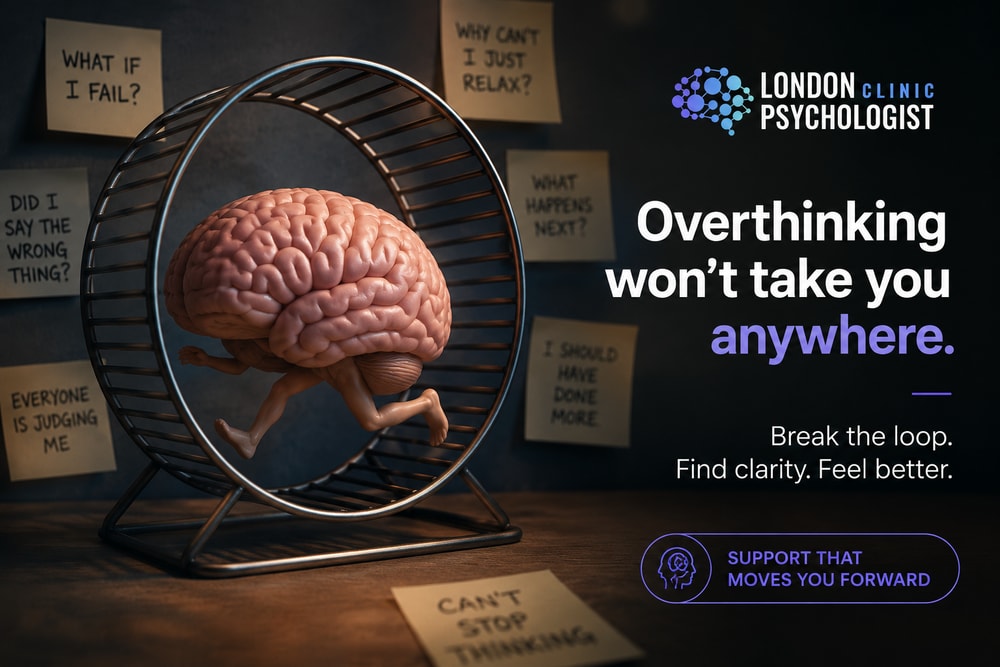
The result is a mental treadmill.
You may feel busy, but you are not moving forward.
Signs That You May Be Overthinking
Many people do not realise how much mental energy is consumed by overthinking until they begin paying attention.
Common signs include:
- Difficulty making decisions
- Replaying past events repeatedly
- Constant self-criticism
- Struggling to relax
- Difficulty falling asleep
- Seeking excessive reassurance from others
- Feeling mentally exhausted despite doing very little physical activity
How Therapy Can Help
One of the most effective ways to reduce overthinking is not to eliminate thoughts entirely but to change your relationship with them.
Evidence-based approaches such as Cognitive Behavioural Therapy (CBT) and Acceptance and Commitment Therapy (ACT) help individuals develop greater psychological flexibility and reduce the tendency to become trapped in repetitive thought patterns.
Therapy can help you:
- Recognise unhelpful thinking patterns
- Reduce rumination and worry
- Improve emotional regulation
- Increase tolerance of uncertainty
- Develop healthier coping strategies
- Improve sleep and concentration
Many clients are surprised to discover that the goal is not to stop thinking, but to stop becoming entangled in every thought that appears.
Overthinking is often mistaken for problem-solving. In reality, it frequently leaves us feeling stuck, anxious and emotionally drained.
The mind's search for certainty can become endless, particularly when facing situations that are inherently uncertain.
Learning to step back from repetitive thought patterns, tolerate uncertainty and focus on what can actually be controlled can have a profound impact on wellbeing.
If you find yourself trapped in mental loops, replaying conversations, catastrophising about the future or struggling to switch off, professional psychological support can help you develop a healthier relationship with your thoughts and regain a greater sense of calm and control.