


Punch: Attachment, Rejection and Human Nature
posted 25th February 2026
Why “Punch” the Monkey Has Captured Our Hearts: Rejection, Attachment, and Human Nature
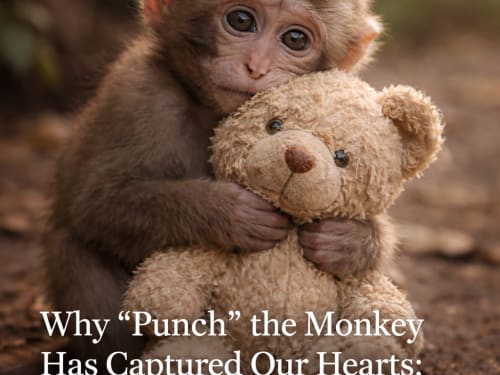
Every so often, a story appears that cuts straight through the noise of politics, celebrity scandal, and digital outrage. Punch — the small monkey rejected by his mother, clinging to a teddy bear and struggling to integrate into his troop — is one of those stories. On the surface, it is simple. A baby animal is rejected. It finds comfort in a substitute object. It appears lost, small, and alone.
And yet, the reaction has been visceral. People who scroll past war and disaster pause for Punch. They feel something immediate — protective, tender, almost painful. You would have to have the coldest heart not to feel a flicker of sympathy at the sight of a baby creature carrying around a teddy bear because his mother would not carry him.
The psychological power of this story lies in what it awakens in us.
The Attachment Instinct
Humans are wired for attachment. The British psychiatrist and psychoanalyst John Bowlby argued that attachment is not a sentimental luxury but a biological survival system. Infants are born with behaviours — crying, clinging, gazing — designed to keep caregivers close. Caregivers, in turn, are wired to respond to vulnerability. A small, distressed being activates something ancient in us.
When attachment is secure, the infant explores the world confidently, knowing safety is available. When attachment is disrupted, the system goes into alarm. Protest, despair, withdrawal — these are not moral failings; they are biological responses to perceived abandonment.
In humans, early attachment disruption can have lasting effects. The DSM-5 recognises Reactive Attachment Disorder, a condition that can arise when children experience severe neglect or inconsistent caregiving. Even outside of diagnosable disorders, disrupted attachment increases vulnerability to anxiety, depression, and relational instability later in life. The manual also acknowledges the impact of relational stressors — “Parent-Child Relational Problems” and chronic interpersonal conflict — as significant contributors to mental health distress.
Punch’s image — small body, substitute comfort object — mirrors this attachment alarm state. We are witnessing, in symbolic form, what happens when the attachment system activates and no primary caregiver responds.
The Teddy Bear as Transitional Object
The teddy bear is not incidental. Psychologically, it represents what the psychoanalyst Donald Winnicott called a “transitional object” — something a child clings to when navigating the painful space between dependence and separateness. It is a bridge between isolation and comfort.
Almost every adult can remember a blanket, a stuffed animal, or some object that carried disproportionate emotional weight. The object was not just fabric; it was safety, continuity, reassurance. Seeing Punch carry a teddy compresses that universal childhood memory into a single image.
It is difficult not to project ourselves onto him.
Why Rejection Hurts So Deeply
Neuroscience has repeatedly demonstrated that social rejection activates many of the same neural circuits as physical pain. Exclusion does not feel metaphorically painful — it is processed as pain. Evolutionarily, this makes sense. For social species, being cast out once meant death.
Rejection in childhood — whether from parents or peers — leaves especially deep traces. The playground is often a laboratory of belonging. Children learn quickly who is “in” and who is “out.” They experience alliances forming and dissolving in real time. For some, those early rejections become part of their internal narrative: I am not chosen. I am not wanted.
In adulthood, these themes resurface in intimate relationships, workplaces, and friendships. Conditions such as Social Anxiety Disorder, Persistent Depressive Disorder, and aspects of Borderline Personality Disorder often contain threads of abandonment sensitivity or relational instability. Not because individuals are weak, but because early relational pain shapes the nervous system’s expectations.
Punch’s rejection resonates because it bypasses intellectual defence. We are not debating family dynamics or personal responsibility. We are looking at vulnerability in its rawest form.
Why We Show Compassion to a Monkey
There is also something revealing in how easily we mobilise empathy for an animal while sometimes withholding it from other humans. A monkey cannot be blamed for being “difficult.” It cannot be accused of overreacting. It cannot be judged for being needy. Its distress appears pure.
Human beings, in contrast, carry complexity. When we see a rejected child or adult, we often unconsciously search for reasons. What did they do? Why were they excluded? Were they too sensitive? Too demanding?
Punch carries none of that narrative baggage. He is simply small and alone.
Our empathy flows freely because it does not threaten our own defensive structures. In fact, it may feel safer to mourn his rejection than to revisit our own.
The Pack and the Problem of Belonging
Primates are deeply social animals. To be outside the group is to be at risk. Humans are no different. We speak of “finding our tribe,” “not fitting in,” “being the black sheep.” These metaphors are not accidental; they reflect an enduring tension between individuality and belonging.
Punch struggling to integrate into his troop mirrors something existential. Most of us, at some point, have felt like we were orbiting a group without fully landing inside it. That awkward edge position — not quite included, not fully excluded — is psychologically exhausting. It activates vigilance. It erodes self-worth.
The teddy becomes not only comfort but a signifier of difference. He is the one who carries something others do not.
Why This Story Won’t Let Us Go
Punch’s story is powerful not because it is rare, but because it is ordinary. Rejection, substitution, resilience — these are common across species. What makes it poignant is the clarity of the image. It distils abandonment into something we can see.
We are, at core, relational beings. We are shaped by who holds us and who does not. We carry early experiences of being chosen or overlooked into our adult lives, often without realising it. When we see Punch, we see attachment laid bare. We see the small, vulnerable part of ourselves that once needed someone to come back.
The intensity of public sympathy suggests that, beneath the armour most adults wear, there remains a deep capacity for tenderness. The sight of a rejected baby monkey holding a teddy interrupts cynicism. It reminds us that vulnerability still moves us.
Perhaps that is why the story has spread so widely. It is not just about Punch. It is about the universal fear of being left out and the equally universal longing to be held.
And the fact that we feel for him — instinctively, almost protectively — tells us something hopeful about human nature. Beneath our defences, beneath our social hierarchies and judgments, the attachment system still responds.
We are moved because somewhere inside, we remember what it feels like to need someone — and to hope they will not turn away.