


PTSD and Fear Memory
posted 26th May 2026
Click to enlarge
New Research Into PTSD and Fear Memory: How “Support Cells” in the Brain Could Transform Trauma Treatment
For decades, psychologists and neuroscientists believed that neurons were the primary drivers of fear, trauma, and memory. When someone experiences a traumatic event, it was thought that networks of neurons within the amygdala — the brain’s fear center — encoded frightening memories and triggered later symptoms such as flashbacks, panic, and hypervigilance.
But groundbreaking new research is beginning to challenge that traditional view.
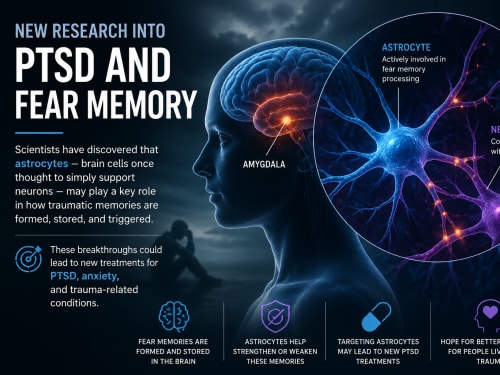
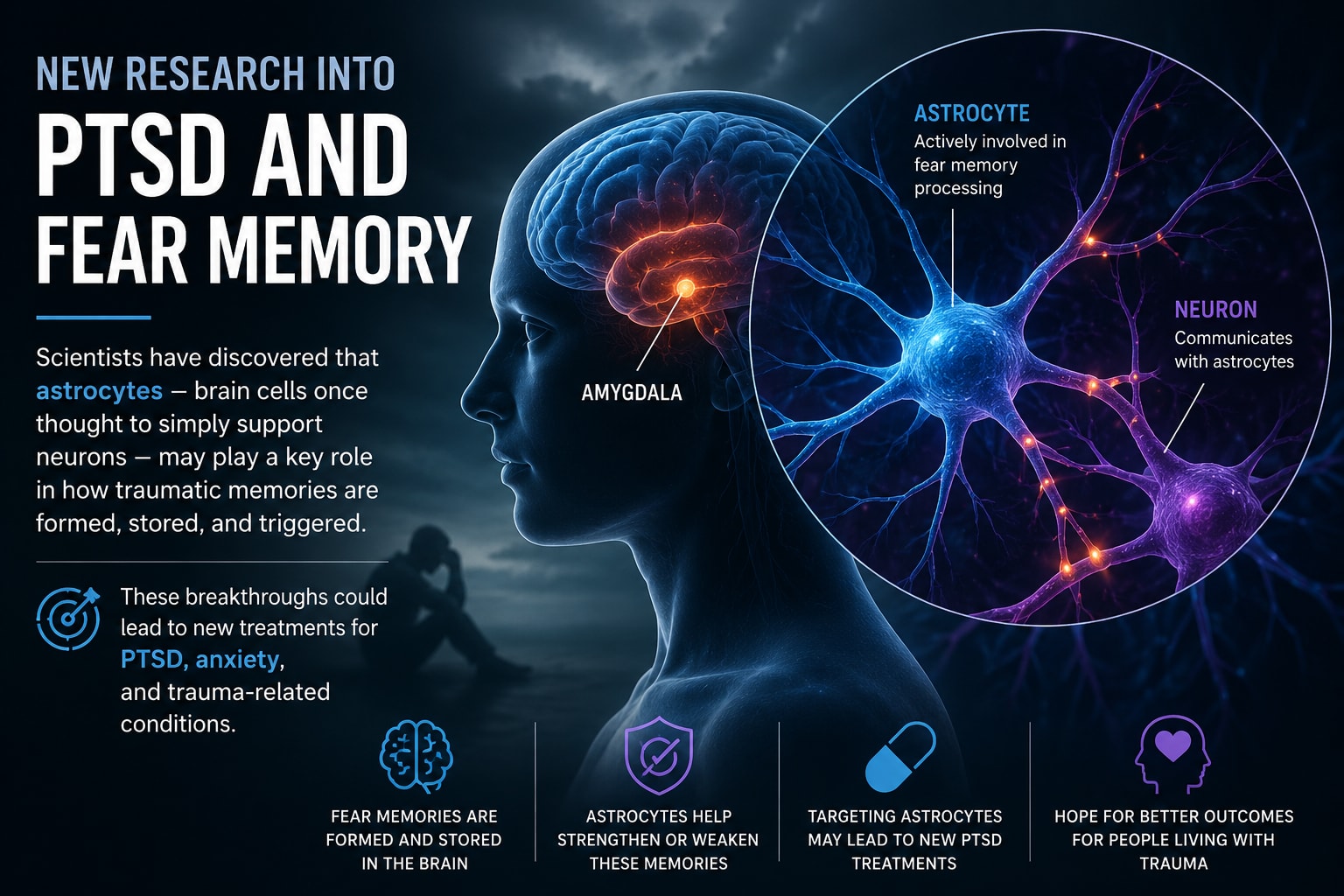
Scientists are now discovering that *astrocytes* — star-shaped brain cells once dismissed as simple “support cells” — may play a major role in how traumatic memories are formed, stored, and triggered. These findings could transform our understanding of PTSD and lead to entirely new approaches to trauma treatment.
What Is PTSD?
Post-traumatic stress disorder (PTSD) is a trauma-related mental health condition that can develop after exposure to highly distressing experiences such as abuse, violence, war, accidents, or life-threatening events.
Symptoms often include:
- Intrusive memories and flashbacks
- Nightmares
- Emotional numbness
- Hypervigilance and anxiety
- Avoidance behaviours
- Difficulty regulating emotions
- Persistent fear responses
At a neurological level, PTSD is strongly linked to dysfunction within brain regions involved in fear learning and emotional memory, including the amygdala and hippocampus.
The Traditional Understanding of Fear Memory
Historically, researchers believed fear memories were controlled almost entirely by neurons.
When someone experiences danger, neurons within the brain rapidly encode associations between environmental cues and threat. This process, known as *fear conditioning*, allows the brain to remember dangerous situations in the future.
For example:
- A combat veteran may associate loud noises with explosions
- A survivor of assault may associate certain locations or smells with trauma
- Someone involved in a car accident may experience panic while driving
In PTSD, these fear associations can become extremely persistent, leaving the brain “stuck” in a heightened state of danger detection.
Researchers have long explored how traumatic memories are stored and reactivated. Existing treatments such as exposure therapy and EMDR already aim to help patients process and reconsolidate these memories more safely.
However, the new astrocyte research suggests neurons may only be part of the story.
The Rise of Astrocytes
Astrocytes are glial cells — non-neuronal brain cells that surround and support neurons throughout the nervous system.
For years, they were thought to function mainly as passive support cells responsible for:
- Maintaining chemical balance
- Supplying nutrients to neurons
- Cleaning cellular waste
- Stabilising neural circuits
But recent neuroscience research has revealed something far more significant: *astrocytes may actively participate in fear learning itself.*
Researchers found that astrocytes within the amygdala became highly active during the formation and retrieval of fear memories.
Even more remarkably:
- Increasing astrocyte activity strengthened fear memories
- Suppressing astrocyte activity weakened fear responses
- Disrupting astrocyte signalling interfered with traumatic memory processing
This suggests astrocytes are not passive support cells at all — they may be active architects of emotional memory.
Why This Matters for PTSD
One of the defining features of PTSD is impaired fear extinction.
In healthy fear learning, the brain gradually learns when a threat is no longer dangerous. In PTSD, however, this updating system often fails.
The new research suggests astrocytes may play a critical role in whether traumatic memories remain emotionally “alive.”
This has enormous clinical implications.
Future PTSD treatments may eventually target astrocyte pathways directly rather than focusing solely on neurons and neurotransmitters.
A Major Shift in Neuroscience
The findings represent a wider shift occurring across psychology and neuroscience.
For decades, brain research focused almost exclusively on neurons. Scientists now increasingly recognise that glial cells — especially astrocytes — may influence:
- Memory
- Emotional regulation
- Learning
- Attention
- Decision-making
- Psychiatric illness
Emerging evidence also suggests astrocytes may contribute to:
- Anxiety disorders
- Depression
- Phobias
- Chronic stress responses
- Trauma-related neuroimmune dysfunction
Could This Change Psychological Therapy?
Potentially, yes.
Current PTSD treatments such as:
- Trauma-focused CBT
- EMDR
- Prolonged exposure therapy
- Somatic approaches
primarily work by helping patients reinterpret and process traumatic memories psychologically.
But future therapies may combine psychological treatment with astrocyte-targeted pharmacology designed to:
- Weaken pathological fear circuits
- Improve fear extinction
- Reduce hyperreactive trauma responses
Some early experimental treatments are already showing promise in animal models of PTSD.
The Future of Trauma Research
Although this research remains in relatively early stages, it may represent one of the most important developments in trauma neuroscience in years.
It challenges the idea that PTSD is simply a disorder of “overactive fear neurons” and instead points toward a far more complex brain network involving neuron-glia interaction and dynamic emotional memory systems.
For psychologists, psychiatrists, and neuroscientists, the implications are profound:
- Traumatic memories may be more biologically modifiable than previously believed
- Fear responses may be regulated by broader cellular networks
- Future PTSD treatment could become far more personalised and precise
As research continues, astrocytes may move from being overlooked “support cells” to becoming one of the most important frontiers in mental health science.