

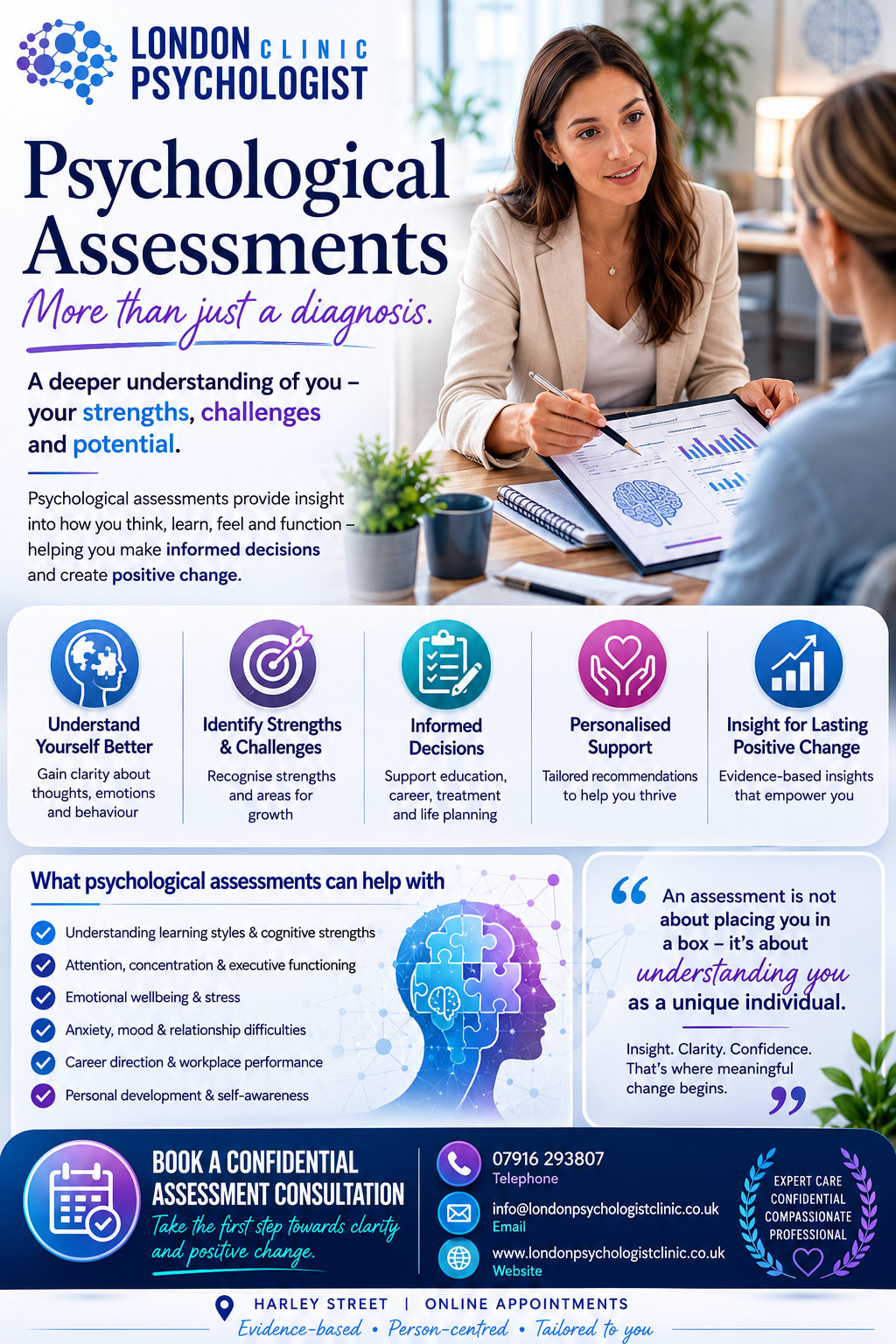
Psychological Assessments: More Than Just a Diagnosis
posted 22nd June 2026
Click image to enlarge
More Than a Diagnosis: The Real Purpose of a Psychological Assessment
When people hear the phrase "psychological assessment", they often assume it involves receiving a diagnosis. Many imagine a psychologist administering a series of tests before delivering a label that explains their difficulties. While diagnosis can sometimes form part of an assessment, this view overlooks the broader and arguably more valuable purpose of psychological evaluation.
A comprehensive psychological assessment is not simply about identifying what may be wrong. It is about understanding how an individual thinks, learns, feels, copes, relates to others and functions within the world. At its best, assessment provides a detailed psychological formulation that helps explain not only difficulties, but also strengths, resilience factors and opportunities for growth.
Rather than reducing a person to a diagnostic category, a high-quality assessment seeks to understand the unique individual behind the symptoms.
Why Understanding Matters
Human beings are complex. Two individuals may present with similar difficulties but arrive there through entirely different pathways.
For example, two professionals may both experience workplace burnout. One may be struggling with perfectionism and excessive self-criticism, while another may be responding to chronic stress, organisational pressures and unrealistic demands. Similarly, two students may experience concentration difficulties, but the underlying causes may range from anxiety and sleep deprivation to learning differences or attentional challenges.
Without careful assessment, there is a risk of treating symptoms without understanding their origins.
Psychological assessment helps create a clearer picture of what is happening and why. This understanding allows interventions to be more targeted, effective and meaningful.
Looking Beyond Labels
Diagnostic systems such as the DSM-5 and ICD-11 provide useful frameworks for understanding mental health conditions. They help clinicians communicate, guide research and support treatment planning.
However, diagnostic categories cannot fully capture the complexity of an individual's experience.
Many people do not fit neatly into a single diagnostic box. Others may experience significant distress despite not meeting formal diagnostic criteria. Some individuals function highly effectively on the surface while privately struggling with anxiety, perfectionism, self-doubt or emotional exhaustion.
A psychological assessment explores these nuances.
Rather than asking only, "What diagnosis does this person have?", psychologists often ask broader questions:
What factors are contributing to the current difficulties?
What personal strengths can support recovery?
How does this individual perceive themselves and the world?
What patterns have developed over time?
* What interventions are likely to be most effective?
These questions often provide more useful answers than diagnosis alone.
Understanding Cognitive Strengths and Differences
Psychological assessments are frequently used to understand cognitive functioning, learning styles and intellectual strengths.
Many individuals seek assessment because they want a clearer understanding of how they process information, solve problems, retain knowledge and approach challenges. Educational assessments, cognitive assessments and neuropsychological evaluations can provide valuable insight into an individual's profile of strengths and weaknesses.
For students, this may help identify learning needs and appropriate support strategies.
For professionals, assessment can offer a better understanding of cognitive strengths, leadership potential, decision-making styles and areas for development.
For parents, assessments can provide clarity regarding a child's educational needs and emotional wellbeing.
In many cases, the most valuable outcome is not a diagnosis but a deeper understanding of how someone learns and functions.
The Value of Psychological Formulation
One of the most important outcomes of assessment is the development of a psychological formulation.
A formulation differs from a diagnosis. Rather than simply assigning a label, it seeks to explain how various biological, psychological and social factors interact to create and maintain difficulties.
This approach recognises that symptoms rarely occur in isolation.
Current difficulties may be influenced by:
Early life experiences
Personality traits
Coping strategies
Family dynamics
Workplace pressures
Relationship patterns
Stressful life events
Cultural influences
A formulation provides a personalised explanation that reflects the individual's unique circumstances.
Many clients describe this process as one of the most valuable aspects of assessment because it helps them make sense of experiences that previously felt confusing or overwhelming.
Assessment as a Tool for Growth
Psychological assessment is not only relevant for individuals experiencing difficulties.
Increasingly, assessments are being used to support personal development, leadership coaching, career planning and performance enhancement.
Elite athletes routinely undergo performance assessments. Senior executives seek feedback regarding leadership strengths and interpersonal effectiveness. Students use assessments to better understand learning preferences and study strategies.
In each of these contexts, the goal is not diagnosis.
The goal is insight.
Greater self-awareness allows individuals to make informed decisions, optimise performance and develop more effective ways of navigating challenges.
The Psychological Benefits of Being Understood
Perhaps one of the most overlooked aspects of assessment is its emotional impact.
Many people spend years questioning themselves.
Why do I react this way?
Why do I struggle with certain situations?
Why do I feel different from others?
Why do I keep repeating the same patterns?
A thorough psychological assessment can often provide answers to these questions.
Being understood can be profoundly validating.
Research consistently shows that making sense of our experiences contributes to psychological wellbeing. When individuals develop coherent narratives about their difficulties and strengths, they often experience reduced distress and increased self-compassion.
The process can transform confusion into understanding and self-criticism into curiosity.
More Than a Test
A psychological assessment is not simply a collection of questionnaires or standardised measures.
It is a collaborative process designed to build understanding.
Whether the focus is mental health, learning, cognitive functioning, occupational performance or personal development, the ultimate aim is to provide meaningful insight that supports positive change.
While diagnosis may occasionally form part of the process, it is rarely the entire story.
The most valuable assessments do not simply tell people what category they fit into.
They help people understand who they are, how they function and what they need in order to thrive.
And sometimes, that understanding can be life-changing.