


Positive Thinking vs Manifestation
posted 6th May 2026
Click image to enlarge
Manifestation, Magical Thinking, and Mental Health: A Psychological Perspective
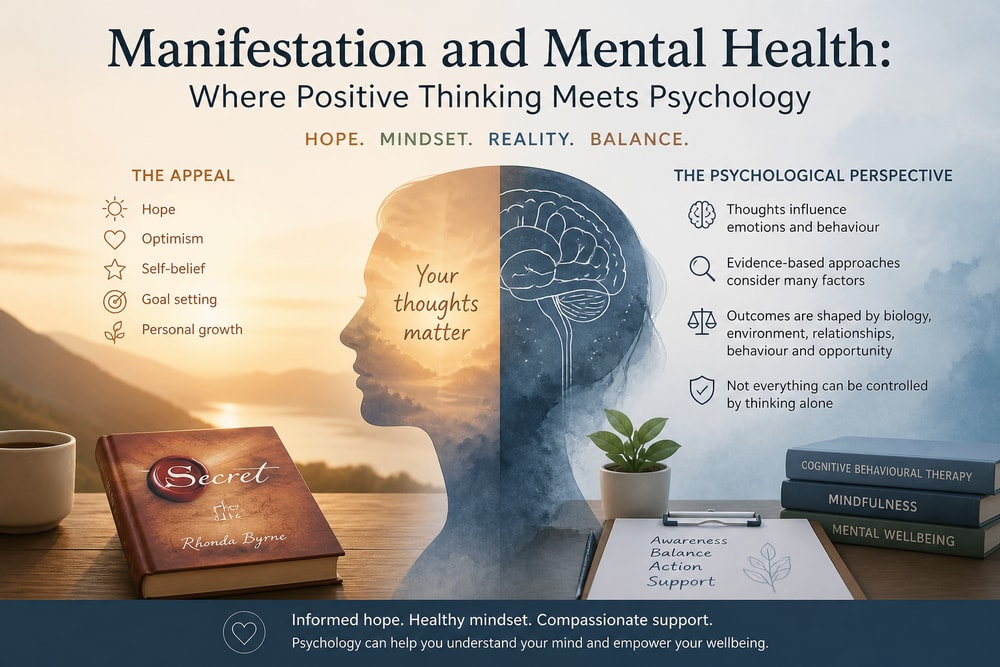
Many people are drawn to books such as The Secret because they offer something deeply appealing: the idea that our thoughts have power, that optimism can shape our lives, and that personal transformation may be within our control. In times of uncertainty, stress, grief, or dissatisfaction, these messages can feel comforting, motivating, and hopeful. For some readers, manifestation-based books encourage reflection, goal-setting, confidence, and emotional resilience.
However, while aspects of positive thinking overlap with established psychological principles, many manifestation claims move beyond what scientific psychology supports. Understanding where these ideas align with psychology — and where they depart from it — is important, particularly for individuals vulnerable to anxiety, obsessive thinking, depression, or other mental health difficulties.
Why Manifestation Books Appeal to People
Humans naturally search for meaning, patterns, and a sense of control over their lives. Psychological research consistently shows that people cope better when they feel hopeful and capable of influencing outcomes. Manifestation literature taps directly into these needs.
Books like The Secret often suggest that thoughts, emotions, and beliefs can attract experiences into one’s life through the “law of attraction.” The message is simple and emotionally powerful: think positively, visualise success, and the universe will respond accordingly.
This can be psychologically attractive for several reasons:
- It offers certainty in uncertain times
- It promotes optimism and self-belief
- It creates a sense of personal agency
- It provides emotionally reassuring explanations for success and failure
- It encourages future-oriented thinking and goal focus
These themes resonate because they partially overlap with legitimate psychological concepts.
Where Positive Thinking Does Align With Psychology
Mainstream psychology does recognise that thoughts influence emotions and behaviour. Cognitive behavioural therapy (CBT), for example, is based on the understanding that persistent negative thinking patterns can contribute to depression and anxiety.
For individuals prone to hopelessness, self-criticism, or depressive thinking, developing more balanced and constructive thought patterns can genuinely improve wellbeing.
Psychological research also supports several related concepts:
- Cognitive Reframing
- Learning to challenge catastrophic or self-defeating thoughts can reduce emotional distress.
- Self-Efficacy
- Believing that one is capable of achieving goals often increases motivation and persistence.
- Optimism and Resilience
A realistic sense of hope is associated with better coping, improved mental health outcomes, and greater resilience during stress.
- Behavioural Activation
- Visualising goals may increase the likelihood of taking meaningful action toward them.
In this sense, positive thinking is not inherently problematic. Encouraging hope, motivation, gratitude, and confidence can be psychologically beneficial when grounded in reality and accompanied by practical action.
Where Manifestation Parts From Evidence-Based Psychology
The difficulty arises when manifestation literature moves from psychological encouragement into claims that thoughts directly control external reality in a literal or supernatural way.
Evidence-based psychology does not support the idea that individuals can attract or repel life events purely through mental energy, vibration, or thought frequency. Nor does mainstream psychological science support the notion that negative events occur because someone “thought negatively enough” to cause them.
This distinction matters clinically.
Psychology generally views outcomes as influenced by multiple interacting factors:
- biology
- environment
- relationships
- socioeconomic conditions
- behaviour
- opportunity
- trauma history
- cognition
Manifestation frameworks can sometimes oversimplify this complexity by implying that thoughts alone determine outcomes.
For some individuals, this may lead to self-blame when life does not improve despite sustained “positive thinking.” Someone struggling financially, physically unwell, grieving, or experiencing discrimination may incorrectly conclude they have somehow “failed to manifest properly.”
The Link With Magical Thinking
From a clinical perspective, certain manifestation beliefs can overlap with what psychologists call magical thinking. Magical thinking refers to the belief that thoughts, rituals, or mental processes can directly influence unrelated external events in ways that are not supported by objective evidence. Importantly, magical thinking exists on a spectrum. Mild forms are extremely common in the general population. Many people engage in harmless superstitions, lucky rituals, or symbolic thinking without any mental health disorder.
However, in some circumstances, these beliefs can become psychologically problematic.
When Manifestation May Become Harmful
For individuals with underlying vulnerabilities — particularly undiagnosed anxiety disorders or obsessive-compulsive tendencies — manifestation practices may unintentionally reinforce unhealthy patterns of thinking.
Obsessive-Compulsive Disorder (OCD)
In OCD, individuals may experience thought-action fusion: the belief that having a thought can make an event more likely to occur or morally equivalent to carrying it out. Manifestation content can sometimes intensify this fear by suggesting that thoughts carry direct causal power. A person vulnerable to OCD may begin monitoring their thoughts excessively, fearing that “negative thinking” could cause harm to themselves or others.
This may lead to:
- compulsive reassurance-seeking
- mental rituals
- excessive positive-thinking exercises
- anxiety around intrusive thoughts
- heightened guilt and responsibility
Anxiety Disorders
People with high anxiety may become hypervigilant about maintaining the “correct mindset,” creating pressure to suppress normal emotions such as fear, sadness, or anger. Ironically, research shows that excessive suppression of unwanted thoughts often increases psychological distress.
Depression
While optimism can support recovery, some manifestation frameworks may unintentionally invalidate genuine emotional suffering by implying that distress reflects insufficient positivity or poor mindset. This can discourage people from seeking professional help or acknowledging legitimate mental health struggles.
Does This Mean Manifestation Books Are Dangerous? For most people, probably not.
Many readers engage with manifestation literature in a flexible, symbolic, or motivational way. Used casually, these books may encourage reflection, confidence, goal-setting, gratitude, or healthier habits. The concern is less about occasional positive visualisation and more about rigid or literal interpretations — particularly among individuals already vulnerable to obsessive thinking, anxiety, paranoia, or emotional distress.
In clinical psychology, context matters enormously. A strategy that feels motivating and harmless for one person may become distressing or compulsive for another.
A Balanced Psychological Perspective
Manifestation books occupy an interesting cultural space between self-help, spirituality, motivational philosophy, and popular psychology. Their popularity reflects genuine human needs: hope, control, meaning, and emotional reassurance. At the same time, it is important to distinguish scientifically supported psychological principles from claims that fall outside established evidence.
Psychology supports:
- realistic optimism
- cognitive flexibility
- resilience
- healthy goal-setting
- self-belief
- behavioural change
Psychology does not support:
- thoughts literally attracting external events
- emotional states determining fate
- blame-based interpretations of illness or hardship
- the idea that unwanted thoughts can “manifest” tragedy
For most individuals, manifestation content is unlikely to cause harm when approached critically and flexibly. But for those with pre-existing or undiagnosed mental health vulnerabilities — especially OCD or severe anxiety — these ideas may reinforce unhealthy cognitive patterns and should be approached with caution.
Ultimately, hope and positive thinking can be valuable components of wellbeing, but they work best when grounded in evidence, emotional realism, and compassionate psychological understanding rather than magical certainty.