


People Pleasing and the Leaking Bucket
posted 15th June 2026
People Pleasing and the Leaking Bucket: Why Approval Never Feels Like Enough
Most people enjoy being liked. We naturally want positive relationships, acceptance, and connection with others. There is nothing unhealthy about being kind, considerate, or helpful. For some people, however, pleasing others becomes far more than a preference. They struggle to say no, worry excessively about disappointing people, and put other people's needs ahead of their own, even when it comes at a personal cost. Their self-worth begins to depend on whether others approve of them.
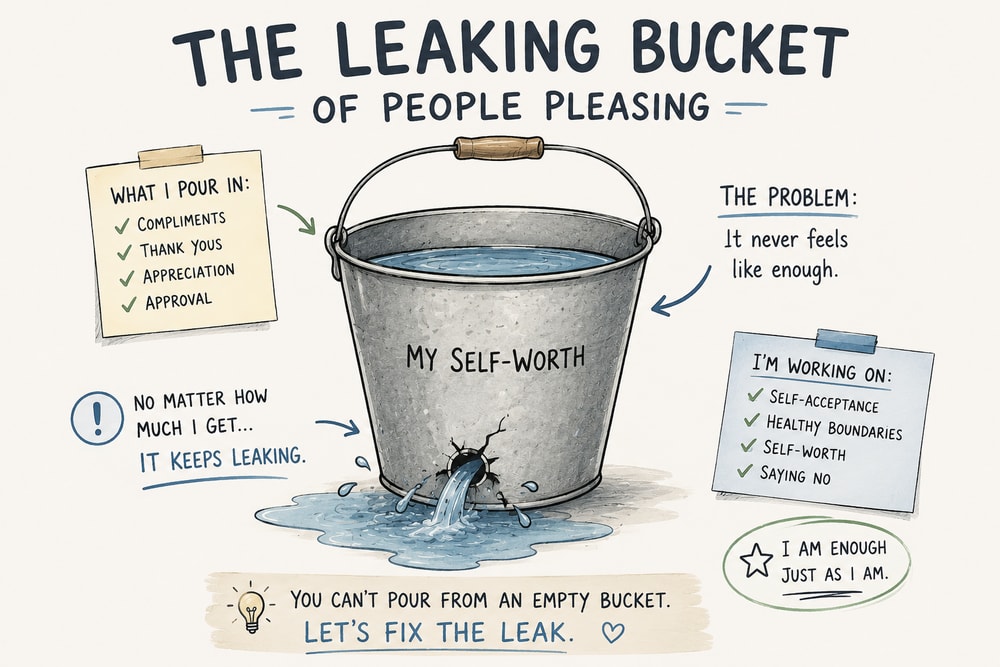
One helpful way to understand people pleasing is through the analogy of a leaking bucket.
The Bucket That Never Stays Full
Imagine carrying a bucket that represents your sense of self-worth. For some people, the bucket feels reasonably full most of the time. They appreciate positive feedback and enjoy feeling valued, but their confidence does not disappear when someone disagrees with them or becomes disappointed.
Now imagine a bucket with a small hole in the bottom. No matter how much water is poured into it, it slowly leaks away. This is often what people pleasing feels like. Compliments feel good for a while. Approval provides temporary relief. Praise creates a brief sense of confidence. But before long, the bucket begins to empty again, and the person feels compelled to seek more approval, more validation, and more reassurance to refill it.
How People Pleasing Develops
People pleasing rarely develops without reason. For many individuals, it begins in childhood. Perhaps they learned that being helpful reduced conflict. Perhaps they received praise primarily when they achieved, behaved well, or met other people's expectations. Perhaps expressing their own needs was criticised, ignored, or seen as selfish.
Over time, they may develop an important belief: "My value depends on making other people happy." As adults, this belief can continue operating automatically, even when it creates difficulties.
The Hidden Fear Beneath People Pleasing
Many people assume that people pleasing is simply about being nice. In reality, it is often driven by fear. The fear of rejection. The fear of criticism. The fear of conflict. The fear of being seen as selfish. The fear of losing important relationships.
Saying no can feel incredibly uncomfortable because it triggers the worry that someone may become upset or disappointed. As a result, people often agree to things they do not want to do, suppress their own needs, or take responsibility for other people's emotions.
Why Approval Never Feels Like Enough
One of the most frustrating aspects of people pleasing is that approval rarely creates lasting confidence. Just like pouring water into a leaking bucket, the relief tends to be temporary.
A person may receive reassurance that someone is happy with them, only to find themselves worrying about the next interaction. They may work hard to gain approval from one person, then immediately start worrying about someone else. The goalposts keep moving.
No amount of external validation fully solves the underlying problem because the bucket continues leaking. The person becomes trapped in an endless cycle of seeking approval without ever feeling truly secure.
The Cost of Constantly Pleasing Others
At first glance, people pleasing may appear helpful or selfless. However, over time it can have significant consequences.
Many people experience exhaustion, resentment, anxiety, and burnout. Relationships may become unbalanced because their own needs are consistently overlooked. Some individuals become disconnected from what they genuinely want because they spend so much time focusing on what everyone else expects.
Ironically, trying to keep everyone happy often leaves the people pleaser feeling unhappy themselves.
Learning to Repair the Bucket
One of the most important parts of overcoming people pleasing is recognising that self-worth cannot rely entirely on other people's approval. The goal is not to become selfish, uncaring, or inconsiderate. The goal is to develop a sense of worth that remains stable even when other people disagree, feel disappointed, or have different expectations.
Rather than constantly pouring more approval into the bucket, therapy focuses on repairing the hole.
As individuals begin to develop self-acceptance and healthier boundaries, they become less dependent on external validation. Their confidence starts coming from within rather than from the reactions of others.
How Therapy Can Help
Therapy helps individuals understand where people pleasing patterns originated and why they continue today. Many people discover that their behaviours developed as understandable ways of gaining acceptance, avoiding conflict, or feeling safe.
Evidence-based approaches such as Cognitive Behavioural Therapy (CBT), Compassion-Focused Therapy (CFT), and schema therapy can help individuals challenge unhelpful beliefs, strengthen boundaries, and develop healthier ways of relating to others.
Therapy can also help people become more comfortable with the reality that not everyone will always approve of them. This is not a sign of failure. It is a normal part of healthy relationships.
Recovery Is About Balance, Not Rejection
Many people worry that if they stop people pleasing, they will become selfish. In reality, healthy relationships involve balance.
You can be kind without sacrificing your own wellbeing. You can care about others without taking responsibility for their emotions. You can be compassionate without constantly seeking approval.
Recovery involves learning that your worth does not increase when everyone likes you, nor does it decrease when someone is disappointed. It means recognising that healthy boundaries often strengthen relationships rather than damage them.
Seeking Professional Support
If you find yourself constantly putting other people's needs first, struggling to say no, or feeling responsible for everyone else's happiness, you are not alone.
People pleasing is a common difficulty, but it does not have to control your life. At The London Psychologist Clinic, we help individuals develop healthier boundaries, strengthen self-esteem, and build confidence that comes from within rather than from constant approval.
You do not need to spend your life trying to fill a leaking bucket. With the right support, it is possible to develop a stronger, more secure sense of self-worth and build relationships that feel healthier, more balanced, and more authentic.