


Pathological Narcissism in Women
posted 20th March 2026
Pathological Narcissism in Women: A Psychological Perspective
Narcissism is often discussed in ways that imply a particular gendered pattern, with popular discourse frequently associating more overt, grandiose narcissism with men. However, psychological research suggests a more complex picture. While men may be more frequently diagnosed with Narcissistic Personality Disorder (NPD), this does not mean that narcissism is absent in women. Rather, it may present differently, be less easily recognised, or overlap with other psychological patterns that are more commonly identified in women. Understanding these nuances is essential for both accurate diagnosis and effective clinical work.
According to the DSM-5, Narcissistic Personality Disorder is defined as a pervasive pattern of grandiosity, a need for admiration, and a lack of empathy, present across contexts and leading to significant impairment in functioning. The diagnostic criteria were largely developed based on observable, external behaviours such as dominance, entitlement, and overt self-importance. These features align closely with what is often described as grandiose narcissism, a presentation that is more visible and, in many cases, more socially tolerated in men.
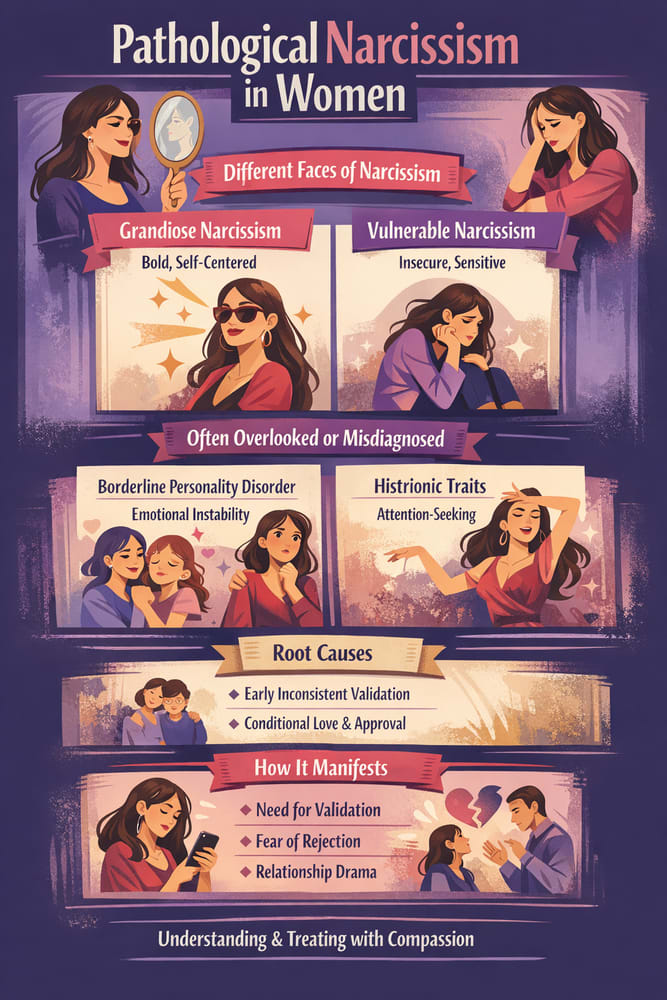
In contrast, research has increasingly highlighted the concept of vulnerable narcissism, which may be more common in women or, at the very least, more socially acceptable for women to express. Vulnerable narcissism is characterised by hypersensitivity to criticism, insecurity, emotional volatility, and a fluctuating sense of self-worth. Rather than appearing overtly confident or dominant, individuals may present as anxious, self-doubting, or preoccupied with how they are perceived by others. Despite these differences in presentation, the underlying structure remains similar: a fragile sense of self that is highly dependent on external validation.
This distinction raises an important clinical issue. Because diagnostic frameworks such as the DSM-5 are more attuned to grandiose expressions, narcissistic traits in women may be under-recognised or misattributed. For example, emotional reactivity or sensitivity to perceived rejection may be interpreted through the lens of anxiety or mood disorders, rather than understood as part of a narcissistic structure. As a result, women with significant narcissistic traits may be more likely to receive alternative diagnoses.
One such diagnosis is Borderline Personality Disorder (BPD), which is more commonly diagnosed in women. BPD is characterised by instability in relationships, self-image, and affect, as well as a marked fear of abandonment. While distinct from narcissism, there is some conceptual overlap, particularly in areas such as emotional dysregulation, sensitivity to rejection, and difficulties with identity. In clinical practice, it is not uncommon to see features of both presentations, or for narcissistic vulnerabilities to be embedded within a broader pattern of relational instability.
Similarly, certain features of Histrionic Personality Disorder, also more frequently diagnosed in women, may overlap with narcissistic dynamics, particularly in relation to attention-seeking, a strong need for validation, and interpersonal sensitivity. Again, the key distinction lies in the underlying motivation and structure of the self, but these categories can sometimes obscure as much as they clarify.
It is therefore important to consider the role of sociocultural factors in shaping both the expression and diagnosis of narcissism. Traditional gender norms often encourage men to display confidence, dominance, and independence, while women may be socialised towards relational sensitivity, appearance-based self-worth, and emotional attunement to others. These expectations can influence how narcissistic traits develop and how they are perceived. For instance, a woman who is highly concerned with how she is viewed by others may be seen as insecure, while a man with similar underlying needs may be perceived as ambitious or self-assured.
Developmentally, the origins of pathological narcissism in women are similar to those observed in men. Early environments characterised by inconsistent validation, conditional approval, or emotional unpredictability can contribute to an unstable sense of self. In some cases, individuals may have been excessively praised without realistic feedback; in others, they may have experienced criticism or emotional neglect. Both pathways can lead to a reliance on external validation and a heightened sensitivity to how one is perceived by others.
In adult relationships, these patterns may manifest differently from the stereotypical image of narcissism. Rather than overt dominance or entitlement, individuals may display emotional dependency, reassurance-seeking, or covert forms of control, such as guilt-inducing behaviours or withdrawal. Relationships can become characterised by cycles of idealisation and disappointment, often driven by unmet emotional needs and difficulties regulating self-esteem.
From a clinical perspective, individuals with narcissistic traits—regardless of gender—rarely present with the label of narcissism. More commonly, they seek support for difficulties such as anxiety, low mood, relationship conflict, or chronic dissatisfaction. Therapeutic work in this area requires a careful and empathic approach, focusing on building insight into underlying patterns without triggering excessive defensiveness or shame.
Approaches such as schema therapy, psychodynamic therapy, and adapted Cognitive Behavioural Therapy (CBT) can be particularly helpful. These modalities aim to address core beliefs about self-worth, reduce reliance on external validation, and develop more stable and authentic ways of relating to others. Over time, this can lead to improved emotional regulation, more secure relationships, and a stronger sense of internal stability.
In considering whether narcissism is a “male” or “female” phenomenon, the most accurate answer is that it is neither. Rather, it is a human response to developmental and relational experiences, shaped by personality and culture. What differs is not the presence of narcissism, but its expression, recognition, and interpretation.
Ultimately, the goal of psychological understanding is not to label or pathologise individuals unnecessarily, but to recognise when patterns of thinking and relating become rigid, distressing, or limiting. By broadening our understanding of how narcissism presents across genders, we can move towards more accurate diagnosis, more effective treatment, and a more compassionate understanding of the individuals behind the label.