


Overexercising Links to Low Mood
posted 14th November 2026
How Overexercising Links to Low Mood
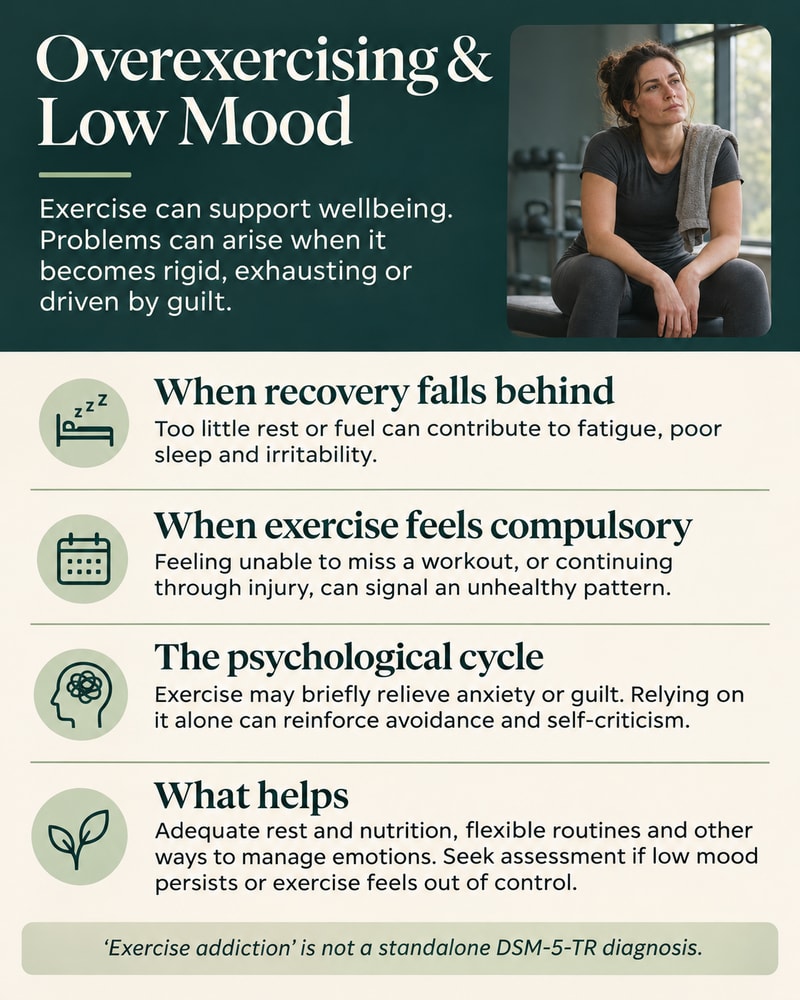
Exercise can support mental health, providing pleasure, structure and a sense of achievement. But when movement becomes driven by guilt, rigid rules or a need to escape difficult feelings, it can become part of a cycle of exhaustion and low mood.
Someone may appear highly motivated while privately feeling anxious about missing a workout, dissatisfied with their body or unable to rest. Understanding this pattern means looking beyond the number of hours spent exercising and considering the psychological function it serves.
When does exercise become excessive?
There is no single number of workouts that makes exercise psychologically unhealthy. Training demands, physical health, nutrition and recovery all matter. A demanding routine may be sustainable for one person and harmful for another.
Compulsive exercise describes a driven, inflexible relationship with movement: feeling that you must exercise, even when doing so causes harm or interferes with everyday life. Warning signs include continuing through injury, sacrificing relationships to complete sessions, or experiencing intense guilt when plans change. [1]
A useful question is: Can I adapt my exercise to what my body and circumstances need, or do I feel compelled to follow rules regardless of the consequences?
What does the DSM-5-TR say?
The Diagnostic and Statistical Manual of Mental Disorders, Fifth Edition, Text Revision (DSM-5-TR) does not recognise “overexercising” or “exercise addiction” as a standalone diagnosis. These terms can describe a problem, but they do not establish a psychiatric disorder. [1]
Excessive exercise can occur within recognised conditions. In bulimia nervosa, it may function as a compensatory behaviour intended to prevent weight gain after binge eating. It may also feature in anorexia nervosa, alongside restrictive eating and fear of weight gain. Exercise alone is insufficient to diagnose either condition; the wider diagnostic criteria require careful assessment. [2]
Similarly, a rigid exercise routine does not automatically indicate obsessive-compulsive disorder. A psychologist considers the thoughts driving the behaviour, its consequences and the broader clinical picture, rather than attaching a diagnosis to one habit.
How physical strain can affect mood
Exercise places demands on the body. When training repeatedly exceeds recovery capacity, fatigue, disturbed sleep, irritability and declining performance can develop. More persistent difficulties may warrant assessment for overtraining syndrome, a sports medicine condition that can involve psychological as well as physical symptoms. Feeling tired after a difficult session is not, by itself, evidence of this syndrome. [3]
Another consideration is low energy availability: insufficient dietary energy remains to support the body’s functions after exercise expenditure. Problematic, prolonged or severe low energy availability can contribute to Relative Energy Deficiency in Sport (REDs), with consequences for physical and psychological health. This can affect people of different genders and does not necessarily involve an eating disorder. [4]
The relationship with mental health can work in both directions. Psychological difficulties may contribute to under-fuelling or excessive training, while inadequate energy availability may contribute to changes in mood and wellbeing. Research is still developing, and low mood should not automatically be attributed to exercise. [4]
When exercise becomes emotional avoidance
Exercise can be a helpful form of emotion regulation. Problems may arise when it becomes the only reliable way a person feels able to manage distress.
In a psychological formulation, this may involve experiential avoidance: using activity to avoid contact with painful thoughts or feelings. Someone might train whenever loneliness, shame or anxiety emerges. They experience short-term relief, but have fewer opportunities to understand those feelings or respond to what is causing them.
This can create a negative reinforcement cycle. Because exercising removes an unpleasant feeling temporarily, the urge to exercise in similar situations becomes stronger. Rest then feels threatening, and movement becomes less of a choice.
This is one possible explanation, rather than an assumption about everyone who trains frequently. Exercising to manage stress is not inherently unhealthy; flexibility and the longer-term consequences matter.
Perfectionism, self-worth and the pressure to do more
For some people, exercise becomes entangled with conditional self-worth: the belief that personal value depends on achievement, appearance or self-discipline. Missing a workout may then feel like evidence of personal failure.
Dichotomous thinking, sometimes called all-or-nothing thinking, can intensify this pattern: “If I cannot complete the whole session, it does not count.” A target provides brief satisfaction, but the standard soon rises again.
Consider an illustrative example: someone starts running to cope with work stress. Over time, they stop meeting friends to protect their training schedule and feel guilty on rest days. As fatigue increases, their performance declines. They interpret this as laziness and train harder. A psychological formulation would explore how self-criticism, reduced recovery and loss of social connection may be maintaining their low mood.
Is it low mood or depression?
Low mood after a demanding period of training is not necessarily a depressive disorder. However, persistent sadness, hopelessness or anhedonia—a marked loss of interest or pleasure—deserves attention.
In DSM-5-TR terms, a major depressive episode involves a cluster of symptoms over at least two weeks, including depressed mood or loss of interest or pleasure, with clinically significant distress or impairment. Diagnosis also requires consideration of medical causes, substances and the wider psychiatric history. Being able to work or maintain an exercise routine does not rule out depression. [5]
A GP can assess persistent fatigue and mood changes, including possible contributors such as anaemia, thyroid problems, sleep difficulties or inadequate nutrition. Seek support sooner if symptoms are severe or worsening; there is no need to wait two weeks to ask for help.
How can psychological therapy help?
A psychologist develops an individual formulation: a shared understanding of how thoughts, emotions, behaviour, relationships and physical health interact. The aim is to understand why exercise has become difficult to regulate and what keeps the pattern going.
Depending on the assessment, therapy may include:
- Cognitive behavioural therapy (CBT): examining rigid rules, catastrophic predictions about rest and beliefs linking achievement to personal worth.
- Behavioural activation: rebuilding varied sources of pleasure, connection and meaning, rather than relying on exercise alone. This does not mean prescribing more activity to someone who is already overexercising.
- Emotion regulation work: developing additional ways to respond to anxiety, sadness and shame.
- Work on self-criticism: learning to recognise physical limits without interpreting them as weakness or failure.
- Where an eating disorder, REDs or significant physical symptoms are suspected, psychological work should be coordinated with appropriate medical and nutritional care. Changes to exercise may require an individual clinical plan.
Rebuilding a more flexible relationship with exercise
Recovery involves being able to respond to your body, circumstances and values. That may mean accepting rest, fuelling adequately, reconnecting with other interests and noticing when guilt is making decisions for you.
If exercise is leaving you persistently depleted, distressed or unable to stop despite harm, seek professional assessment. Fainting, chest pain or severe physical weakness require prompt medical attention.
At the London Psychologist Clinic, we can help you explore low mood, perfectionism, self-criticism and the emotional patterns influencing your relationship with exercise. To enquire about psychological support, email info@londonpsychologistclinic.co.uk.
This article provides general information and is not a substitute for an individual psychological or medical assessment.
References and further reading
National Eating Disorders Association. Excessive Exercise.
American Psychiatric Association. What Are Eating Disorders?
Cleveland Clinic. Overtraining Syndrome.
Intersection of mental health issues and Relative Energy Deficiency in Sport (REDs). British Journal of Sports Medicine (2023), 57, 1127.
American Psychiatric Association. Diagnostic and Statistical Manual of Mental Disorders, Fifth Edition, Text Revision (2022); see also What Is Depression?
National Institute for Health and Care Excellence. Depression in adults: treatment and management (NG222).