


Our Need For Certainty
posted 29th June 2026
Click image to enlarge
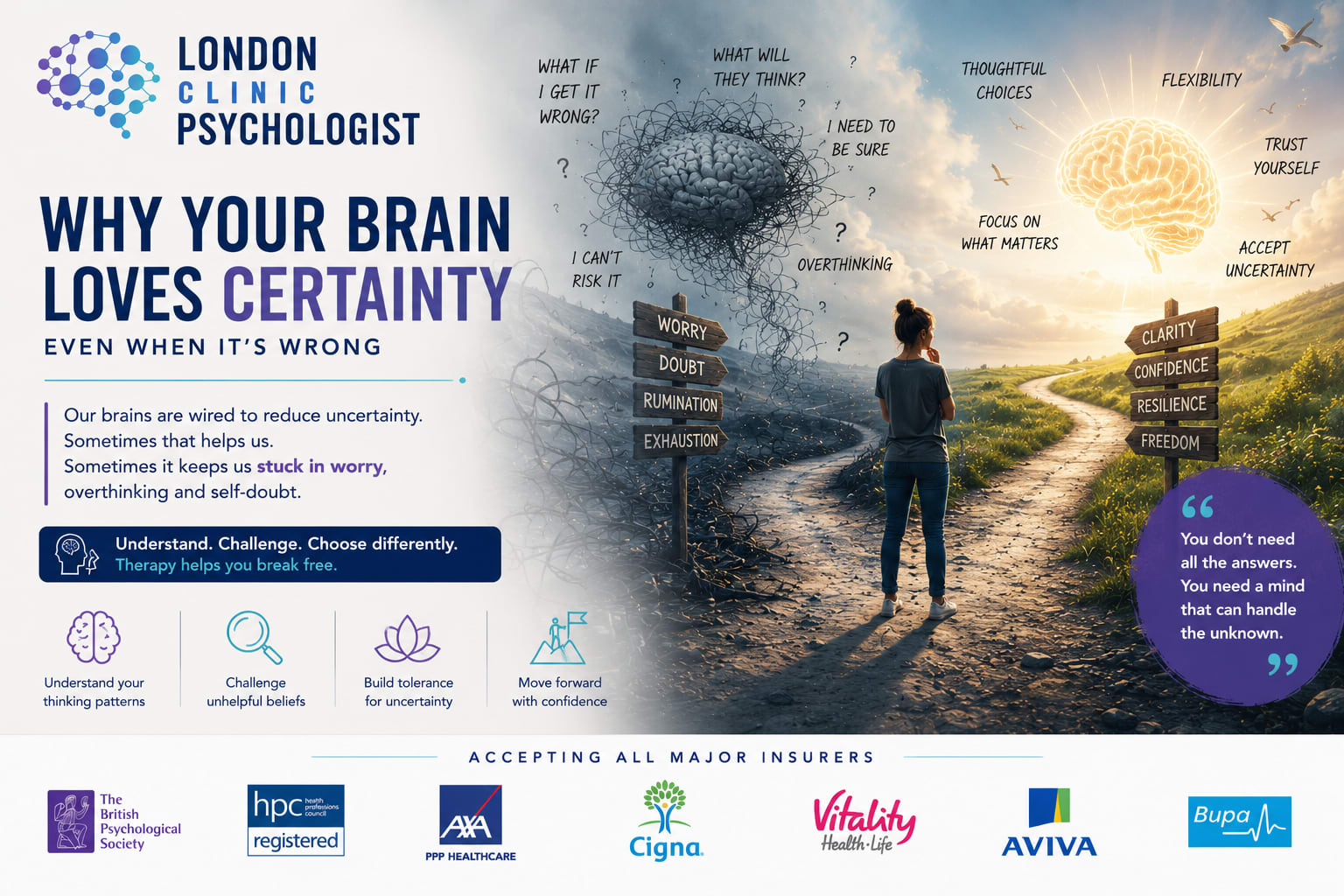
Why Your Brain Loves Certainty – Even When It's Wrong
Imagine two people waiting for a text message that hasn't arrived. One assumes their friend has simply become busy. The other becomes convinced they've upset someone, the relationship is over or something terrible has happened. The same situation produces two entirely different emotional experiences.
The difference often lies in one of the brain's most fundamental drives: our need for certainty.
Although we often think of ourselves as logical decision-makers, psychologists have long understood that the human brain is, above all else, a prediction machine. Every second of every day, it attempts to anticipate what will happen next, allowing us to respond quickly to the world around us. In many situations, this ability is remarkably adaptive. However, when certainty is unavailable—as it often is—the brain may begin generating explanations that feel convincing but are not necessarily accurate.
One of the leading neuroscientists in this field, Professor Karl Friston, proposed the influential Free Energy Principle, suggesting that the brain constantly attempts to minimise uncertainty by updating its internal predictions about the world. Put simply, uncertainty requires mental effort. Certainty, even if inaccurate, often feels psychologically more comfortable than not knowing.
This explains why our minds frequently jump to conclusions. We assume someone dislikes us because they seemed distant. We believe a colleague's short email means they're angry. We become convinced a headache must indicate something serious after reading information online. These conclusions reduce uncertainty, but they may also increase anxiety because the brain often prefers an answer over no answer.
Clinical psychologists frequently observe this process in individuals experiencing Generalised Anxiety Disorder (GAD). According to the Diagnostic and Statistical Manual of Mental Disorders (DSM-5-TR), excessive and difficult-to-control worry is a defining feature of the disorder. Importantly, the worry is rarely about one specific problem. Instead, it reflects an ongoing struggle to tolerate uncertainty across multiple areas of life, including health, relationships, work and finances.
Research by psychologists Professor Michel Dugas and colleagues has shown that intolerance of uncertainty is one of the strongest psychological processes maintaining chronic anxiety. Individuals who struggle with uncertainty often believe that worrying prepares them for future problems or prevents negative events from occurring. Ironically, this continual search for certainty usually increases rather than reduces anxiety.
The same psychological mechanism also appears in Obsessive-Compulsive Disorder (OCD). Someone may repeatedly check whether a door is locked, reread emails numerous times or seek constant reassurance from loved ones. These behaviours provide temporary certainty but teach the brain that uncertainty itself is dangerous. Over time, the need for reassurance grows stronger rather than weaker.
Perhaps surprisingly, our brains can also become attached to negative certainty. Someone with low self-esteem may automatically conclude, "I'm not good enough." Although painful, this belief can feel strangely familiar and therefore psychologically predictable. Challenging it introduces uncertainty, and uncertainty often feels more uncomfortable than maintaining an existing belief.
One famous psychological demonstration illustrates this tendency. In experiments conducted by psychologist Professor Peter Wason, participants consistently searched for information confirming their existing beliefs while overlooking evidence that contradicted them. This phenomenon, known as confirmation bias, means that once our brains settle on an explanation, they naturally seek evidence supporting it—even when alternative explanations are equally plausible.
Fortunately, psychological therapy helps individuals become more comfortable with uncertainty rather than eliminating it altogether. Cognitive Behavioural Therapy (CBT) teaches people to recognise automatic assumptions, examine evidence objectively and tolerate uncertainty without rushing to conclusions. Acceptance and Commitment Therapy (ACT) similarly encourages people to move towards valued actions even when complete certainty is impossible.
Interestingly, some of the most psychologically resilient individuals are not those who have all the answers. Instead, they are those who have learned that uncertainty is an unavoidable part of life. They no longer feel compelled to answer every question immediately or solve every possible future problem before it occurs.
At The London Psychologist Clinic, we often help people who describe themselves as "overthinkers." In reality, many are not overthinking because they enjoy analysing problems—they are searching for certainty in situations where certainty simply does not exist. Therapy helps people recognise this pattern, reduce reassurance-seeking behaviours and develop greater confidence in their ability to cope with uncertainty itself.
Ultimately, psychological wellbeing is not about predicting the future perfectly. It is about developing the flexibility to face an uncertain future without allowing uncertainty to dominate the present. Ironically, the moment we stop demanding certainty from life is often the moment we begin feeling most psychologically free.
References
- American Psychiatric Association (2022). Diagnostic and Statistical Manual of Mental Disorders (5th ed., Text Revision). DSM-5-TR.
- Dugas, M. J., Gagnon, F., Ladouceur, R., & Freeston, M. H. (1998). Generalized Anxiety Disorder: A Preliminary Test of a Conceptual Model.
- Friston, K. (2010). The Free-Energy Principle: A Unified Brain Theory? Nature Reviews Neuroscience.
- Wason, P. C. (1960). On the Failure to Eliminate Hypotheses in a Conceptual Task.
- Carleton, R. N. (2016). Into the Unknown: A Review and Synthesis of Contemporary Models Involving Uncertainty.