


OCD and the Potato Sorter
posted 3rd June 2026
OCD and the Potato Sorter: Why the Search for Certainty Never Ends
Obsessive-Compulsive Disorder (OCD) is often misunderstood. Many people assume it is simply about cleanliness, organisation, or wanting things done in a particular way. While OCD can sometimes involve these behaviours, at its core it is usually a struggle with doubt, uncertainty, and the overwhelming need to feel completely sure.
One of the most distressing aspects of OCD is that it creates the feeling that certainty is both possible and necessary. Whether the concern relates to health, relationships, responsibility, morality, or the fear of causing harm, the individual becomes trapped in the belief that if they think hard enough, check carefully enough, or seek enough reassurance, they will eventually arrive at a point where all doubt disappears. Unfortunately, that moment rarely comes.
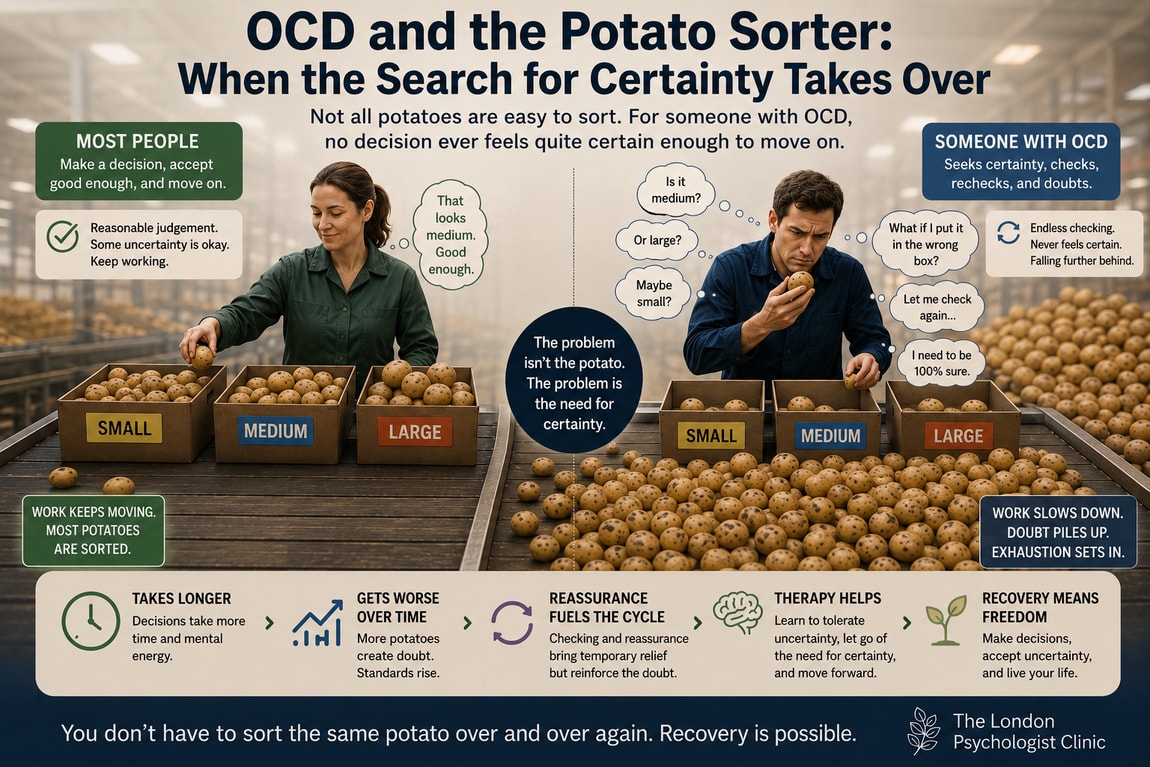
A useful way of understanding OCD is to imagine a potato sorting factory. Two workers are given the same task: to sort potatoes into three boxes labelled small, medium, and large. Most people approach this task relatively easily. They pick up a potato, make a reasonable judgement, place it into the box that seems most appropriate, and move on to the next one. They understand that some potatoes sit near the boundary between categories, but they accept that perfection is neither possible nor necessary. As a result, the work progresses smoothly. By the end of the day, most of the potatoes have been sorted and very little time has been spent worrying about whether every decision was exactly right.
For someone with OCD, however, the task looks very different. They pick up a potato and immediately begin questioning themselves. Is it really medium, or is it actually large? What if it belongs in the small box? What if I make a mistake? They compare it with other potatoes, hold it up from different angles, reconsider their judgement, and perhaps even move it from one box to another. Eventually they make a decision, but the feeling of uncertainty remains. Before long they find themselves checking again.
While the first worker has already sorted dozens of potatoes, the individual with OCD may still be focused on a handful. The problem is not that they are less intelligent or less capable. In fact, many people with OCD are exceptionally conscientious and thoughtful. The difficulty lies in the fact that their brain demands a level of certainty that simply cannot be achieved. Every decision must feel completely right before they can move on, yet no decision ever quite reaches that standard.
Over time, the situation often becomes worse. Initially, only a few potatoes create uncertainty. As OCD strengthens, more and more potatoes begin to feel difficult to sort. Decisions that once seemed straightforward now trigger doubt. The sorting process slows down even further, and the individual becomes increasingly exhausted by the constant need to analyse, review, and verify. What began as an attempt to prevent mistakes gradually turns into an endless cycle of checking and reassurance-seeking.
This process mirrors what happens in many forms of OCD. Someone with checking OCD may repeatedly question whether they locked the front door, turned off an appliance, or sent the correct email. A person with relationship OCD may spend hours analysing their feelings for their partner. Someone experiencing health-related OCD may repeatedly search for symptoms or seek reassurance from medical professionals. In each case, the individual is attempting to sort a potato that refuses to fit neatly into a box.
The difficulty is that reassurance rarely solves the problem. Each time a person checks, researches, or asks someone else for confirmation, they experience a brief reduction in anxiety. However, the brain learns that the doubt must have been important because so much effort was devoted to resolving it. As a result, the uncertainty returns, often stronger than before. What feels like a solution becomes part of the problem.
One of the most important goals of therapy is helping people develop a different relationship with uncertainty. Effective treatments such as Cognitive Behavioural Therapy (CBT) and Exposure and Response Prevention (ERP) do not focus on eliminating doubt altogether. Instead, they help individuals recognise that uncertainty is an unavoidable part of life and that it is possible to move forward without achieving complete certainty first.
Returning to the potato sorter analogy, therapy helps the individual learn to place the potato into the box that seems most appropriate and continue with the task, even when a small amount of uncertainty remains. Rather than repeatedly revisiting the same decision, they learn that doubt can be tolerated. Over time, the urge to check diminishes, confidence grows, and the sorting process becomes easier.
Perhaps the most important lesson for people living with OCD is that recovery does not come from finding the perfect answer. It comes from letting go of the belief that a perfect answer is required. The goal is not to eliminate uncertainty from life but to stop allowing uncertainty to dictate every decision.
When people begin to trust themselves enough to move forward despite doubt, something remarkable happens. The potatoes keep moving, the work gets done, and life becomes larger than the questions OCD demands they answer.
At The London Psychologist Clinic, we provide evidence-based treatment for OCD and related anxiety disorders. If you find yourself trapped in cycles of overthinking, checking, reassurance-seeking, or persistent doubt, professional support can help you break free from the search for certainty and regain confidence in your ability to live alongside uncertainty.