


Neat Personality Categories?
posted 2nd June 2026
Click image to enlarge
Are You a Leader or a Follower? The Problem with Personality Labels
Most people have, at some point, been described as either a leader or a follower.
Perhaps it happened at school, in the workplace, or within a social group. Some individuals seem naturally confident, decisive and influential, while others appear more comfortable taking guidance from those around them. Over time, these observations often become labels, and those labels can become identities.
Many people spend years believing they are simply "the confident one," "the shy one," "the leader," or "the follower." These descriptions can feel surprisingly permanent. Yet psychological research suggests that human personality is far more complex than such categories imply.
The tendency to place ourselves and others into neat psychological boxes is understandable. Human beings naturally seek patterns and shortcuts to make sense of a complicated social world. Psychologists refer to this process as social categorisation. By creating categories, the brain reduces complexity and allows us to make rapid judgements about ourselves and those around us.
The problem is that while categories may be convenient, they are rarely accurate.
One of the most persistent myths in popular psychology is the idea that people fall into distinct personality "types." Personality tests, social media quizzes and self-help literature often reinforce the notion that individuals belong to fixed categories that determine how they think, feel and behave. While these frameworks can sometimes provide useful insights, they often oversimplify the reality of human behaviour.
Modern personality research paints a very different picture. Rather than viewing personality as a collection of rigid types, psychologists generally understand personality as a series of dimensions that exist along a continuum. One of the most influential models is the Five Factor Model of Personality, developed through decades of research by psychologists such as Paul Costa and Robert McCrae. This model suggests that personality is best understood through broad traits such as extraversion, conscientiousness, openness to experience, agreeableness and emotional stability.
Importantly, individuals do not fit neatly into one category or another. Most people fall somewhere between the extremes. A person may be highly sociable in familiar situations but reserved in unfamiliar ones. Someone who appears confident at work may experience significant self-doubt in their personal life. Human behaviour is remarkably dependent upon context, which makes simplistic labels inherently limited.
The distinction between leaders and followers provides an excellent example. Society often celebrates leadership as though it were an innate characteristic possessed by a fortunate few. Leadership is frequently portrayed as a fixed personality trait rather than a skill that can be developed. Yet the evidence suggests otherwise.
Research has identified certain characteristics that may contribute to effective leadership, including emotional intelligence, adaptability, conscientiousness and confidence. However, these traits alone do not determine whether someone will become a successful leader. Environmental factors, life experiences, opportunities, relationships and cultural expectations all play significant roles. Many individuals who appear to be natural leaders have developed their skills over years of experience rather than being born with them.
Furthermore, effective leadership is often highly situational. A person who demonstrates exceptional leadership within one environment may struggle in another. Equally, someone who prefers to follow in one context may take charge confidently when operating within an area of expertise. Human behaviour is far more fluid than the labels we attach to it.
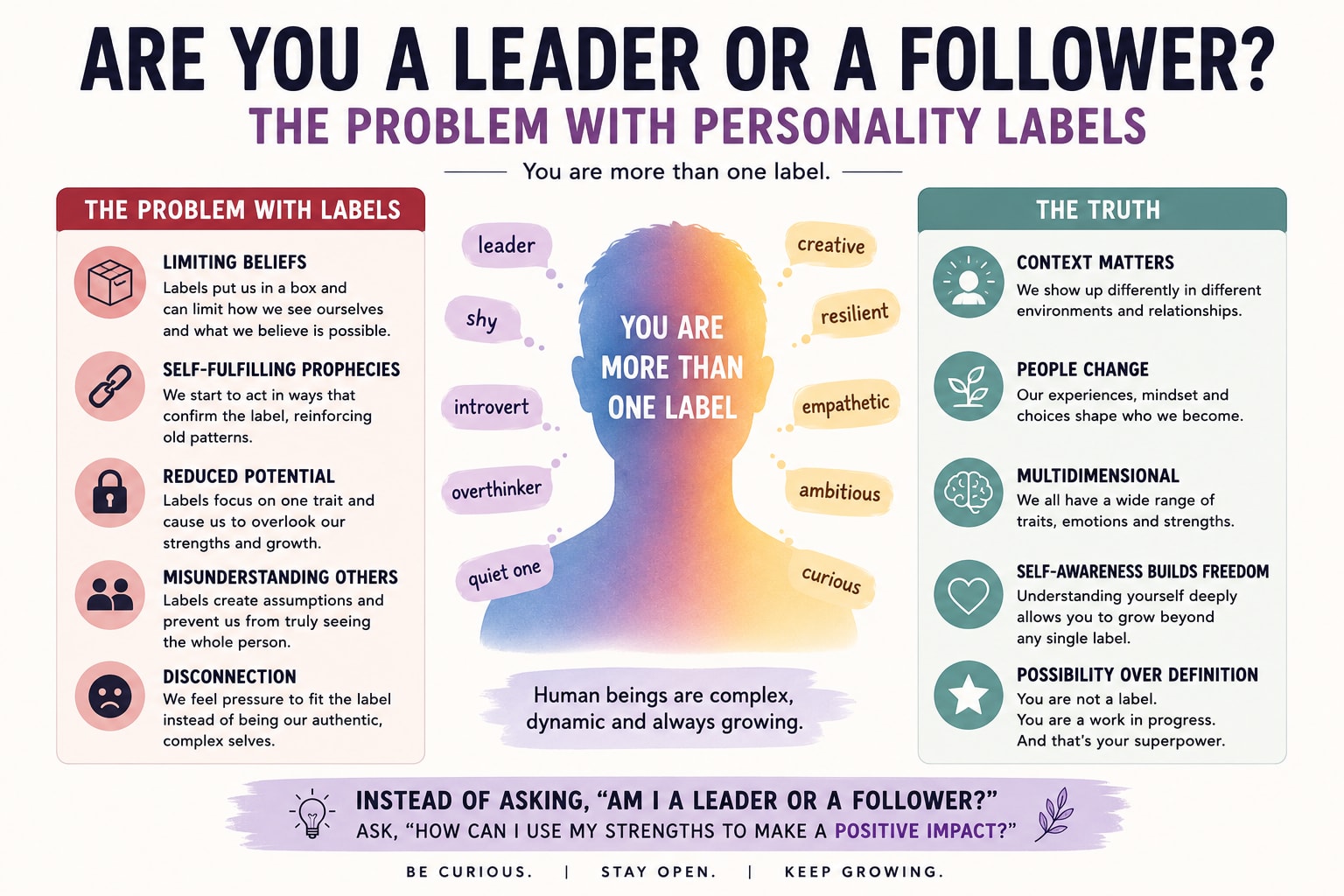
One reason personality labels can become problematic is that they often evolve into self-fulfilling prophecies. Psychological research has repeatedly demonstrated that beliefs about ourselves influence our behaviour. When individuals are repeatedly told they are shy, anxious, unassertive or not leadership material, they may gradually begin to behave in ways that reinforce those expectations.
Over time, the label stops being a description and becomes a limitation.
This is one reason why the work of psychologist Carol Dweck has been so influential. Her research on growth mindset highlights the difference between viewing personal qualities as fixed versus seeing them as capable of development. Individuals who believe their characteristics are fixed often avoid challenges that might threaten their identity. By contrast, those who believe they can grow and develop are more likely to embrace new experiences, tolerate setbacks and achieve long-term success.
From this perspective, asking whether someone is a leader or a follower may be asking the wrong question entirely. A more useful question is whether they are willing to develop leadership skills when circumstances require them.
Therapy frequently involves helping individuals challenge long-standing assumptions about who they are. Many people enter therapy carrying deeply ingrained beliefs about themselves. They may describe themselves as lacking confidence, being naturally anxious, or simply not being the kind of person who succeeds in certain situations. These beliefs often feel factual because they have been repeated for years.
Yet closer examination often reveals that these identities are based on learned patterns rather than permanent truths.
One of the most liberating discoveries many people make in therapy is that personality is not a prison. While we all possess certain tendencies and preferences, our capacity for growth is often far greater than we realise. Confidence can be developed. Communication skills can improve. Assertiveness can be learned. Emotional resilience can be strengthened.
The question is not whether you fit into a particular category.
The question is whether the category you have assigned to yourself is preventing you from becoming the person you could be.
Psychological wellbeing often begins when we stop asking which box we belong in and start exploring the possibilities that exist beyond it.
Book a Consultation
If long-standing beliefs about your personality are limiting your confidence, relationships or professional development, psychological therapy can help you understand where those beliefs originated and whether they still serve you. Greater self-awareness often reveals that many of the labels we carry are far less permanent than we once believed.