


Maladaptive Daydreaming: When Your Imagination Starts Taking Over
posted 10th December 2025

Maladaptive Daydreaming: When Your Imagination Starts Taking Over
Most of us drift into daydreams from time to time, imagining future possibilities, replaying memories, or building fictional scenarios in our minds. Daydreaming is usually harmless and can even be a source of creativity, problem-solving, and emotional processing.
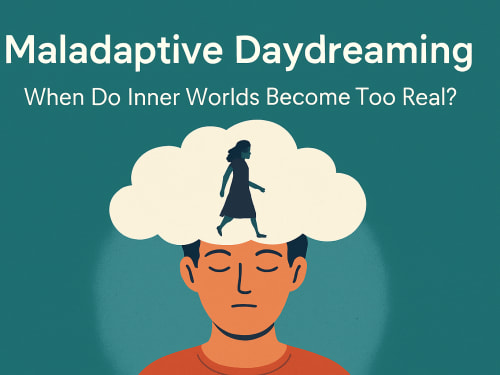
For some people, however, imagination becomes something more consuming. These vivid inner worlds can feel so real, so emotionally charged, and so absorbing that they begin to interfere with everyday life. When this happens, it may be a sign of maladaptive daydreaming.
What Is Maladaptive Daydreaming?
Maladaptive daydreaming (MD) is not yet recognised as an official mental health diagnosis, but it is increasingly discussed in psychological research and clinical settings. The concept was introduced by clinical psychologist Eli Somer (2002) to describe an intense, immersive form of daydreaming that involves complex narrative fantasies.
People who experience MD often:
- Create detailed, story-like inner worlds
- Spend long periods imagining characters, plots, or idealised versions of themselves
- Feel strong emotional connections to their fantasies
- Struggle to pull themselves back into the present moment
These daydreams can provide comfort, escape, or a sense of control, particularly during times of stress or emotional overwhelm. But when fantasy becomes a primary coping strategy, it may begin to overshadow real-life responsibilities, well-being, and relationships.
MD is often linked with anxiety, depression, trauma histories, and dissociation. For some, it becomes a way of retreating from challenges that feel too difficult to address directly.
What Causes Maladaptive Daydreaming?
MD doesn’t have a single clear cause, but research highlights several contributing factors:
- Coping with trauma or stress: Fantasy offers escape or emotional relief.
- Loneliness or unmet emotional needs: Imagined relationships or scenarios can feel safer or more fulfilling.
- Anxiety and depression: MD often appears alongside these difficulties.
- Personality traits: Highly imaginative or absorption-prone individuals may be more vulnerable.
- Repetitive triggers, such as music, pacing, or specific environments, can enhance immersion and reinforce the habit.
What Does the Research Say?
Although still an emerging field, studies consistently highlight the unique nature of MD:
- Bigelsen & Schupak (2011): Individuals with MD report movie-like, emotionally intense fantasy worlds that can be difficult to interrupt.
- Somer, Soffer-Dudek & Ross (2016): Found that MD can occupy hours of a person’s day and is strongly connected with stress, dissociation, and distress.
- Somer et al. (2017) developed the Maladaptive Daydreaming Scale (MDS), now widely used to assess symptoms.
- Soffer-Dudek (2018) showed that MD often intensifies during stress, acting as an emotional escape mechanism.
Collectively, these findings validate what many individuals report: MD is vivid, time-consuming, sometimes compulsive, and worthy of clinical attention.
How to Manage Maladaptive Daydreaming
If you find yourself disappearing into your imagination more than you’d like, there are compassionate, practical steps you can take.
1. Identify Your Triggers
Music, pacing, boredom, and certain moods, MD often have predictable patterns. Becoming aware of them helps you intervene earlier.
2. Schedule “Daydreaming Time.”
Creating a small, intentional window for imagination can prevent it from spilling into the rest of your day. Think of it as giving your mind a safe space, with boundaries.
3. Keep Your Mind and Body Engaged
Activities that occupy your attention, drawing, walking with a podcast, puzzles, or fidget tools, can reduce the pull toward fantasy.
4. Use Grounding Techniques
If you feel yourself slipping away, try slow breathing, sensory grounding (5 things you can see, 4 you can feel), or holding something cold. These techniques bring your focus back to the present moment.
5. Speak to a Mental Health Professional
If MD is affecting your mood, work, or relationships, therapy can help. Approaches that explore anxiety, trauma, emotional regulation, or dissociation can be particularly supportive.
6. Be Compassionate With Yourself
MD is often a coping strategy, not a character flaw. The goal isn’t to eliminate imagination, but to find balance and build alternative ways of managing emotions.