


Major Depressive Disorder vs. Bipolar Disorder
posted 17th April 2026
Major Depressive Disorder vs. Bipolar Disorder: A Clinical Overview
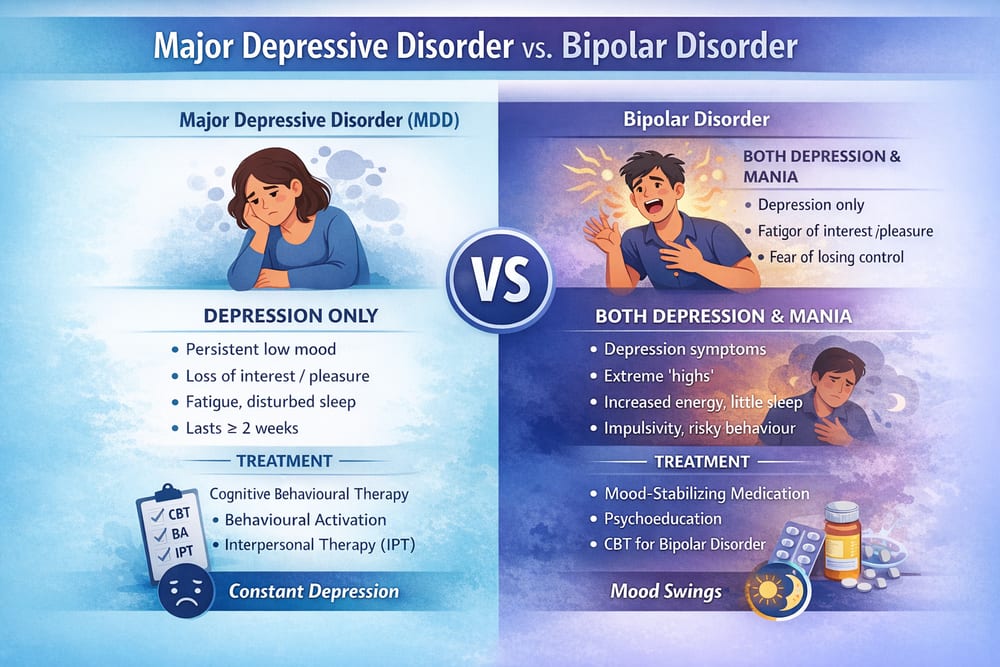
Major Depressive Disorder (MDD), as defined in the Diagnostic and Statistical Manual of Mental Disorders, Fifth Edition (DSM-5), is characterised by the presence of one or more major depressive episodes without any history of manic or hypomanic episodes. A depressive episode involves a persistently low mood and/or loss of interest or pleasure (anhedonia) lasting at least two weeks, accompanied by additional symptoms such as sleep disturbance, appetite changes, fatigue, impaired concentration, psychomotor changes, and recurrent thoughts of death or suicide. Importantly, these symptoms must cause clinically significant distress or impairment in social, occupational, or other areas of functioning.
From a psychological perspective, MDD is often understood through cognitive and behavioural models. Cognitive theories emphasise negative automatic thoughts, maladaptive core beliefs, and cognitive distortions (e.g., catastrophising, overgeneralisation), while behavioural models highlight reduced engagement in rewarding activities and withdrawal, which perpetuate low mood. Evidence-based treatments typically include Cognitive Behavioural Therapy (CBT), Behavioural Activation (BA), and Interpersonal Therapy (IPT). Treatment duration is often 12–20 sessions, with many individuals experiencing significant symptom reduction. Outcomes are generally favourable, although relapse is common, necessitating relapse prevention strategies and ongoing psychological awareness.
In contrast, what is commonly referred to as “manic depression” is clinically termed Bipolar Disorder, also classified within the DSM-5. The defining feature that distinguishes bipolar disorders from MDD is the presence of manic or hypomanic episodes. A manic episode involves a period of abnormally elevated, expansive, or irritable mood, accompanied by increased energy or activity levels, lasting at least one week (or requiring hospitalisation). Symptoms may include grandiosity, decreased need for sleep, pressured speech, racing thoughts, distractibility, and risk-taking behaviours. Hypomania represents a milder form of mania but still indicates a fundamentally different disorder process than unipolar depression.
Although individuals with Bipolar Disorder often experience depressive episodes that are clinically similar to those seen in MDD, the presence of mania or hypomania changes both the diagnosis and treatment approach. Psychologically, Bipolar Disorder is conceptualised in terms of mood dysregulation, circadian rhythm disruption, and heightened sensitivity to environmental and interpersonal stressors. Psychological interventions, such as CBT for bipolar disorder, psychoeducation, and Interpersonal and Social Rhythm Therapy (IPSRT), focus less on eliminating symptoms entirely and more on relapse prevention, mood stabilisation, and early identification of mood shifts. Treatment is typically long-term and adjunctive to pharmacological management, as medication plays a central role in stabilising mood.
The distinction between MDD and Bipolar Disorder is clinically critical. Misdiagnosing bipolar depression as MDD can lead to inappropriate treatment, particularly the use of antidepressants without mood stabilisation, which may precipitate manic episodes. Therefore, thorough assessment, including a detailed longitudinal mood history, is essential. In summary, while both conditions involve depressive symptoms, MDD is a unipolar disorder characterised solely by depression, whereas Bipolar Disorder involves cyclical mood states, including both depressive and manic or hypomanic episodes, requiring a more complex and sustained treatment approach.